


Table of Contents
01
Introduction to eLearning is Transforming Finance Training
04
Designing Effective Digital Finance Training Transformation Learning Experiences
02
Why eLearning Is Now the Default Mode for Finance Training
05
Real Cases and Lessons from the Field
03
Five Ways eLearning Is Changing Finance Capability Development
06
Conclusion
Introduction to eLearning is Transforming Finance Training
eLearning trends in finance 2026 are a transformative, mostly irreversible shift in corporate financial capability development. Initially, a reaction to COVID-19 constraints – converting face-to-face instructor-led training into online courses because there was no other choice – the learning style has evolved into a strategic choice. Finance teams that were initially resistant to digital finance training transformation now cite flexibility, consistency, scalability, and the ability to learn at the time and place of need as drivers of their now-preferred digital delivery over face-to-face classroom-based approaches for more and more capability-building objectives.
However, the growth of online finance education is not equal. The organisations that are having the most success with digital finance training transformation are those that have developed a greater awareness of what can be delivered effectively through eLearning, and what needs to be delivered live. Compliance, reference and basic financial literacy training can largely be delivered as self-paced digital content. Interpersonal skills such as business partnering, judgment, and leadership usually continue to require live facilitation (face-to-face or online).
This article is aimed at L&D professionals, finance leaders and new entrants to the corporate learning space who are interested in the eLearning trends in finance 2026 that are specific to finance training, how to design remote finance learning solutions and the lessons that can be learned from organisations that have done the most effective job of transitioning from in-person finance development to eLearning.
Why eLearning Is Now the Default Mode for Finance Training
The structural drivers of digital finance training transformation
Digital finance training transformation has sped up. First, the nature of finance teams: hybrid and remote working has led to the decentralisation of finance teams, making in-class delivery an expensive and complex logistical challenge for any organisation with a distributed workforce. Second, the speed of technological and regulatory change: mandated sustainability reporting, changes to IFRS, and new privacy and anti-money laundering (AML) controls mean that learning needs are now on a rolling basis and need to be addressed outside the classroom. Third, the adoption of AI tools to support finance processes: the need to digitally upskill finance teams in AI-powered analytics requires on-demand rather than scheduled training.
• Technology in finance training has evolved from delivery convenience to capability infrastructure; without an effective modern finance training platform stack in place, organisations cannot keep pace with emerging capability needs.
• The cost-per-learner benefits of eLearning adoption in corporate training become most evident at scale: an eLearning module that costs the same to deliver to five people as it does to 500 people makes the case for coverage more compelling than in-class alternatives of the same quality.
What online learning in the finance industry actually looks like in 2026
Online learning in the finance industry in 2026 has evolved from the narrated slide-deck e-course. Progressive organisations are using blended learning programs that integrate short-form, on-demand modules for content, virtual live classes for discussion and skill-building, AI-driven personal learning pathways that tailor content to capability requirements and application activities that link the digital learning to the workplace. The future of finance eLearning is not one thing; it is a variety of digital learning formats to fulfil different capability goals with the best fit for purpose.
• In on-demand digital delivery, short-form (5-10-minute modules) outperform long-form; finance professionals learn in small bites, not in blocks.
• The learning management system is the platform, not the product; organisations that invest in LMS capacity without investing in quality content perform much worse than organisations with simpler LMS platforms and better content.
Five Ways eLearning Is Changing Finance Capability Development
The eLearning trends in finance 2026 are changing the way training is delivered and transforming finance capability development. The following five changes represent the key challenges facing L&D and finance leaders.
| Change | What It Means in Practice | Digital Finance Training Transformation Implication | Challenge to Manage |
| 1. Learning at the point of need | Finance professionals can access relevant content at the moment they need it: a tax calculation method before a client meeting, a regulatory compliance checklist during a filing period, an AI tool tutorial when a new system is deployed | Remote finance learning solutions that are accessible on demand reduce the lag between the capability gap and skill acquisition that scheduled training inherently creates | Content must be searchable and retrievable, not just structured as a sequential course; library architecture and search functionality matter as much as content quality |
| 2. Personalised learning pathways | Modern finance training platforms use capability assessments and learning data to personalise the content each learner sees, prioritising the topics most relevant to their role, level, and identified gaps | Digital upskilling finance teams through personalised pathways is more efficient than delivering the same content to every learner regardless of what they already know | Personalisation requires a competency framework and an assessment mechanism; organisations without either will serve generic content regardless of platform capability |
| 3. Consistent delivery quality at scale | A digital module delivered to 500 learners across three countries delivers the same content quality to each; an instructor-led programme delivered by different facilitators across locations is inherently variable | eLearning adoption of corporate training enables consistent minimum capability standards across large, distributed teams in a way that face-to-face delivery cannot | Consistency of delivery can mask inconsistency of application; learners who complete the module at the same quality do not necessarily apply the skills at the same quality |
| 4. Data-driven programme improvement | Online learning in finance industry platforms generates completion, engagement, and assessment data that allows L&D teams to identify specific content gaps, drop-off points, and assessment failure patterns and improve programmes in near-real time | eLearning trends finance 2026 include the shift from annual programme reviews to continuous data-driven improvement; organisations using learning analytics improve faster than those that do not | Learning analytics data is available but rarely acted on; organisations collect data without the L&D capacity to analyse and apply it; data richness creates an illusion of insight without producing programme improvement |
| 5. Integration of AI-powered learning tools | AI tools embedded in modern finance training platforms can generate personalised practice scenarios, provide automated feedback on financial model outputs, and adapt the difficulty of assessments to individual performance. | Technology in finance training, enabled by AI, enables a level of practice intensity and feedback specificity that human facilitators cannot deliver at scale. | AI-generated content must be reviewed for technical accuracy and contextual appropriateness; finance-specific AI learning tools require subject matter validation that general-purpose AI platforms do not provide |
Change 4 – leveraging data for programme improvement – is the most underutilised opportunity of the digital finance training transformation. Companies that have implemented learning management systems (LMS) have a wealth of information on learner performance, assessment results and engagement, but most rely on a simple completion metric. Finance teams that leverage the data set – pinpointing which assessment questions show consistent learning gaps, which learning content modules result in high drop-off rates, and which topics show low rates of application of learning – improve their programmes much more rapidly than teams that rely on annual surveys.
Designing Effective Digital Finance Training Transformation Learning Experiences
The remote finance learning solutions design workflow
There is a different workflow to designing effective digital upskilling for finance teams, compared to in-classroom design. The workflow below illustrates how experienced learning and development (L&D) professionals design and deliver finance e-learning solutions.
| Phase 1 | Phase 2 | Phase 3 | Phase 4 |
| Format Selection | Content Architecture | Platform & Delivery | Data Review & Iteration |
| Map each capability objective to the format most suited to it: on-demand modules for technical reference and foundational content; virtual live sessions for judgment and discussion; AI-powered practice for skill reinforcement; blended pathways for complex capability development | Design short-form module structure (5–10 minutes per topic); build a searchable content library with a clear taxonomy; design assessment checkpoints at module completion; create application bridges connecting digital learning to real work | Select or configure the Modern Finance Training Platform to support personalised pathways; integrate with HR systems for role-based content assignment; establish completion and assessment tracking; brief managers on reinforcement role | Monitor completion, engagement, and assessment data from week one; identify drop-off points and assessment failure patterns; update content based on findings within 30 days; conduct quarterly programme reviews against capability outcomes |
Real cases: what online finance education growth looks like in practice
A global manufacturing firm implemented a remote finance learning solutions programme for its 180-person global finance function, replacing an annual face-to-face training week. This included 24 short on-demand modules covering technical, regulatory, and analytical content, and six quarterly live virtual sessions on business partnering and judgment. After 12 months, average completion of mandatory content across the function increased from 58 per cent (with the annual classroom approach) to 91 per cent (with the digital approach), and average scores on capability assessments increased by 34 per cent across the focus areas. This rise was partly due to the on-demand flexibility: finance professionals in different time zones who had been unable to attend classroom-based sessions were able to complete modules during their workday.
The experience of a professional services firm is informative. This firm had installed a top-quality modern finance training platform. Still, the content was not developed for electronic delivery; it consisted of existing PowerPoint presentations as e-as courses. Within six weeks, learner engagement dropped, and only 35 per cent of modules longer than 20 minutes were completed. The platform was well chosen and deployed; the content was not. Online finance education growth within the company resumed after a redesign that transformed each module into a series of 5-10-minute “chunks” of information, with assessments. The message: eLearning adoption in corporate training is not about content migration, but content redesign.
Conclusion
eLearning trends in finance 2026 demonstrate that digital finance training transformation is now the default organisational structure for most organisations scaling financial capability development. Online finance education growth has been spurred by the real benefits of digital delivery – convenience, uniformity, scale, and data – and the organisations that are benefiting the most are those that have learned how to harness these benefits rather than simply digitising what already exists.
• Format is the critical design choice in digital finance training transformation capability development: remote finance learning solutions that make the right fit between format and capability objectives outperform those that use the same format for all capability objectives, regardless of the objectives.
• eLearning finance upskilling for finance teams requires finance content that is designed for digital upskilling finance teams – short, searchable, assessable, and applied through application bridges to real-world practice – not for classrooms and uploaded unmodified.
• For those professionals who want to build a career in technology in finance training, organisations that will be most effective in developing digital finance training transformation capability over the next five years are those building the data literacy to use their learning analytics, the content design capability to produce effective digital finance training transformation modules, and the blended design savvy to know when live human interaction is still the only game in town.
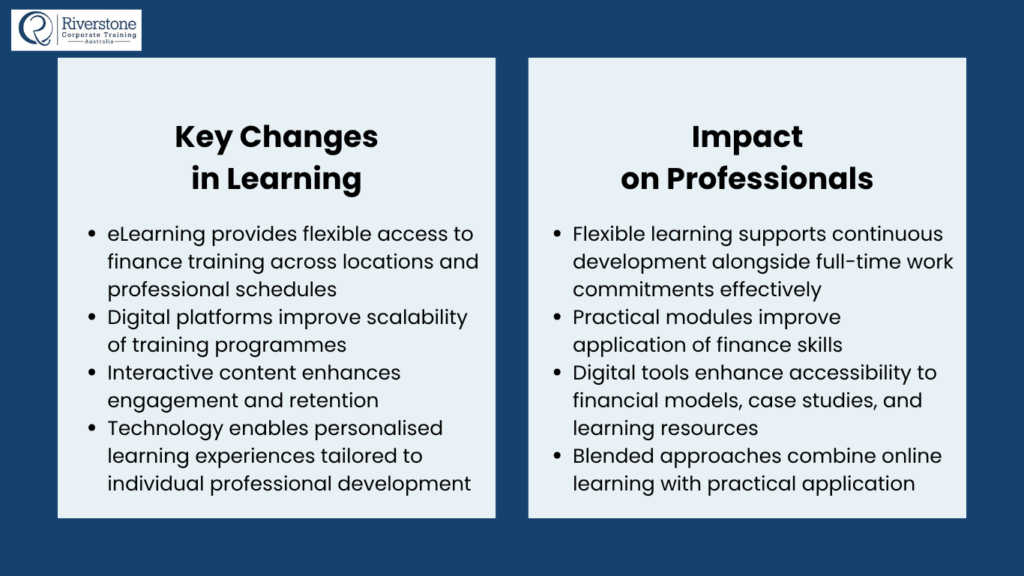
Transforming finance training involves moving beyond traditional classroom-based learning to more practical, interactive, and business-focused development programmes. The goal is to equip employees with the financial, analytical, and strategic skills needed to support better decision-making and drive organisational performance in a rapidly changing business environment.
Finance professionals are increasingly expected to contribute to strategy, digital transformation, performance improvement, and business planning. As organisations face new technologies, data-driven decision-making, and changing market conditions, finance training must evolve to develop both technical expertise and commercial acumen.
Effective modern finance training programmes typically combine practical case studies, real-world applications, interactive learning activities, digital learning tools, and workplace-focused exercises. These elements help participants apply financial concepts more effectively and retain knowledge longer than traditional lecture-based approaches.
Organisations that modernise their finance training programmes can improve employee capability, strengthen financial decision-making, enhance collaboration between finance and operational teams, and build a workforce that is better prepared to respond to business challenges and opportunities.
The impact of finance training can be assessed through improvements in employee performance, financial analysis skills, decision-making quality, productivity, and business outcomes. Organisations may also evaluate training effectiveness through participant feedback, knowledge assessments, and the successful application of new skills in the workplace.