This course offers insight into the use of private capital to gain ownership, build and exit businesses.

Challenges for Finance Managers:

  • Knowing how private equity deals are structured and implemented
  • Analysing investment opportunities from a private equity point of view
  • Understanding the value creation process in a private equity owned business
  • Appreciating the interests and incentives of sponsors, management and lenders
  • The exit strategy and how profits are realised and calculated

About This Course

Riverstone’s Private Equity course offers an in-depth and practical introduction to the private equity market for professionals. The course examines the entire investment process, including deal sourcing and due diligence, structuring, value creation and exit strategies. Delegates learn how private equity firms identify, structure, and execute investments, partner with the management team to improve performance, and exit investments through trade sales, secondary sales or IPOs. Through case studies and tools, the course provides insights into the strategies and approaches private equity firms use at each stage of the investment process.

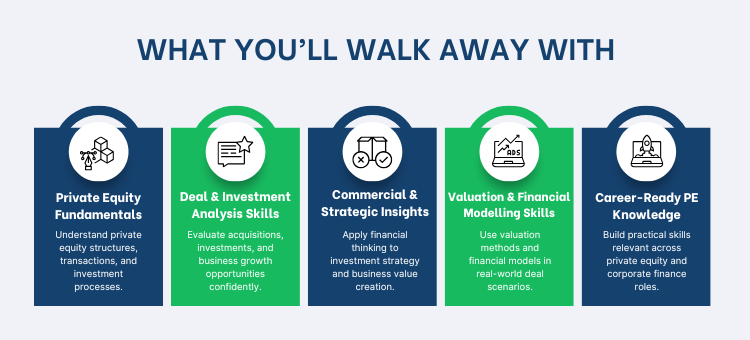
  • Understand the structures and processes of private equity investments
  • Gain an understanding of how to value businesses and deals from a private equity point of view
  • Enhance in-house expertise for dealing with private equity sponsors, advisers and investors
  • Assist those in or moving to private equity or other business areas
  • Gain an insight into the private equity market and how it works
  • Analyse investment opportunities using the approaches taken by private equity practitioners
  • Evaluate deal structures and financing options, and returns
  • Evaluate opportunities for value creation and how they are executed in portfolio firms
  • Learn about exit strategies, and how private equity returns are created and calculated

Module – 1

Private equity industry structure and importance

  • Industry structure and overview
  • Different types of private equity funds and their strategy
  • Summary of private equity processes – due diligence and investments, documentation, monitoring, and exits


Module – 2

Company analysis process

  • Company analysis including competitive positioning and its mapping in the industry
  • How to analyze financial models of the investee companies
  • Evaluate promoters and management team
  • Study the capital structure
  • How to run the valuation exercise (DCF, Comparables, NAV, multiple-based, operational metrics, etc)
  • Identify key pitfalls
  • Sensitivity analysis and its impact on overall returns


Module – 3

How to prepare investment proposal and Investment Committee presentation

  • Structure of Investment proposal
  • Keys points in the proposal
  • Importance of return and exit information
  • Preparation for Investment Committee presentation
  • Points to remember for presenting to Investment Committee
  • Report to be prepared for Investment Committee meeting


Module – 4

Due Diligence

  • How to create your due diligence plan
  • How to balance role of external and internal service providers
  • Key focus areas
    • Financial models
    • Business
    • Legal
    • Accounting
    • Management due diligence
  • How to resolve post due diligence observations
  • How to identify keys risks


Module – 5

Documentation (commercial overview)

  • Keys terms and their impact on business- Minority Protection, Affirmative Rights, Exit rights, Conditions Precedents, Board rights etc
  • How to negotiate effective terms sheets
  • Key points to focus while negotiating shareholders agreement


Module – 6

Investment structures

  • What are the various structures for investments
  • Direct Equity – private market, public market, listed and unlisted market
  • Equity-linked debt – mezzanine funding, convertible securities etc
  • Debt funding – bridge funding, subordinated debts, securitization and structured finance


Module – 7

Monitoring investments and value-add

  • How to help the investee company develop a common business goal and plan
  • How to support the business on various operational and strategic areas
  • Common restructuring activities that can be carried out
  • Financial engineering to improve shareholders’ return and reduce riskiness
  • Manage the risks highlighted during due diligence process


Module – 8

Exit process

  • How to prepare the investee company for exits
  • Analyze various exit options and their pitfalls
  • How to do exit valuation
  • Determining the target price and exit returns
  • Essential concepts – Gross and net IRR, cash multiple and its relevance


Module – 9

Case Discussions

  • Case discussions based on past private equity transactions to explain the entire process and its implications

This course can be taken as a scheduled public course at various locations around Australia, as a customised professional course at your office, or as an e-learning course. Length and delivery of the program can be tailored to your team’s requirements.

  • Monday, September 14, 2026.
  • Monday, December 7, 2026.