Finance for Non-Finance provides professionals with the finance skills they need to work with numbers, reports and decision-making.

Challenges for Non-Finance Professionals:

  • Not feeling confident or well-equipped to read financial reports and budgets
  • Having difficulty engaging in discussions about financial information
  • Not having a clear grasp on the measurement and management of financial performance
  • Not knowing how daily actions impact financial performance
  • Having to deal with finance teams or management on financial issues

About This Course

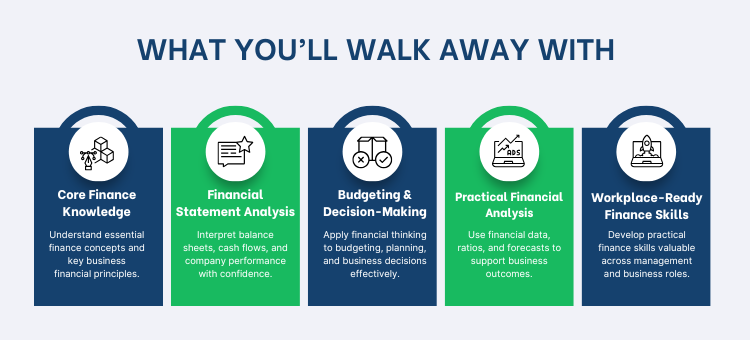
Riverstone’s Finance for Non-Finance course is aimed at those who work with finance professionals but do not have a financial background. This course offers a real-world understanding of financial reporting, budgeting and reporting. Attendees learn to interpret profit and loss statements, balance sheets and cash flow reports, and see how their own actions impact on the financial performance of the company. The program is less theoretical and more practical, so that participants can speak the language, and know what to do, to engage in financial discussions at all levels of the organisation.

  • Boost financial literacy and responsibility among non-finance teams and departments
  • Improve operational decision-making with an understanding of financial impacts
  • Improve finance/non finance team collaboration
  • Minimize the need to depend on finance teams for financial reporting and analysis
  • Confidently interpret the three main financial statements
  • Read and interpret key financial ratios and their meaning
  • Trace the impact of decisions and activities on the financials
  • Interact and communicate with finance colleagues, budgets and reports
  • Use financial knowledge to prioritise, plan and make business decisions

Module – 1

Basic concepts in financial management

  • Importance and applicability of finance knowledge in day-to-day working and long-term planning
  • Introduction to financial statements
  • Key issues in Accounting & Finance


Module – 2

Understanding Financial Statements – Balance Sheet and Income Statement

  • Step-by-step understanding of financial statements
  • Preparation of Income statement (Profit & Loss Account) and Balance sheet
  • Reading and analyzing financial statements


Module – 3

Importance of cash flows statement – Heart of any business

  • Basic concepts and preparation of cash flow statement
  • Difference between Accounting profit and Cash profit
  • Relationship between Profit & Loss Account and Balance Sheet
  • Cash flow from Operations
  • Case Discussion


Module – 4

Ratio Analysis, Interpretation, and Du-Pont Analysis

  • Importance and application of ratios for different industries
    • Profitability ratios
    • Debt Equity ratios
    • Turnover ratios
    • Shareholders’ ratios
    • Liquidity ratios
  • Analysis of company performance from the perspective of both Shareholders as well as Debt holders
  • Financial and operating leverage, assessment of risk and profitability based on ratio analysis


Module – 5

Marginal Costing Principles

  •  Calculation of Break-even point and its usage in different decision making aspects – setting sales targets, product costing, sales price determination, marketing decisions, credit sales, discounts, etc
  • Understanding Fixed and Variable Costs and their implications for business
  • Calculation of PV ratio and Contribution margin
  • Calculation of break-even and cash break- even for projects


Module – 6

Project Finance and Capital Budgeting

  • Project evaluation from the financial perspective with examples
  • Understanding the time value of money
  • Capital budgeting techniques
    • Payback and Discounted Payback NPV
    • IRR and Modified IRR
    • Profitability Index
  • Preparing Financial projections for Project Evaluation & Sensitivity Analysis
  • Case discussion on Project appraisal


Module – 7

Working Capital Management

  • Working Capital Management
  • Understanding of Cash cycle and calculation of item-wise Working Capital requirements
  • Working capital financing


Module – 8

Step-by-step guide for understanding Annual Reports of company

  • How to check performance and financial health of a company
  • Analysis of financial and non-financial information
  • Importance of footnotes

This course can be taken as a scheduled public course at various locations around Australia, as a customised professional course at your office, or as an e-learning course. Program duration and delivery can be customised to suit your team’s requirements.

  • Thursday, September 10, 2026.
  • Thursday, December 17, 2026.