


Table of Contents
01
Introduction to Project Finance Skills
04
How Finance Professionals Can Build Project Finance Capability
02
The Scale of Australia’s Renewable Energy Investment Pipeline
05
Real Cases and Lessons from the Field
03
Five Project Finance Skills in Highest Demand
06
Conclusion
Introduction to Project Finance Skills
Australia’s project finance skills are in demand as never before. Australia’s renewable energy goals have established one of the largest infrastructure investment pipelines ever seen in Australia, with hundreds of solar, wind, battery storage, and green hydrogen projects that need to be financed in ways that differ from the corporate finance expertise many finance professionals have been trained in. The number of renewable energy investment finance jobs is increasing in banks, infrastructure funds, project developers, government departments and advisors – but the bottleneck in filling these jobs is not a lack of investors or projects; it is a lack of the talent with the skills to structure, model and manage project finance transactions.
The skills shortage in the energy sector for infrastructure finance is indicative of a structural change in the Australian economy, which is expected to accelerate in the 2030s. The federal government’s Capacity Investment Scheme, state renewable energy investment zones, the process of awarding offshore wind farm development rights, and the emergence of the corporate power purchase agreement (PPA) market have created a transaction landscape where the annual value of energy infrastructure deals is growing at a pace that the talent pool is not prepared to meet. Project finance career growth in Australia is, therefore, one of the strongest career signals in the finance sector for those with the will to develop the necessary capability.
This piece is for junior to mid-level finance professionals who want to know which energy sector finance skills are most in demand, how project finance differs from corporate finance, and how to develop the specific skills employers in this sector are looking for. It is also a helpful guide for career-switchers from non-specialist finance, banking and consulting who are interested in the career path into renewable energy investment finance.
The Scale of Australia’s Renewable Energy Investment Pipeline
Why the demand for project finance professionals is structural, not cyclical
The need for project finance professionals in Australia is underpinned by an investment pipeline that is not a function of a single policy or commodity price cycle. The National Electricity Market in Australia is in the midst of a technology transformation that will see investment in capital assets over the coming decades: from centralised, fossil-fuelled generation to distributed renewable generation, firming capacity and transmission. Both the International Energy Agency and CSIRO’s GenCost modelling forecast renewables will be the major form of new generation investment in the 2030s and beyond.
• Renewable energy investment skills are needed not only for financing generation assets but also for the whole value chain: battery storage, transmission network upgrades, green hydrogen production plants, offshore wind vessels and port facilities, as well as corporate offtake that supports project financing.
• Policy settings are supporting investment: state-based renewable energy investment zones in New South Wales, Victoria and Queensland are establishing structured procurement programs to give lenders and equity investors the revenue certainty required to scale up investments.
What distinguishes project finance skills Australia from corporate finance
The project finance skills Australia needs are different from corporate finance in three ways. First, the credit analysis is centred on the cash flows of the individual project, not the company’s balance sheet; the loans must be repaid with cash flows generated by the asset, which means the financial model must include all relevant cash flow drivers. Second, the allocation of the risks among the project company, sponsors, lenders and offtakers is a legal and commercial negotiation that must be understood and modelled by the finance professional. Third, the energy-specific regulatory, technical and construction risks require a multi-disciplinary analysis skill that is not typical of corporate finance professionals.
• Energy project finance skills include knowledge of power purchase agreements, renewable energy investment certificates, grid connection, and the relationship between revenue certainty and debt size.
• Jobs in clean energy finance demand a comfort level operating at the intersections of finance, law, engineering and policy; those who can only work in their specialty are less successful than those who see the connections.
Five Project Finance Skills in Highest Demand
Energy project finance capabilities are not all created equal. Employers in renewable energy investment finance consistently cite five skill areas as the areas with the greatest gap between supply and demand, and with the most immediate career impact from investing in development.
| Skill Area | What It Involves | Why It’s in Demand for Project Finance Professionals | How to Build It |
| 1. Project finance modelling importance: integrated project models | Building a full project finance model from scratch: construction cost schedule, operating cash flow projections, debt service coverage ratios (DSCR), equity returns, and sensitivity analysis across key variables (energy yield, merchant price, interest rate) | Project finance modelling importance cannot be overstated: every financing decision, every covenant negotiation, and every investment committee presentation rests on the model; inaccurate or inflexible models create material transaction risk | Build project finance models from scratch using public infrastructure transaction data; practise DSCR covenant analysis, sculpted repayment structures, and base/downside/upside scenario runs; use real energy price assumption sets |
| 2. Revenue structure and offtake analysis | Understanding power purchase agreements (PPAs), merchant revenue assumptions, renewable energy investment certificate income, capacity market revenues, and how the mix of contracted and merchant revenue affects debt sizing and equity returns | Renewable energy investment skills without revenue structure knowledge are incomplete; the bankability of any project depends on whether lenders are satisfied that the contracted revenue is sufficient to service the debt under a downside scenario | Study disclosed PPA structures from publicly announced projects; understand floor price mechanisms, indexation provisions, change-of-law clauses, and how rating agencies assess PPA counterparty credit quality |
| 3. Risk identification and allocation in project documents | Reading and interpreting the key project contracts: EPC construction contract, O&M agreement, grid connection agreement, land access agreements; identifying which risks are allocated to which party and how unallocated risks affect the financing | Infrastructure finance skills demand is highest in professionals who can bridge legal and financial risk analysis; lenders’ technical advisors and lawyers identify risks in contracts, but the finance professional must translate those risks into model adjustments and covenant protections | Review project finance legal structure diagrams and key contract summaries for publicly disclosed infrastructure projects; understand the direct agreement structure between lenders and key project parties |
| 4. Regulatory and policy framework literacy | Understanding the National Electricity Market (NEM) rules, AEMO’s Integrated System Plan, state-level renewable energy zone frameworks, environmental approvals, and how policy changes affect project revenue and bankability | Energy sector finance skills require policy literacy because regulatory risk is a primary credit risk in energy projects; a financing structure that is viable under current policy settings must be stress-tested for plausible policy scenarios | Follow AEMO’s Integrated System Plan updates, state government renewable energy zone consultations, and Clean Energy Finance Corporation publications; understand the policy instruments that create contracted revenue certainty for new projects |
| 5. Construction and completion risk assessment | Understanding the key risks during the construction phase: contractor capacity and financial strength, construction timeline, cost overrun scenarios, and the completion guarantee structures that lenders require before debt drawdown | Project finance career growth in Australia in senior roles requires the ability to assess whether a project can be completed within budget and on schedule, and whether the sponsor and contractor have the capacity to absorb cost overruns without triggering project distress. | Study publicly disclosed construction contract structures for major renewable projects; understand the performance security and liquidated damages provisions that protect lenders during construction; review cost overrun case studies from infrastructure projects. |
The first of these skill areas – integrated project modelling – is the most fundamental to project finance. An individual who cannot develop a robust, adaptable, and integrated model for a project will always be constrained in what they can bring to the table, no matter how strong they are in the other four skill areas. The revenue stack’s complexity magnifies the importance of project finance modelling in renewable energy: a large-scale solar project with a partial PPA, merchant tail, large-scale generation certificates, and interest during the construction period (linked to BBSY) during a loan drawdown schedule is a far more complex modelling exercise than an EBITDA forecast of a corporate entity, and the modelling standards required by project finance lenders are accordingly more demanding.
How Finance Professionals Can Build Project Finance Capability
A practical development pathway for clean energy finance careers
There are many pathways to a career in clean energy finance – from banking, advisory, accounting and engineering finance. The four-step pathway outlined below is based on how finance professionals with corporate finance backgrounds best acquire the particular skills that project finance employers in the renewable energy sector are looking for.
| Phase 1 | Phase 2 | Phase 3 | Phase 4 |
| Technical Foundation | Sector Immersion | Transaction Exposure | Specialisation |
| Learn project finance structure from first principles: SPV structure, non-recourse debt, DSCR mechanics, sculpted repayment; build a project finance model from scratch using publicly available data from a disclosed renewable energy transaction | Study the Australian energy market: NEM structure, renewable energy zones, AEMO ISP, PPA mechanics, LRET scheme; follow three to five major renewable energy transactions through public announcements, environmental approvals, and financial close | Seek any role that provides proximity to live project finance transactions: lender advisory, developer finance team, infrastructure fund analyst, government clean energy agency; project finance capability develops fastest through transaction exposure | Develop depth in one transaction role (lender, equity investor, developer, or advisor); build a network within the sector; contribute to the professional community through industry events, APIA membership, or specialist publications |
Real cases: building project finance skills Australia from a corporate background
A four-year leveraged finance analyst in corporate banking identified the renewable energy industry as her desired sector a year before her active job search. In the first six months, she developed a project finance model from public sources for a disclosed solar project. She examined the differences between debt sizing based on DSCR and leverage ratios used for corporate loans. She also took a project finance course and read the AEMO Integrated System Plan. In an interview for an analyst position at an infrastructure debt fund, she discussed with the panel the model she had built, the main covenant mechanisms, and the revenue risk allocation for the specific project’s PPA. She was shortlisted among three applicants out of over 80. She was offered the job because of her preparation (before the interview), not her seniority.
The second example is of a senior corporate finance advisor joining the finance team of a renewable energy developer after a decade in M&A advisory. He brought his modelling and valuation skills but underestimated the time needed to develop sector knowledge: NEM market characteristics, the risks associated with the queue for grid connections, timeframes for gaining planning approval, and the specific credit criteria for the major project finance lenders in the Australian market. He recounts the first 12 months as a steep learning curve, during which he had to consider himself a junior again in terms of sector knowledge, even though he was a senior in finance. The takeaway for professionals contemplating the move: renewable energy finance jobs demand a combination of technical finance and sector knowledge. For professionals with a high level of financial skills, they need to put in the effort to develop the latter component rather than rely on it to develop organically.
Conclusion
Project finance skills in Australia are structurally and persistently in demand amid an infrastructure investment boom in the country’s modern history. Renewable energy finance roles are available across the entire transaction value chain (evaluation, debt, equity, advisory, and government), and the limiting factor is not the number of roles but the skill sets required. Finance professionals who invest in the specific skills needed to undertake project finance work are entering a market where demand significantly outstrips supply, a trend expected to continue for another 10 years.
For professionals looking to the future of infrastructure finance, the demand for skills as a career: the combination of strong technical project finance skills and deep industry knowledge is almost unique and carries a premium in the market; invest in both, and your career path in clean energy finance will benefit.
Project finance modelling skills in this industry are critical: the professional who can build and justify an integrated project finance model is in a different market space from the professional who can analyse models developed by others. Invest in technical skills; it is worth the effort and directly supports career progression.
The demand for project finance professionals in Australian renewable energy is structural, not cyclical – the reward is a capital investment plan that has a time horizon of many decades and a human capital base that hasn’t been developed for it; the time to enter the market is in the growth, not the maturity phase.
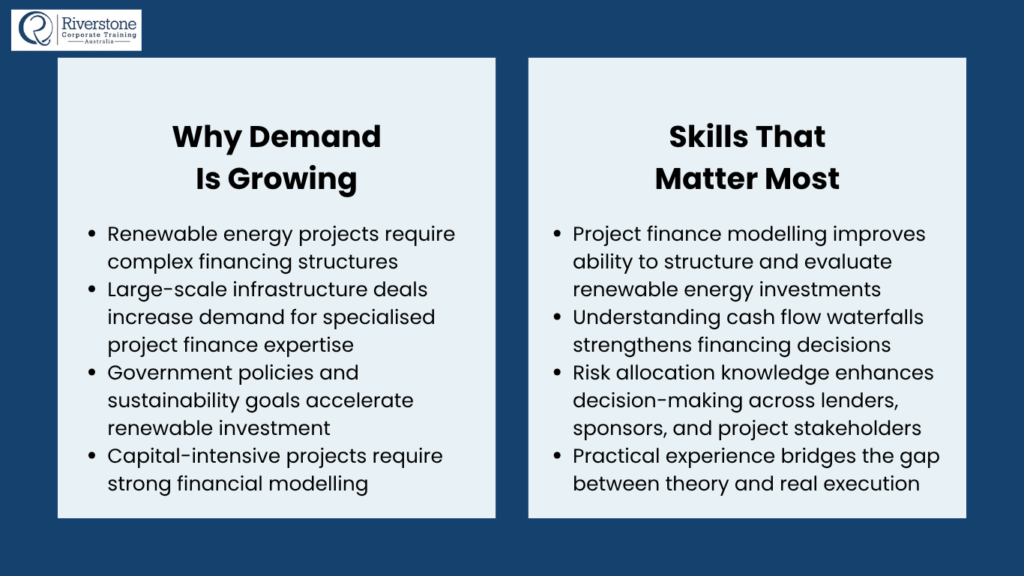
Project finance professionals need a combination of financial modelling, cash flow analysis, risk assessment, valuation, debt structuring, and investment evaluation skills. Strong analytical thinking and the ability to assess project feasibility are also essential for making informed financing and investment decisions.
Financial modelling is a core project finance skill because it helps professionals forecast project performance, evaluate funding requirements, analyse cash flows, and assess investment returns. Accurate models enable stakeholders to make informed decisions regarding project viability, financing structures, and risk management.
Project finance professionals frequently use metrics such as Net Present Value (NPV), Internal Rate of Return (IRR), Debt Service Coverage Ratio (DSCR), loan life coverage ratios, and sensitivity analysis. These measures help evaluate a project's profitability, financial sustainability, and ability to meet debt obligations.
Practical project finance skills are best developed through hands-on financial modelling, case studies, transaction-based learning, and real-world project analysis. Training programmes that incorporate project cash flow forecasting, debt structuring, and risk assessment exercises can help learners build capabilities that are directly applicable in the workplace.
Project finance skills are valuable for finance professionals, investment bankers, infrastructure specialists, corporate finance teams, consultants, project managers, and anyone involved in evaluating or financing large-scale projects. These skills support better decision-making across sectors such as infrastructure, energy, real estate, and public-private partnerships.