


Table of Contents
01
Introduction to Common Cost of Capital Mistakes in Finance
04
Getting It Right: A Practical Framework
02
What Cost of Capital Actually Means — and What It Doesn’t
05
Real Cases and Lessons from the Field
03
Five Ways Finance Professionals Misapply Cost of Capital
06
Conclusion
Introduction to Common Cost of Capital Mistakes in Finance
Why Most Finance Professionals Misunderstand Cost of Capital in Real Decisions
One of the most serious analytical mistakes in corporate finance is misunderstanding the cost of capital, which spreads like a virus throughout valuations and capital allocation decisions affected by it. A finance professional who understands the formula for WACC but doesn’t understand how to use it (wrong inputs, wrong cash flows, failure to adjust for risk differences between the decision and the firm) will calculate numbers that look technically correct, but that consistently lead to incorrect conclusions. WACC errors in practice are typically not detected until after a decision is made and the results are different from predictions.
Confusion about the cost of capital is rife in finance groups for a particular reason: it is taught as a formula before it is understood as a concept. Finance professionals generally know how to calculate a WACC. Fewer can explain what that number means, why it is the right discount rate to use in a particular investment, how it varies when the investment is riskier or less risky than the business, or what the impact would be if the WACC calculation were 150 basis points higher than they thought it would be. Confusion at this level – the idea level, not the calculation level – about the discount rate is the most common source of misguided investment decisions.
This article is for finance practitioners who apply cost of capital in real decisions (investment, valuation, capital structure, performance measurement), and who are interested in the common mistakes and how to avoid them. It is also helpful for managers and L&D practitioners designing training to address the corporate finance problems their people encounter.
What Cost of Capital Actually Means — and What It Doesn’t
The concept behind the formula in applying WACC calculation in real decisions
To use WACC to make decisions, you need to understand what it means so you can use it properly. WACC calculation is the average of the returns required by the equity and debt providers to compensate them for the risk of lending money to the firm. It’s not an interest rate, a cost, or a policy. It is the discount rate the firm needs to earn on its capital to create, rather than destroy, value – the opportunity cost of the capital invested in the firm, as viewed from the point of view of the providers of the capital whose money is at risk.
• WACC calculation practice pitfalls start with the data input: the cost of equity is not directly observable and has to be estimated (usually assuming CAPM) with several assumptions; the cost of debt is the current market cost of new debt, not the historical cost of existing debt.
• WACC calculation is a dynamic, market-based value: it represents the cost of capital today, not yesterday when the firm last adjusted its balance sheet; using an out-of-date WACC calculation is one of the most common (and easily avoided) WACC pitfalls.
The critical distinction between firm WACC and project WACC
A common misunderstanding among finance professionals about the cost of capital is that the firm’s WACC calculation is the discount rate to use for all the firm’s projects. It is not. The firm’s WACC calculation is the cost of capital for a project as risky as the firm’s average project. A project that is riskier than the firm’s portfolio (a new geographic market, a new technology, a takeover in a related industry) should expect a higher rate of return. A project that is less risky – a replacement capital investment in an established, existing business – could use a lower rate. Finance valuation mistakes that use a firm’s WACC as the hurdle rate for all projects bias investment selection toward high-risk projects and away from low-risk projects.
• The hurdle rate for any given project is not the firm WACC calculation; the rate is the cost of funding the future cash flows of the project.
• Company financial decision errors that apply the firm’s WACC calculation to all investments skew the investment decision process towards risky projects because they are more attractive when compared to a rate that does not account for the investment’s risk.
Five Ways Finance Professionals Misapply Cost of Capital
The cost of capital mistakes made by finance professionals is not random: they are centred on a few common misapplications and occur across companies and industries. The following five are the most common and most important.
| Misapplication | What Happens | Valuation Errors in Finance: Consequences | What to Do Instead |
| 1. Using book value weights instead of market value weights in WACC | Debt and equity are weighted by their balance sheet values rather than their current market values; in companies where equity market value differs materially from book value, this produces a WACC that does not reflect the actual cost structure | WACC calculation mistakes in practice from book value weighting typically understate the cost of equity’s contribution to WACC in successful firms (where equity market value exceeds book) and overstate it in distressed ones; the direction of the error depends on the specific firm | Always use market value weights: current market capitalisation for equity, and the current market value of outstanding debt; recalculate whenever there has been a significant change in share price or debt structure |
| 2. Using the wrong risk-free rate | The risk-free rate used in CAPM is sourced from a short-term government bond yield rather than a long-term yield, consistent with the duration of the cash flows being discounted | Discount rate confusion from mismatched duration produces a cost of equity that does not reflect the long-run risk compensation required by equity investors; in environments where the yield curve is steeply inverted, this can produce material errors | Use the 10-year government bond yield as the risk-free rate for most business valuations and long-term investment appraisals; the risk-free rate should match the duration of the cash flows being discounted |
| 3. Applying a single WACC calculation to projects with different risk profiles | The firm’s corporate WACC calculation is applied as the hurdle rate for all investments, regardless of whether specific projects have risk profiles that differ materially from the firm average | Corporate finance decision mistakes from universal WACC calculation application: riskier projects appear relatively more attractive than they should (because the hurdle is too low for their risk), and safer projects appear less attractive (hurdle too high); capital allocation is distorted toward higher-risk investments | Adjust the project hurdle rate for specific risk factors: use comparable unlevered betas from pure-play companies in the project’s risk category, not the firm’s own beta, to set the equity risk premium component of the project WACC |
| 4. Ignoring the tax shield in the cost of debt | The after-tax cost of debt is used in WACC calculation correctly, but the tax rate applied is the statutory corporate tax rate rather than the firm’s effective tax rate, or the tax shield is ignored entirely in the cash flow projections | Real-world WACC calculation application issues from incorrect tax treatment produce a WACC calculation that overstates the cost of debt in firms with effective tax rates below the statutory rate, or understates the value of the interest tax shield in highly leveraged structures | Use the firm’s effective marginal tax rate (the rate at which additional interest deductions will actually be sheltered) in the after-tax cost of debt calculation; for project finance, model the tax shield in the cash flows rather than in the discount rate |
| 5. Using historical WACC calculation in a changed rate environment | The firm’s WACC is calculated using a risk-free rate and market risk premium from a previous period when rates were materially lower; the result is a hurdle rate that no longer reflects the current cost of capital | Applying WACC calculation in real decisions with a stale rate systematically overstates the NPV of future cash flows in a higher-rate environment, making investments appear more attractive than they are at current capital costs; this error has been particularly significant since the rate normalisation cycle began | Recalculate WACC whenever there has been a material change in interest rates, market risk premium estimates, or the firm’s capital structure; do not use a WACC from a prior year without verifying that its inputs remain current |
Misapplication 3 – using a single WACC calculation for projects with different risks – has the most practical implications, as it is baked into the way most firms operate their capital allocation process. It is easy to administer and seems to promote consistency – but it distorts investment selection as described above. The practical answer is not to estimate a WACC calculation for each tiny investment opportunity; rather, to adjust for risks that are significantly different to the firm’s average risk. Practical corporate finance challenges in doing this do not involve precision: they involve judgment, to ensure that the hurdle rate is in the right risk ballpark, rather than calculating it to three decimal places.
Getting It Right: A Practical Framework
A structured approach to applying WACC in real decisions\
The correct use of WACC calculation in practice involves a process that separates the firm’s “normal” WACC calculation from the project-specific hurdle rate, ensures the inputs are up to date and aligns the discount rate to the risk of the cash flows being discounted. The four-step process outlined below is a typical approach among corporate finance professionals.
| Phase 1 | Phase 2 | Phase 3 | Phase 4 |
| Build the Base WACC | Assess Project Risk Deviation | Apply the Correct Rate to the Correct Cash Flows | Sensitivity and Sanity Checks |
| Use current market value weights; risk-free rate from current 10-year government bond yield; equity risk premium from current market-based estimate; beta from comparable listed companies; effective marginal tax rate; cost of debt from current market borrowing cost | Compare the specific project’s risk profile to the firm average: geographic market, technology maturity, revenue certainty, competitive position, construction or execution risk; determine whether the project WACC should be adjusted above or below the base | Free cash flows to firm: use WACC; free cash flows to equity: use cost of equity only; cash flows with explicit debt service: either adjust cash flows or use equity IRR; ensure the tax shield is not double-counted in both the rate and the cash flows | Run the decision at WACC +150bps and WACC -150bps; if the decision reverses within that range, document that sensitivity explicitly; compare the implied valuation to market comparables to test whether the rate is producing a credible output |
Real cases: the cost of getting the cost of capital wrong
The corporate finance team of a diversified industrial company was assessing a capital project for a new factory in a fast-growing emerging market. The WACC used to evaluate the investment was the company’s WACC of 8.2 per cent – calculated using Australian market inputs and the company’s current risk profile in Australia. The project was approved on a positive net present value (NPV). After three years of the project’s investment, the project was not performing to the expected case, and an analysis indicated that the 8.2 per cent WACC did not account for the specific risks of an emerging market investment: foreign currency risk, political risk, construction risk, and that the project was correlated with risk factors that had zero weight in the domestic beta. After-the-fact analysis indicated the project’s discount rate should have been 13 to 15 per cent (at which point the project would have been marginal at approval). The corporate finance decision errors were not related to the model, but the belief that the domestic WACC applied to a different risk profile.
A second example was a finance manager at a professional services company who needed to compute the NPV of extending a contract to a client. She applied to the client contract the firm’s WACC of 9.5 per cent as calculated at the time of the firm’s previous capital raising 18 months prior. The calculation used a risk-free rate of 2.1 per cent, based on the interest rate environment at that time. The yield of the equivalent government bond at the time of the contract analysis was 4.4 percent. The WACC should be about 11.8 per cent, based on current market inputs, a 230 basis point change which, applied to a five-year cash flow stream, would reduce the NPV by about 22% of the analysis number. The contract was signed with the higher NPV. WACC problems in practice are not always spectacular; sometimes they are just about not keeping the figure up to date.
Conclusion
Real-world cost of capital misapplications are systematic, not random. They are the result of instruction that focuses on the formula, not on the concept, of convenience in management reporting that substitutes a single hurdle rate for risk-specific capital costing, and of a failure to update WACC inputs when the prevailing rate environment changes. Finance valuation mistakes resulting from these misapplications are impactful because they alter investment choices, capital allocation, and purchase prices – often in subtle ways that are not apparent until after the results fall outside the forecast range.
• The biggest learning for any corporate finance professional is that WACC is not a formula to be calculated but a cost to be estimated: it is the cost of capital charged by the provider for the risk that it bears, and every input into the WACC calculation is an estimate of that risk, not an external reference.
• WACC errors in practice that arise from the use of a single firm rate for all investments can be avoided without the need for detailed project calculations: an adjustment system that adds a premium to the firm rate for projects that are more risky than average and subtracts a discount for less risky projects has most of the effect of a full analysis with much less complexity.
• For corporate finance managers responsible for training “real-life” challenges: the best way to close the discount rate gap is to present the same investment opportunity three times, each with a different discount rate and ask the participants why their investment recommendation changes – the ensuing discussion will indicate the extent of conceptual versus computational understanding.
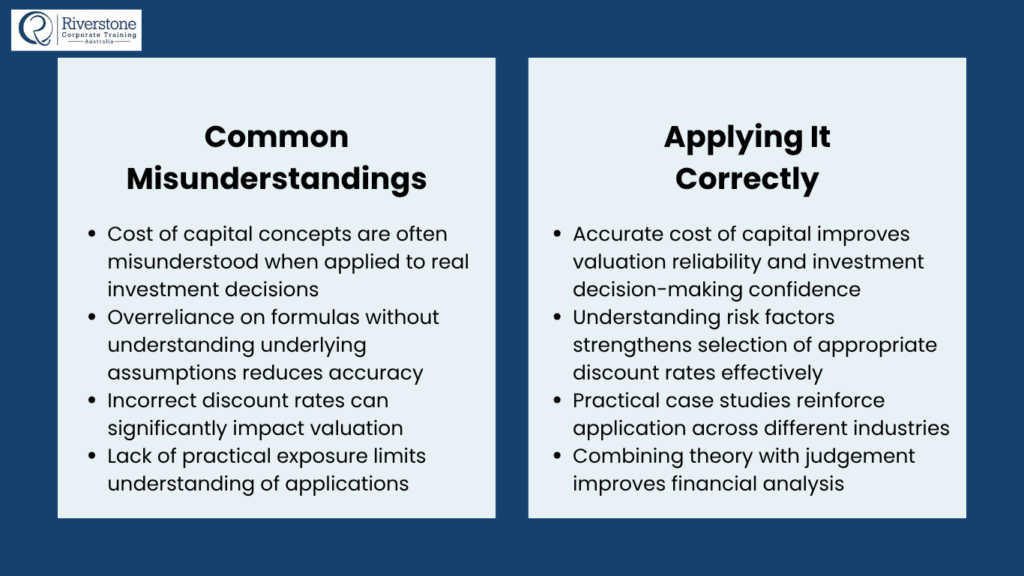
The cost of capital represents the minimum return a company must earn to satisfy its investors and lenders. It is a critical input in investment appraisal, business valuation, financial modelling, and capital budgeting because it serves as the benchmark for evaluating whether a project creates or destroys value.
Common mistakes include using book-value weights instead of market-value weights, applying an incorrect capital structure, confusing discount rates with capitalisation rates, and relying on unrealistic assumptions when estimating the cost of equity or cost of debt. These errors can significantly distort valuation and investment decisions.
The discount rate has a direct impact on the present value of future cash flows. Even small changes in the cost of capital can lead to substantial differences in business valuations, project appraisals, and investment decisions. Using a rate that does not properly reflect risk can result in overvalued or undervalued outcomes.
A company’s weighted average cost of capital (WACC) depends on the proportion of debt and equity used to finance the business. Applying incorrect weightings or failing to reflect the company's target capital structure can produce inaccurate WACC calculations and lead to poor financial decisions.
Finance professionals can improve accuracy by using market-based inputs, applying appropriate risk assumptions, regularly reviewing capital structure data, performing sensitivity analysis, and validating their calculations against multiple valuation approaches. Careful documentation of assumptions also helps improve transparency and decision-making quality.