


Table of Contents
01
Introduction to Finance Careers in Australia
04
How to Stand Out: A Practical Career Strategy
02
What Is Driving Increased Competition in Australian Finance Careers
05
Real Cases and Lessons from the Field
03
Five Skills That Separate Candidates in 2026
06
Conclusion
Introduction to Finance Careers in Australia
Why Finance Careers in Australia Are Becoming More Competitive Than Ever
The intensity of competition for finance jobs in Australia has dramatically increased across all levels of seniority, and the underlying drivers are not short-term. The interaction of roles being compressed by technology, the growing educational qualifications of new entrants to the market, the ease of mobility across geographies, and the rapidly changing demand for finance skills in Australia in 2026 has resulted in a market where the qualifications that would have secured an interview five years ago are the minimum standard required to be considered today. Greater competition for finance jobs in Australia is not something people imagine; it’s a reality having a profound impact on the actions candidates must take to advance their careers and the standards employers are setting.
For early- and mid-career finance professionals, an appreciation of the role of underlying market drivers in shaping job market trends in Australia is essential for informing career development decisions. The candidates who are seeing the most consistent progress in the current market are not those with the highest academic performance or with the most “glamorous” employer names on their resumes – they are those who have been able to build the right combination of technical, commercial and communication skills that are valued in the current market.
This article is for finance graduates, early career professionals and those in need of a reset to accelerate their career after a slower period of growth who want to know what the reality of finance career trends Australia is, what the most important finance skills needed for finance jobs in Australia are, and how to develop a career plan that will put them in the best position to succeed in an increasingly competitive environment.
What Is Driving Increased Competition in Australian Finance Careers
The structural forces behind increasing competition for finance careers
The rise of competition in finance careers has three key structural drivers which is of importance and the combination is transformative. First, technology is driving a contraction in job numbers at the transaction- and analysis-level. Finance departments are using automation, AI-supported analytics, and integrated financial systems, reducing the workforce needed to perform tasks that previously took up much of the time of junior and mid-level employees. Second, the competition for finance graduates in Australia has intensified due to the increased number of finance graduates with a stronger quantitative skill set, many with international experience or combined finance-data science degrees that were rare just five years ago. Third, finance jobs in Australia are now open to more global competition: the use of international recruitment platforms, multisite employment, and work visas for high-skilled professionals means finance jobs in Australia are competing with global talent in a way that was not the case a decade ago.
• Finance career trends in Australia in 2026 are not limited to entry-level: mid-level professionals who have not evolved beyond their original area of specialisation are feeling the pinch as a market that is valuing generalisation and commercial judgement over narrower technical competence.
• Job market trends in finance Australia reveal a dichotomy: demand for professionals with niche finance skills in areas where the market is short (project finance, data analytics, sustainability reporting, credit risk) and a surplus of generalists who hold the customary accounting qualifications and have no distinguishing finance skills.
What finance career trends Australia mean for individual strategy
Finance career trends in Australia in 2026 are driven by a market that is demanding specialisation and commercial communication skills. Those who are moving fastest are those who have gained depth in an area of high-demand skill (project finance, M&A advice, data analytics, ESG reporting, credit risk) and the communication skills to translate their technical work into the commercial implications for non-finance stakeholders. Those who are falling behind are those whose technical skills are sufficient but not specialised, and whose communication skills focus on reporting financials with accuracy rather than building commercial understanding and relationships that bring opportunities.
• The best interview conversations for candidates are those in which the candidate can describe a particular depth of expertise, how this expertise helps to solve business problems, and how their work has delivered commercial value – rather than a laundry list of skills.
• Always, the skills required for senior finance roles include the ability to influence others and to be strategic; now these skills are required at mid-career levels, which shortens the window of opportunity for their development.
Five Skills That Separate Candidates in 2026
The finance skills needed for finance jobs in Australia in 2026 are different to those needed when the current generation of senior finance practitioners were starting their careers. The five finance skills listed below are those finance skills that hiring managers and executive recruiters in the Australian market report to be differentiating in the current environment.
| Skill | Why It Is Differentiating | Competitive Finance Industry Skills Signal | How to Build It |
| 1. AI and analytics tool proficiency | Professionals who can use AI-enabled FP&A tools, build data models in Power BI or equivalent, and interpret automated analytical outputs critically are adding value that fully manual analysts cannot match; this skill is growing in employer demand faster than the supply of proficient practitioners | In-demand finance skills 2026: employers report difficulty finding candidates who can work effectively alongside AI tools rather than simply using them; critical evaluation of AI outputs is valued as much as tool proficiency | Spend structured time with one analytics platform; learn to build a financial model in Power BI or Tableau; practise critiquing AI-generated financial summaries for errors and context gaps |
| 2. Commercial storytelling with financial data | The ability to present financial analysis in a narrative that drives a decision — not just summarises the numbers — is consistently cited by hiring managers as the skill most absent in strong technical candidates | How to stand out in finance careers: the analyst who can produce a technically correct P&L and the analyst who can explain what that P&L means for the business strategy are valued very differently in the current market | Practise presenting financial analysis to a non-finance audience; seek roles that require regular presentation to senior stakeholders; get specific feedback on whether your analysis drives a decision or merely informs it |
| 3. Specialisation in a high-demand area | Generic accounting and finance qualifications are increasingly the floor, not the ceiling; professionals with specific depth in project finance, M&A advisory, ESG reporting, credit risk, or data analytics command a material hiring premium | Finance graduate competition in Australia has increased the supply of generalist-qualified candidates; specialisation is what creates scarcity value in a market where general credentials are common | Identify the one or two high-demand specialisations most aligned to your interests and career direction; invest development time in depth rather than breadth within the next 12 months |
| 4. Regulatory and ESG literacy | Mandatory sustainability disclosure, expanding AML obligations, privacy law reforms, and IFRS standard changes are creating specific technical requirements that many existing finance professionals were not trained for; early builders of this capability are entering a market with genuine scarcity | Finance skills needed for finance jobs in Australia in corporate and institutional contexts increasingly include regulatory and sustainability literacy as a minimum competency rather than a specialisation; the professionals who have it are in demand across sectors | Follow AASB S2 implementation guidance, AUSTRAC regulatory updates, and APRA stress testing developments; build the ability to interpret new regulatory requirements and translate them into operational implications for a finance team |
| 5. Cross-functional credibility | Finance professionals who are credible partners to engineering, operations, sales, and strategy teams — who can engage with the commercial substance of decisions rather than only the financial reporting of outcomes — are in higher demand than those whose capability is confined within the finance function | Competitive industry finance skills at mid-career and above include the ability to influence decisions across functional boundaries; employers are explicit about wanting finance professionals who are partners, not scorekeepers | Request involvement in strategic projects with cross-functional teams; build relationships with non-finance leaders; seek feedback on whether your contribution is perceived as analytical support or commercial input |
Skill 2 – telling a commercial story with financial data – is the one that most consistently distinguishes the candidates who move ahead in their careers from those who remain competent but stagnant. The finance person who can develop a perfect model and produce a table of numbers is technically competent. The professional who can look at the same model, identify the three key numbers for the strategic decision, and present them in a story that links to the real question being asked is demonstrating commercial judgement. The latter is the skill required in finance careers in 2026, rather than the former, and it comes from practice, not study.
How to Stand Out: A Practical Career Strategy
A structured approach to how to stand out in finance careers
The path to standing out in finance careers is not through degrees but through career planning. The following four-phase approach is how finance professionals who are best placed to advance their careers in the current Australian environment are developing their careers.
| Phase 1 | Phase 2 | Phase 3 | Phase 4 |
| Identify Your Specialism | Build Depth Deliberately | Develop the Commercial Layer | Manage Your Market Presence |
| Assess the high-demand specialisations against your interests, existing finance skills, and market positioning; choose one area for focused development over the next 12 to 18 months; identify the two or three specific capabilities within that specialism that are most valued by employers | Allocate structured development time to the chosen specialism: courses, live project involvement, self-directed study of real transactions and case studies; seek roles or projects that provide proximity to the target area; build evidence of the capability, not just exposure to it | Practise financial storytelling in your current role; seek regular presentation opportunities to senior or non-finance stakeholders; build cross-functional relationships; get specific feedback on the commercial impact of your financial analysis | Build a professional profile that reflects your specialism clearly; engage with the professional community in your target area (industry events, professional associations, published commentary); ensure your CV and LinkedIn tell a coherent specialisation story rather than a generic finance generalist narrative |
Real cases: what separates those who advance
A finance degree graduate and a CPA applied for 40 analyst jobs in eight months and had a 12 per cent success rate in securing interviews. Her resume was a chronological listing of activities in each position with no description of the business results achieved, technical specialism or specific expertise. She took the advice of a mentor and focused her profile on the types of ESG reporting and sustainability analysis she had been working on in her last role, combined with a brief online project finance course, and prepared two short case studies of analyses that had impacted business decisions. The next 15 applications resulted in 8 interviews. The market was the same, but she was now positioned differently. The Australian finance graduate competition favours specialisation and demonstrable value to the bottom line over generalist experience.
An experienced FP&A (financial planning and analysis) manager with eight years’ experience was not progressing in his career despite annual performance reviews. He excelled at financial modelling and reporting but lacked influence and credibility with stakeholders. He was continually overlooked for senior finance business partner roles and was judged against people with commercial leadership experience in their previous finance jobs in Australia. He took 12 months to build his profile by taking every opportunity to present to the executive team, working as the finance lead on a cross-functional strategy project, and meeting the Chief Operating Officer during the monthly operational review. After 14 months, he was promoted, then lured away to a more senior role. The mid-career challenges that finance professionals face in career advancement are rarely technical; it is always about commercial and relationship skills.
Conclusion
The competition for finance jobs in Australia is structural and ongoing due to technology-driven role contraction, increased supply of high-quality graduates, and a market that increasingly rewards commercial acumen over technical ability. Finance careers in Australia in 2026 reward specialisation and the commercial communication of specialisation, and those doing best are those who have done a good job of strategically building their specialisations and abilities to translate them to commercial value for their employers and clients.
• In-demand finance skills 2026 are not the finance skills that were most valued when the current generation of senior practitioners were starting their careers; AI/analytics, regulatory knowledge and commercial storytelling are in mid-career what were not in the past, and candidates who have not invested in them are at a structural disadvantage.
• How to excel in finance careers requires a clear specialisation strategy, not a scattershot approach to skill-building; the most successful professionals in today’s market are those who have a clearly defined, demonstrable specialisation in one of the areas that are in high market demand and who are able to translate that specialisation commercially.
• For those facing career growth challenges in finance, the most important thing you can do is decide which specialism is best aligned to your interests and the market demand, invest in building expertise in that area over the next 12 months, and make sure your CV, LinkedIn profile and work description are all aligned to that specialism as opposed to being a generalist.
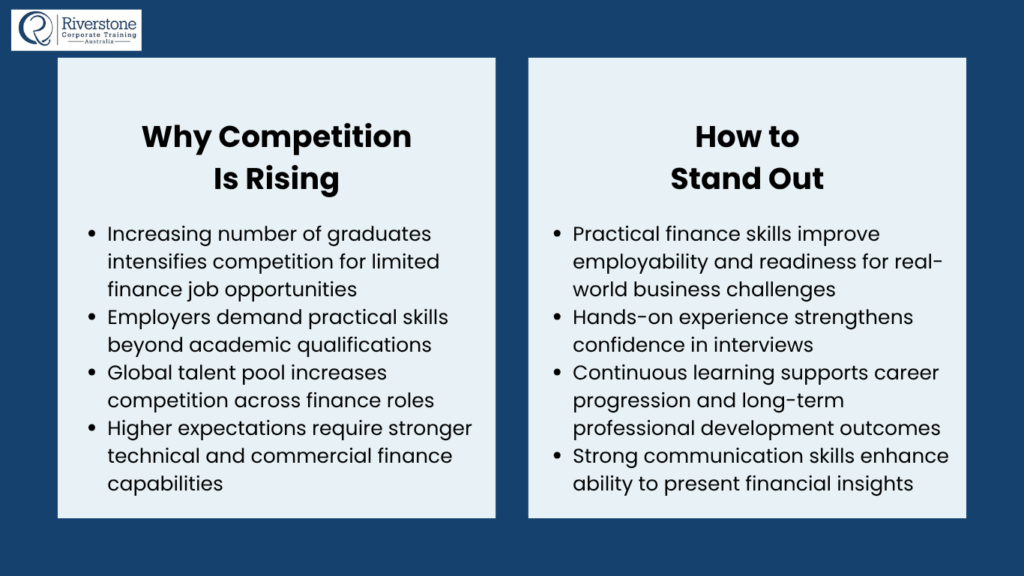
Australia offers a wide range of finance career opportunities, including roles in financial analysis, corporate finance, investment banking, wealth management, credit analysis, financial planning, risk management, and accounting. Demand for finance professionals continues across industries such as banking, consulting, government, and corporate organisations.
Most finance careers require a degree in finance, accounting, economics, business, or a related field. In addition, practical training in areas such as financial modelling, valuation, investment analysis, and corporate finance can help candidates develop job-ready skills and improve their employability in competitive finance roles.
Employers often look for strong analytical skills, financial modelling capabilities, business valuation knowledge, financial statement analysis, problem-solving abilities, and proficiency in spreadsheet-based financial analysis. Communication and commercial awareness are also highly valued in finance-related positions.
Graduates can strengthen their job prospects by gaining practical finance experience, completing industry-relevant training programmes, building financial modelling and valuation skills, undertaking internships, and preparing for technical interviews. Networking and staying informed about industry trends can also support career development.
Finance professionals can progress into senior analyst, finance manager, investment manager, corporate finance advisor, portfolio manager, chief financial officer (CFO), or executive leadership positions. Career advancement often depends on a combination of technical expertise, professional development, industry experience, and leadership capabilities.