

- 01 Introduction
- 02 What Financial Modelling Actually Does in Practice
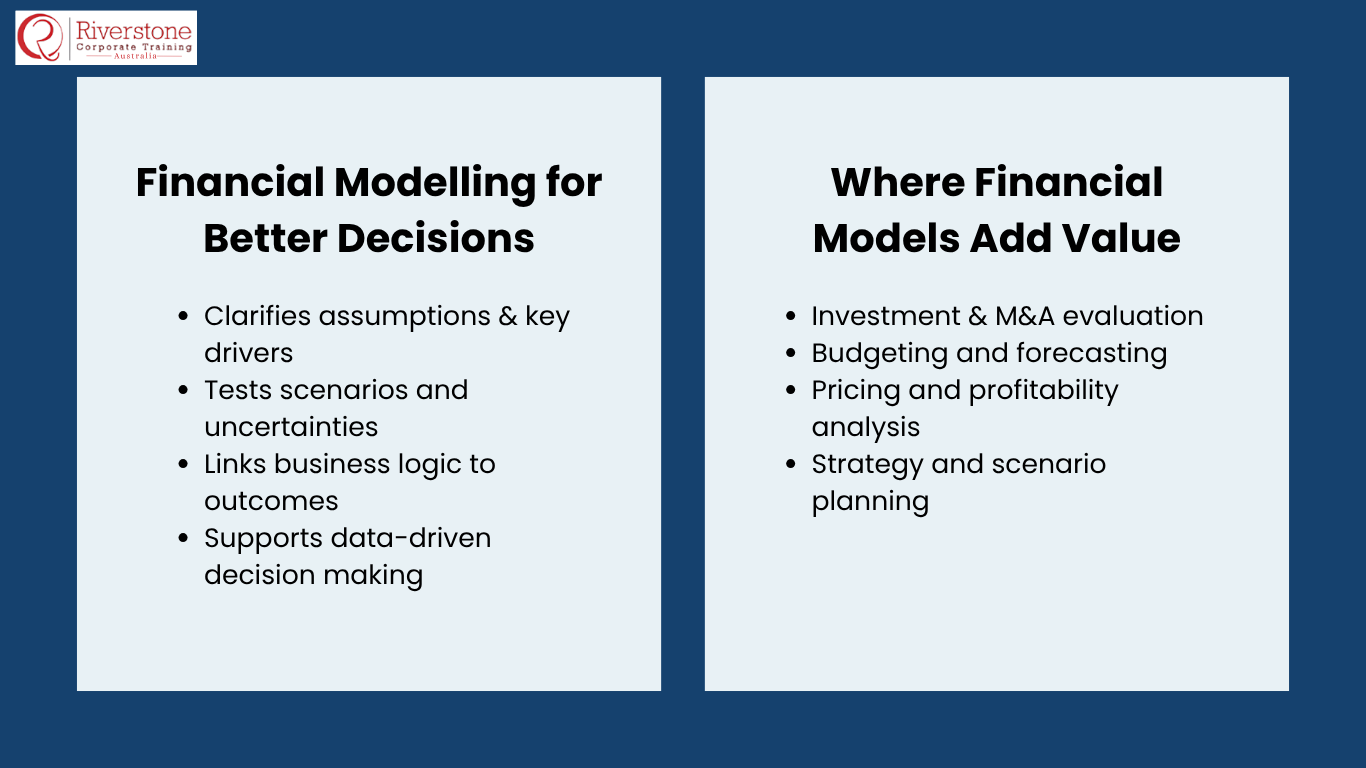
- 03The Decision Contexts Where Financial Models Add Most Value
- 04 The Anatomy of a Decision-Useful Financial Model
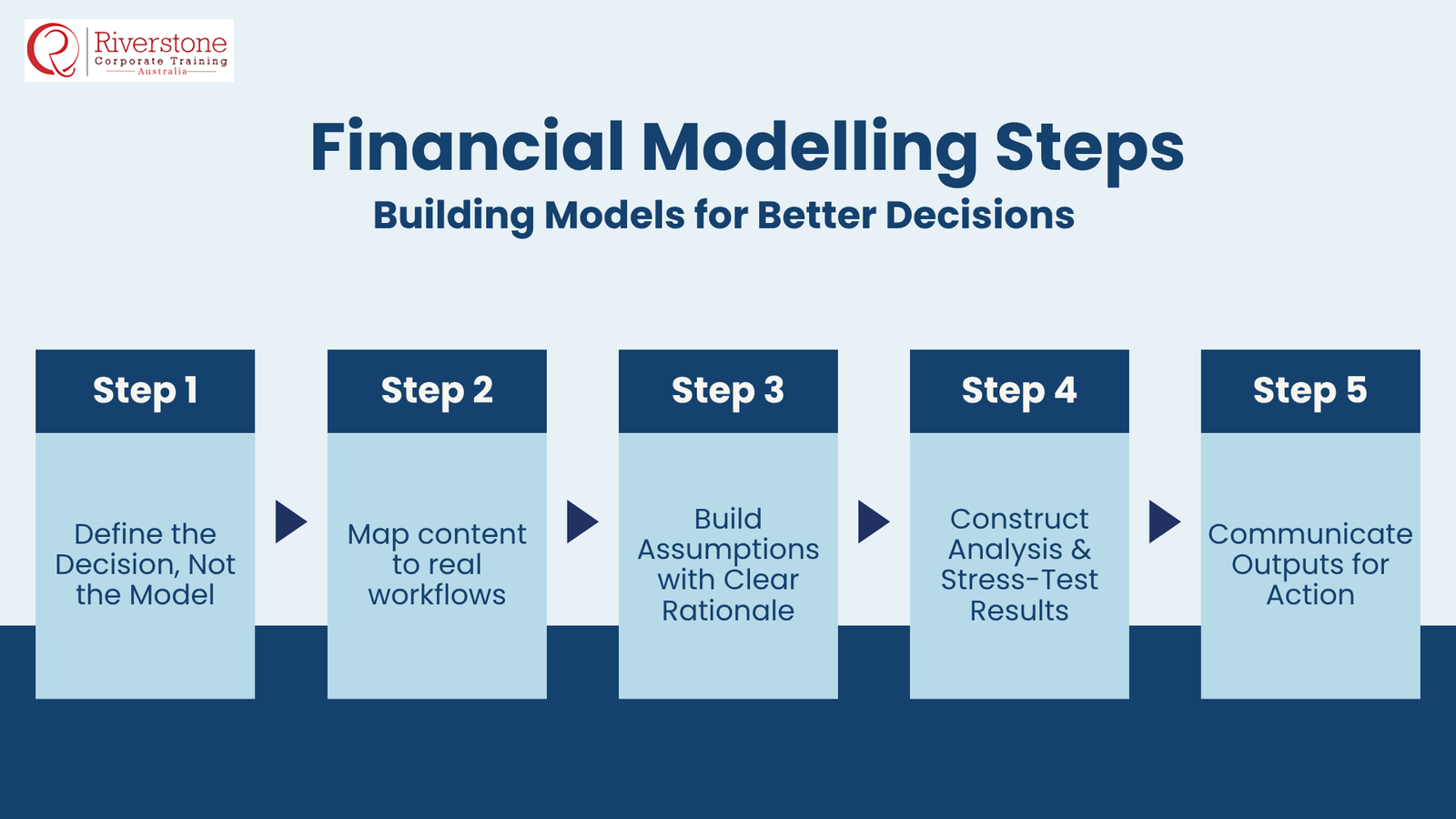
- 05 Five Key Steps: Building Models That Support Better Decisions
- 06Real Applications of Financial Modelling Across Business Contexts
- 07 Common Modelling Mistakes That Undermine Decisions
- 08The Human Element — Judgement Behind the Model
- 09Building Your Modelling Capability for Better Decision Support
- 10Conclusion and Actionable Insights
How Financial Modelling Australia Supports
Better Business and Investment Decisions
Table of Contents
01 Introduction
02 What Financial Modelling Actually Does in Practice
03 The Decision Contexts Where Financial Models Add Most Value
04 The Anatomy of a Decision-Useful Financial Model
05 Five Key Steps: Building Models That Support Better Decisions
06 Real Applications of Financial Modelling Across Business Contexts
Real applications of financial modelling across different business settings show how the same decision analysis principles – clear assumptions, scenario design, sensitivity analysis, and communication focused on the decision – lead to better decision-making in as different settings as the first pitch to investors for a new business, the capital allocation meeting of a global corporation, and the acquisition decision for a mid-sized company.
The Capital Investment Decision — A Manufacturing Expansion
A European manufacturing company was considering a $45 million investment in a new plant to support export growth. The original business case prepared by the operations team had a 4-year payback and a positive NPV. Still, the financial analysis team felt that the revenue estimates were based on existing export demand without any sensitivity analysis for demand and exchange rate ranges.
- The financial modelling course for decision making exercise re-built the investment model with three additions: a demand sensitivity analysis (showing the IRR and payback period at 60%, 80%, 100% and 120% of the projected export demand), an exchange rate sensitivity analysis (showing the impact of a 15% adverse movement in the currency pair on both NPV and payback), and a phased investment option (the option of staging the investment – committing to the first half of the facility and optioning the second half – to reduce downside risk while keeping most of the upside).
- •The result was that the full investment was justified at the base case, but that the phased investment option had significantly superior risk-adjusted returns because the downside (with a 20% shortfall in export demand) was reduced from a negative NPV to a break-even NPV. The choice to go ahead with the phased investment was driven by the scenario and sensitivity analyses made possible by the financial model. This is a typical example of better decision-making using financial analysis: not making a different decision, but making a better decision about the structure of the underlying decision.
The M&A Assessment — Evaluating a Bolt-On Acquisition
A North American technology services firm was considering acquiring a smaller rival with some common customers in a market where the acquirer had a weak presence. The target was profitable, with $8 million in EBITDA on $40 million in revenue, and had an indicative price of $60 million (7.5x EBITDA).
- The investment analysis with financial models showed that the target business was worth around $55-65 million on a DCF basis (in line with the indicative price) but that the target with the revenue synergies (70% retention of target’s customers, cross-selling of the acquirer’s high margin services to that customer base, and removal of redundant costs) was worth $80-90 million to the acquirer. The model was designed to highlight the contribution of synergy and to test it separately, by including a clearly identified synergy module that could be switched on and off with a simple checkbox.
- The lesson: data driven business decisions finance in an M&A valuation context requires that the model separate the standalone value of the target (what it would be worth to a financial buyer with no synergies) from the strategic value to the specific acquirer (what it is worth with the acquirer’s specific synergies) – because conflating the two produces a bid price that either overpays for synergies that may not materialise or undersells the strategic benefit of the acquisition.
The Budget Model — Driver-Based Forecasting for a Retail Group
A 45-store regional retailer was disappointed that the annual budget process was not yielding accurate forecasts: budgeted revenue was consistently overrun by 15%, and costs were consistently underestimated. The CFO thought this was due to a problem with the methodology: the budget was a percentage increase on the previous year’s numbers, rather than being based on the drivers of the business that drove the financial performance.
- The financial forecasting for the strategy model was reconstructed from store-specific drivers: average transaction size by category, transactions per store by store type, foot traffic by store location, cost of labour per hour, and store-specific fixed costs. This driver-based structure resulted in a forecast that was 40% more accurate in its first year of use – not because the assumptions underlying the individual drivers were any better, but because the model structure brought them to the surface for discussion at the management level, rather than hiding them in the top line growth rate.
- The take-out: modelling for accurate business planning is not about the complexity of the analytical methods used; it is about the fit of the model structure to the business. A model that maps how the business makes and spends money will be more accurate than one that applies a mathematical transformation to last year’s results, no matter how sophisticated that transformation is.