


Table of Contents
01
Introduction to How to Build Finance Case-Study Driven Content
04
Design Workflow: Process, Tools, and Real Cases
02
Why Case Studies Work in Finance Training
05
Challenges and Lessons Learned
03
Five Steps to Building Case Study–Driven Content
06
Conclusion
Introduction to How to Build Finance Case-Study Driven Content
How to Build Finance Case Study Driven Content
If you ask any finance professional what they recall from a training course, it is rarely a slide. It is a case study – a situation, a choice, a company in trouble, a deal on the line. Finance case study learning is effective because it places learners in a real or realistic scenario and challenges them to think beyond just hearing. Yet, overwhelmingly, finance training content still follows an abstract, theory-centred, lecture-based approach that is difficult to retain and even harder for learners to apply.
The difference between finance content that educates and finance content that enables is solely about the design and application of real-world finance case studies. A case study is not an example that is tacked onto a slide. It is a story that places the learner in the role of a practitioner, challenges them to put the concept being taught into practice, and helps them identify, through their decision-making, what they don’t understand. It is a skilful design that is increasingly in demand among L&D and finance education practitioners.
This article is aimed at finance educators, L&D professionals, and subject matter experts seeking to develop applied finance learning content that drives behavioural change. It discusses why case-based approaches are better than conventional methods, the five steps to design case study modules from the ground up, and the process that successful practitioners follow to design, test and revise finance content with real scenarios that learners can’t help but engage with and that yield positive outcomes.
Why Case Studies Work in Finance Training
The evidence behind experiential learning in finance
The educational benefits of experiential learning finance are clear. Students learn more when they use a concept, rather than simply being told about it. In finance – where the desired outcome is typically a judgement or decision, not rote memorisation – this makes case-based finance education the most efficient learning path from theory to practice. The student not only knows what a working capital cycle is, but they also know what it feels like to manage one under stress.
• Students retain only 5-20% from passive (lecture, reading) learning; they retain 50-75% from active, scenario-based learning, and this translates into improved performance at work.
• All real finance decisions are made in an environment of uncertainty – only case-based finance education can simulate this environment in a controlled environment.
What makes a case study effective — and what makes it fail
Case studies do not always lead to learning. An ineffective case study overloads the learner, frustrates them and delivers unexpected outcomes. The most frequent failure is the information-dump case: a scenario in which more information is provided than the learner can absorb, with no decision-making rule to guide them. Engaging finance training methods use case studies that are laser-focused – they present the learner with just the data they need to arrive at the desired insight, and nothing more than is needed to achieve the learning objective.
• The case must be believable – learners switch off when the business environment is contrived or not relatable to their industry or job.
• Using storytelling in finance training is what makes a case study interesting and a case study skimmed – the story creates tension, and learners engage when there is tension.
Five Steps to Building Case Study–Driven Content
Here’s the five-step process that content design professionals follow when building case study-based training for a finance audience – from the ground up to a learner-validated, ready-for-deployment training module.
| Step | What It Involves | Why It Matters | Common Mistakes to Avoid |
|---|---|---|---|
| 1. Define the target decision | Identify the specific judgement or action the learner should be able to make after the module — not what they should know, but what they should do | Case studies built around vague objectives produce vague learning; decision-specificity forces precision in scenario design | Designing the case before clarifying the target capability — this produces content that is interesting but not useful |
| 2. Choose the right scenario | Select or construct a scenario that genuinely requires the target decision to be made; the scenario must create authentic tension, not just illustrate a concept | Learners only engage with the case study as a thinking exercise if the scenario creates a real decision point with consequences | Using generic, sanitised scenarios that have no relationship to the learner’s actual work context |
| 3. Build the narrative first | Write the story of the scenario before designing the learning activities; establish character, context, and stakes before introducing the financial data | Storytelling in finance training is the mechanism that creates engagement; the narrative carries the learner through the complexity, not the other way around | Starting with the numbers and building the story around them — this produces data-heavy content with no emotional or contextual anchor |
| 4. Sequence the information | Release information progressively throughout the case — not all at once; structure the case so that each new piece of information either confirms, challenges, or complicates the learner’s working hypothesis | Information release creates the analytical momentum that drives engagement; learners who receive all information at once tend to scan for the answer rather than reason through the problem | Providing a full data set upfront and then asking the learner to conclude — this eliminates the most valuable part of the learning experience |
| 5. Design the debrief, not just the case | Build the facilitation guide and debrief questions with the same care as the case itself; the debrief is where most of the learning consolidation happens — not in the case itself.f | The best applied finance learning content produces insight through reflection; without a structured debrief, learners leave with an experience but not a transferable principle. | Treating the debrief as an improvised discussion rather than a designed learning activity with specific questions and intended outcomes |
Step 3 – storytelling first – is the step that is most commonly overlooked by subject matter experts in their self-help design process. Finance practitioners are naturally numbers-first. But storytelling in finance training is not nifty; it’s the structural glue that creates a need to understand the numbers. A company with a cash-flow problem, a CFO who has to explain a valuation to a doubtful board of directors, an analyst who spots an anomaly in a due diligence data room – these types of events are what make financial concepts meaningful, relevant and important to learn.
Design Workflow: Process, Tools, and Real Cases
The four-phase content design workflow
The process of turning a finance topic into a finance case study module is broken down into four phases. There is an input, output and quality check for each phase – and they’re in the right order. The most common source of finance case study content that doesn’t deliver learning outcomes is short-cutting Phase 1 to go directly to content development.
| Phase | Focus | Key Activity | Output |
|---|---|---|---|
| Phase 1: Learning Design | Define the target decision, the learner profile, and the prerequisite knowledge required before the case makes sense | Write the learning objective as a specific observable action: ‘After this module, the learner will be able to identify early warning signs of working capital deterioration from a cash flow statement and recommend one corrective action’ | A single, precise learning objective that governs all subsequent design decisions |
| Phase 2: Scenario Construction | Build the narrative scenario with character, context, financial data, and decision point; calibrate complexity to the learner’s level | Draft the scenario narrative first; then add the supporting financial data; test whether the data alone — without the narrative — would produce the same learning outcome (it will not) | A complete scenario with narrative, supporting data, and a clearly defined decision point |
| Phase 3: Activity and Debrief Design | Design the learner activities that use the scenario and build the debrief guide that consolidates the insight | Write 3–5 debrief questions that move from ‘what happened in the case’ to ‘what principle does this illustrate’ to ‘how would you apply this in your own work next week’ | Complete facilitation guide with activity instructions, timing, and debrief question sequence |
| Phase 4: Non-Expert Testing | Test the module with a representative learner before finalising; observe where comprehension breaks down and what questions arise that the module does not answer. | Ask the test learner to explain what decision they made, why they made it, and what they would do differently with more time — the quality of their answers reveals exactly where the module succeeded and where it failed. | Revised module with specific improvements to the scenario, data presentation, or debrief question sequence |
Real cases: where case study design changed learning outcomes
For three years, the internal training team at a European investment bank had been delivering a credit financial analysis module with consistently low post-training test scores. The module was technically correct, but it would have benefited from a lecture with illustrative examples. The redesign team started from scratch, using a finance case study-based training principles: the module started with a fictional midmarket borrower – a consumer goods company under margin pressure – in financial stress. The student was required to participate as the relationship manager, preparing for a credit committee meeting. The various components of the credit financial analysis were presented as the method the learner would use to answer a question about the borrower’s situation. The pass rate of the post-programme competency test increased from 34% to 78% in one cohort. It was the same content: finance case study learning.
The L&D team of a North American technology company was developing practical finance examples for training a group of non-finance general managers. They started by using publicly listed companies’ financial analysis data – and immediately ran into engagement issues, because learners were distractingly focused on the new company names, rather than the finance concepts. The follow-up approach featured a single, fictional company across the six modules: a mid-sized retail company that learners tracked from inception to growth, margin challenges and finally acquisition. Learners were emotionally engaged in the company’s fate by Module 3 and asked realistic questions about the company’s financial analysis that had not occurred before. Experiential learning finance – sustained over an entire course through a single storyline – engaged learners differently from individual examples.
Challenges and Lessons Learned
The most consistent failure points in case study content design
There are common mistakes that even experienced content designers make when designing finance case study content with real scenarios. Knowing these failure points ahead of time is the best quality control test before going into the testing stage.
| Design Failure | What It Looks Like | Why It Happens | How to Fix It |
|---|---|---|---|
| Scenario complexity overload | Learners spend the module trying to understand the scenario rather than applying the finance concept | The designer includes too much contextual detail to make the scenario feel ‘realistic’ | Scope the scenario to the minimum context required for the decision; realism comes from authentic tension, not volume of detail |
| Answer-first structure | The correct financial analysis is implied before the learner has attempted their own; learners pattern-match to the expected answer rather than reason independently | Subject matter experts instinctively want to ensure learners reach the right conclusion | Withhold the analytical framework until after the learner has made their initial assessment; use the debrief, not the case, to correct errors |
| Debrief as an afterthought | Facilitated debrief is improvised or cut for time; learners leave with an experience but no transferable principle | Content design effort is concentrated on the case itself; the debrief is assumed to take care of itself | Design the debrief question sequence before finalising the case; the debrief questions reveal whether the case is designed correctly |
| Irrelevant industry context | Learners from technology or services companies disengage from manufacturing or commodity scenarios that are irrelevant to their daily decisions. | Designers use the most familiar or convenient industry for the scenario rather than the most relevant for the target audience | If the target audience works in a specific sector, set the scenario in that sector; if mixed, use a simple retail or services business that all learners can intuitively map to |
Lessons that consistently emerge from experienced practitioners
Across industries and learner populations, the practitioners who create the most engaging finance training methods have three lessons that are easy to articulate, but often under-emphasised.
• The first line of the scenario is the most important determinant of learner engagement – if it does not inspire interest in the next line, the learner has already started to disengage
• The case should not be complicated, the debrief should – the case should be simple (simple enough for the learner to get it right); the debrief offers complexity (exceptions, advanced applications, subtle issues)
• The ultimate way to check content quality is to ask the test person to teach the topic back using the case – if they can, it worked; if not, it’s almost always a problem with the narrative design, not the content.
Conclusion
Creating case-study-based finance content that learners want to learn from is a design problem, not a content problem. The finance knowledge needed to build real-world finance case studies is important. Still, not enough – the design skill is in the scenario selection, narrative creation, progressive information disclosure, and debrief creation. Those who practice these principles successfully build applied finance learning content that alters the way learners think, choose and act – the real measure of any training.
• Start every finance case study design with the goal of the learning activity clearly articulated as a decision or action – not a concept to be learnt – and ensure that all further design decisions, including the scenario choice and the order in which debrief questions are asked, are guided by this objective.
• Storytelling in finance training is not an aesthetic choice; it is the mechanism used to maintain attention and provide learners with the contextual depth needed to make financial analysis concepts relevant to the work context.
• Pilot every module with a typical learner before release – the points at which understanding breaks down are never where the designer expected them to be, and it’s better to discover them before delivery than during.
For L&D, finance education, or corporate learning design professionals, designing case-based finance education that delivers capability is one of the most valued skills in the market. It is a combination of subject matter expertise and learning design skill – and those who develop both will consistently outperform those with only one.
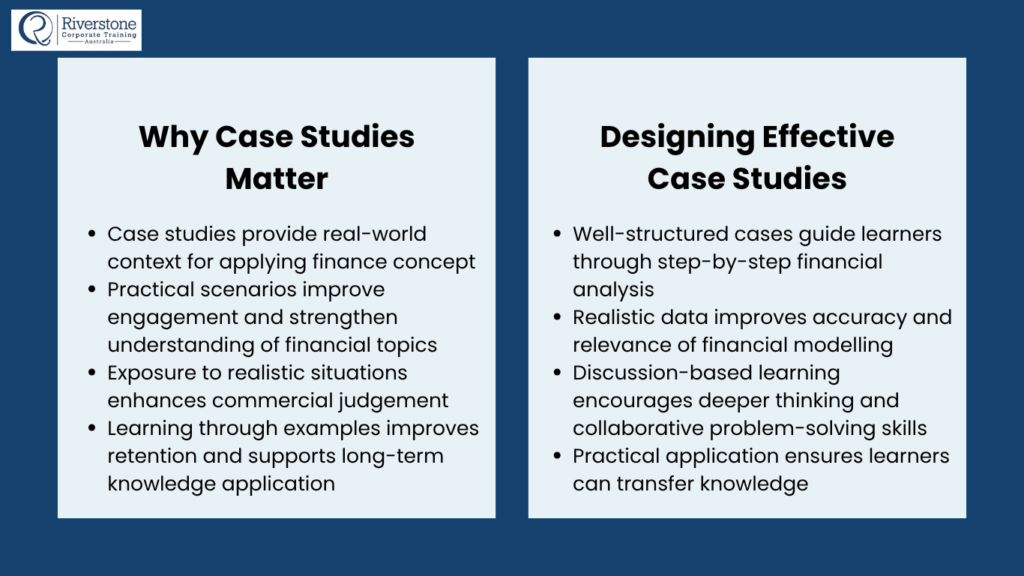
A finance case study is a real-world business scenario that requires learners to analyse financial information, identify key issues, evaluate alternatives, and recommend solutions. Case studies are important because they help bridge the gap between theoretical finance concepts and practical decision-making in professional environments.
Building a finance case study typically involves defining the business problem, gathering relevant financial and operational data, analysing the situation using appropriate financial tools, evaluating potential solutions, and developing clear recommendations supported by evidence. A structured approach helps ensure that conclusions are logical and actionable.
Finance case studies often incorporate techniques such as financial statement analysis, ratio analysis, business valuation, discounted cash flow (DCF) analysis, capital budgeting, risk assessment, and financial modelling. The specific tools used depend on the objectives and complexity of the case.
Learners can improve their case study skills by regularly analysing real business situations, practising financial modelling, developing structured problem-solving approaches, and presenting recommendations supported by quantitative and qualitative evidence. Exposure to diverse case studies also helps strengthen commercial judgement and analytical thinking.
An effective finance case study presents a realistic business challenge, includes relevant financial and contextual information, encourages critical analysis, and requires participants to make well-supported recommendations. The strongest case studies focus not only on calculations but also on strategic decision-making and the practical application of finance concepts.