


Table of Contents
01
Introduction to Designing Effective Finance eLearning
04
The Course Development Workflow
02
Why Financial Modelling and Valuation Are Particularly Challenging to Teach Online
05
Real Cases, Challenges, and Lessons Learned
03
Five Design Principles for Effective Modelling and Valuation eLearning
06
Conclusion
Introduction to Designing Effective Finance eLearning
Designing Effective Finance eLearning for Financial Modelling Courses
There is a challenge in designing eLearning financial modelling courses that is not shared by many other forms of eLearning content: it’s an applied discipline. Modelling and valuation are skills that are learned by doing, not by reading. The easiest way to get it wrong in designing online valuation training courses design is to treat these skills as knowledge-based – to record a lecture on DCF analysis and include a few slides about WACC and call it a financial modelling course. After the course, the student knows more about financial modelling; they still don’t know how to do it. This is the gap in the designing online finance training courses that our design strategies must address.
When building finance eLearning programmes that impart financial modelling and valuation skills, designers must focus on doing rather than explaining, practice rather than theory, and on feedback rather than completion. The learner must model, value and receive feedback on the quality of their work – not in a classroom, but in a digital learning environment that provides the key elements of the skill-building process without needing a physical space and a facilitator to be on hand when the learning takes place.
This article is for instructional designers, finance subject matter experts and L&D professionals who are designing or sourcing eLearning for valuation skills and financial modelling. It addresses the specific design challenges that make these topics more difficult to teach online than other finance topics; the five principles of design that lead to effective eLearning in this area; and lessons learned from experience designing courses that have improved capability through digital financial modelling training courses.
Why Financial Modelling and Valuation Are Particularly Challenging to Teach Online
The hands-on problem in eLearning financial modelling courses
The challenge of design in eLearning financial modelling courses is one not shared by most eLearning courses: the skill is iterative. To learn to build a DCF model, it is not enough to learn the concept; you have to execute it, make mistakes, detect the mistakes, correct them and do it again until you can flawlessly execute it. Classroom-based learning designs readily accommodate this learning cycle, as a facilitator can see, diagnose and correct. Interactive online finance learning must build this loop without an instructor present, which means designing the assessment, error-detection, and correction processes.
• A student who has watched a screen recording of someone building a financial model has been “taught” how to build a model; they have not “practised” building a model. Those are two fundamentally different learning activities that result in different levels of capability.
• Digital financial modelling training courses that is largely demonstrative-based rather than practice-based is the most frequent design flaw in this area; learners may finish their training courses, but they will not be able to build models after completion.
The judgment dimension of eLearning for valuation skills
The second dimension of design, the judgment dimension, is added by valuation. The technical dimension of valuation is about building a valuation model; the judgment dimension is about forming, presenting, and contextualising a valuation conclusion, a skill typically learned through exposure to a range of scenarios, peer discussion, and mentor feedback. eLearning for valuation skills needs to be designed for both these dimensions, but in distinct formats. Practice with interactive eLearning is suitable for the former; the latter usually requires peer interaction or facilitation, or a very carefully crafted scenario-based assessment in which the learner must grapple with the particular ambiguities of valuation judgment.
• Valuation questions with one correct answer test technical skills; valuation questions with many possible correct answers, where the quality of the reasoning is key, test judgment; most online valuation training courses designs and assessments only test the former.
• Finance eLearning best practices include at least one judgment assessment for each valuation program: a scenario in which the learner must articulate a position on an ambiguous valuation question, with a rubric for judging the quality of the reasoning.
Five Design Principles for Effective Modelling and Valuation eLearning
There are five principles of finance training courses instructional design for modelling and valuation skills that address the procedural and judgmental aspects of these skills. Each principle addresses a different failure mode in the design of online finance learning.
| Principle | What It Requires in Practice | Finance eLearning Best Practices Application | Common Design Failure: It Prevents |
| 1. Build-before-explain sequencing | Every module begins with a partially completed model that the learner must build or extend before any explanation is provided; the doing precedes the theory | Creating modelling training courses online that uses a build-first structure exploits the learning science principle that active processing precedes and improves comprehension of explanation; learners who have struggled with the task retain the explanation better than those who received it passively | Modules that open with theory and end with a practice exercise that is too similar to the worked examples to require genuine application; learners complete the exercise by pattern-matching to the example, not by applying the concept |
| 2. Incremental model complexity | Each module adds one or two elements to a model that builds progressively across the course; by the final module, the learner has constructed a complete model incrementally rather than facing its full complexity at once | eLearning financial modelling courses that use progressive complexity manage cognitive load: each increment is within the learner’s current capability, and the sense of progress motivates continued engagement | Modules that introduce complete models at full complexity from Module 1; the cognitive load is unmanageable for learners without prior modelling exposure, and they disengage before the core skill is developed |
| 3. Error-specific, not generic, feedback | Assessment feedback identifies the specific error made, explains why it is incorrect at the level of the underlying concept, and provides the minimum hint necessary for the learner to self-correct; it does not simply show the correct answer | Interactive finance learning online that provides generic “incorrect — try again” feedback teaches persistence, not skill; learners who repeatedly guess until they reach the correct answer have not learned the concept | Single-attempt assessments that show the correct answer immediately after a wrong response; the learner sees the right answer, but has not worked through the reasoning required to produce it |
| 4. Judgment scenarios with structured criteria | At least one module in every valuation programme presents an ambiguous valuation scenario where multiple conclusions are defensible; the assessment criteria evaluate the quality of the reasoning and the identification of key assumptions, not the conclusion itself | eLearning for valuation skills that only test whether the learner can calculate the right number does not develop the commercial judgment that differentiates strong valuation practitioners; judgment must be assessed explicitly | Technical-only assessment throughout the programme; learners who can execute every calculation correctly but cannot form or defend a valuation position under ambiguity are not job-ready for valuation roles |
| 5. Application bridges to real work | Every module ends with a specific, structured activity connecting the learning to a real task from the learner’s role: a model to build from their own company’s data, a valuation assumption to justify using their own sector context, a sensitivity analysis to apply to a real decision they are involved in | Designing online finance courses with explicit application bridges increases skill transfer from the digital learning environment to the actual work context; the transfer is not left to chance or to the learner’s initiative | .Modules that end with a summary of what was covered without connecting the learning to real work; learners complete the module and return to their roles without a structured prompt to apply what they have just practised |
Principle 2 – progressive model complexity – is the design element most critical to the success of a learner new to financial modelling in making it through an online course without becoming disheartened or bored. Building finance eLearning programmes around a single model that evolves during the course – from a basic revenue projection to cost structure, working capital, capital expenditure and debt service – gives learners time to familiarise themselves with the model structure and assumptions before they reach the complexity of the final model. The model at the end of the course is a portfolio piece that the learner understands in depth, rather than a model assembled from disparate exercises across different modules.
The Course Development Workflow and Real Cases
The design of the online finance courses development workflow
The process of designing online finance courses for financial modelling and valuation comprises four development phases: a build-first-then-write approach to model and scenario building, followed by content writing. Models and scenarios must be written to perfection before they are used.
| Phase 1 | Phase 2 | Phase 3 | Phase 4 |
| Model Architecture | Scenario and Assessment Design | Content Development | Pilot and Iteration |
| Build the complete incremental model from Module 1 to the final module; test every formula and link; design the partially-completed states that learners will build from; create the assessment versions with deliberate errors for learners to identify and correct | Design the judgment scenarios and their assessment criteria; write the error-specific feedback for each common mistake; design the application bridge activities for each module; pilot the assessments with target-level learners before writing any instructional content | Write the build-before-explain content for each module; develop the screen recording demonstrations; create the supporting reference materials (formulas, glossary, worked examples); ensure all content serves the learning objective and does not exceed the minimum necessary | Pilot the full course with five to eight learners at the target level; observe where they get stuck, what errors they make most frequently, and where they disengage; update the error-specific feedback, the incremental model, and the assessment criteria before full release |
Real cases: what makes digital financial modelling training work
A corporate education company revamped its financial modelling course after discovering that, while course completion rates were 85 per cent or higher, learners’ self-evaluations of their ability to build financial models had not improved after the learning experience. The course had previously been structured as 14 video lectures with downloadable spreadsheets and quizzes with multiple-choice questions (MCQs) at the end of each module. The new course replaced the passive video with a build-first module, where participants were provided with a partially built model at the beginning of each topic, received error-specific automated feedback as they built formulas, and finished each module with an application bridge where they applied the technique to a different industry scenario. After the redesign, the completion rate was 71 per cent. Still, post-programme self-assessed capability to model scores increased by 58 per cent, and the quality of the model improved in the post-programme employer assessment exercise. Finance eLearning best practices have led to a more difficult course with lower completion rates, but higher usability.
Our second case study is a corporate finance group at an international asset management firm that requested an online valuation training program for its analysts. The first iteration of the brief was a self-paced programme covering discounted cash flow (DCF), comparable companies (comps) and precedent transactions (precedents). The instructional designer challenged the brief: without a judgment assessment, the programme would train in the use of the three methodologies without training in the analytic judgment of which methodology to use and why in a given scenario. They recommended adding a judgment scenario: a hypothetical technology firm in which the three methodologies yield three very different valuations, and the learner must develop and justify a recommended valuation range. The scenario was the most discussed part of the programme at the post-delivery review, and the review committee, comprising senior analysts, commented that the reasoning in some of the submissions was as good as that of more experienced analysts. The judgment element had delivered something the technical content hadn’t.
Conclusion
eLearning financial modelling courses that train financial modelling require a different approach to most eLearning content. The practical, iterative, judgmental nature of financial modelling and valuation skills poses a challenge for standard video-lecture-based eLearning and quizzes. Finance eLearning best practices in these areas include the build-before-explain structure, increasing model complexity, providing error-specific feedback, explicitly assessing judgment, and applying bridges from virtual to professional work.
• The most important design choice in eLearning for valuation skills is the build-before-explain sequence: beginning each eLearning module with a modelling task (rather than a lecture) is more effective for skill development because it activates background knowledge, creates productive struggle, and provides a context for the explanation to be anchored.
• Interactive online finance learning that gives the learner general “incorrect” feedback without stating the error or its conceptual origin teaches persistence rather than the concept; specific error feedback is a design necessity, not a luxury.
• For programme commissioners: a completion rate above 85 per cent in an eLearning financial modelling course is more likely a signal of low challenge than of effective design; the most effective digital financial modelling training is that which is designed to challenge the learner to their fullest ability, even if it means lower completion rates.
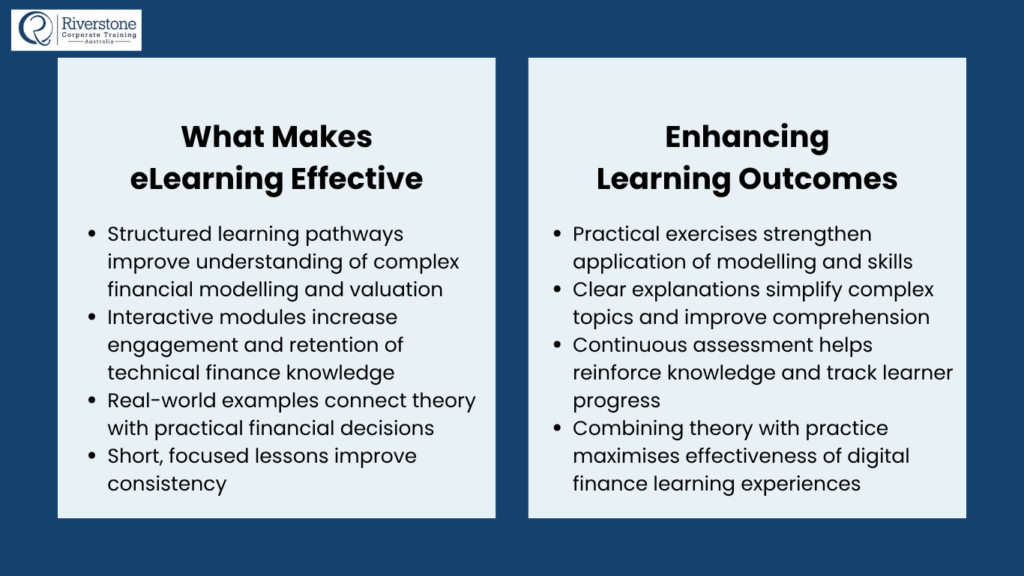
Effective finance eLearning combines technical knowledge with practical application through case studies, financial models, interactive exercises, and real-world business scenarios. This approach helps learners develop skills they can immediately apply in the workplace rather than simply memorising theoretical concepts.
A high-quality finance eLearning programme should include structured learning pathways, interactive content, assessments, practical exercises, progress tracking, and opportunities to apply concepts through realistic scenarios. Features such as adaptive learning and scenario-based activities can further enhance learner engagement and knowledge retention.
Finance eLearning offers greater flexibility, allowing learners to study at their own pace and access content from any location. It also enables organisations to deliver consistent training across teams while providing learners with ongoing access to resources, assessments, and practical exercises that support continuous development.
Finance eLearning programmes are suitable for finance professionals, accountants, analysts, managers, business owners, and non-finance professionals seeking to improve their financial knowledge. Programmes can be tailored to different experience levels, from foundational finance concepts to advanced financial modelling and valuation techniques.
Organisations can assess effectiveness through learner engagement metrics, assessment results, knowledge retention, workplace performance improvements, and the practical application of newly acquired skills. Regular feedback and impact evaluation can help ensure that training programmes continue to meet business objectives and learner needs.