


Table of Contents
01
Introduction to Australian Investors Acquisition Target Criteria
04
The Due Diligence Process and What It Reveals
02
How Australian Investors Actually Think About Target Selection
05
Real Cases and Lessons from the Field
03
Five Characteristics That Consistently Attract Investor Interest
06
Conclusion
Introduction to Australian Investors Acquisition Target Criteria
What Australian Investors Really Look for in an Acquisition Target
The acquisition target criteria in Australia do not match the criteria that sellers presume that investors are using. The most common misconception of most business owners who have not gone through an acquisition target process is that investors are mainly seeking the best business -the most profitable, the fastest growing, the most reputable in their line of business. The old timers understand that the most investable business and the best business are not necessarily the same. It is a particular set of characteristics of the business, a combination of the quality of the earnings, the credibility of the growth, the risk profile, and structural readiness that places the business in a position to create value to a new owner, not just a business that has been performing well for its current owner.
The two forces specific to this scenario influence the investment decision criteria in the Australian private market. First, the market is quite small and relationship-based: repeat investors are familiar with the sector participants and the advisory ecosystem, and often know specific businesses before entering into any formal agreement with them. Second, capital available for mid-market acquisitions has increased substantially over the past decade, creating a competitive environment in which the most attractive targets receive multiple approaches and can be picky about which investors they engage. The investor mindset M&A target screening is thus as significant to the sellers and the advisors they employ as it is to the investors themselves.
The article is addressed to business owners planning the sale of their business, corporate finance professionals advising on acquisitions, and those who have entered the M&A target screening advisory business who want to know how to evaluate business opportunities based on what the investor is considering. The structures here indicate how more seasoned investors in the Australian mid-market evaluate and rank acquisition target criteria under a competitive deal environment.
How Australian Investors Actually Think About Target Selection
The investor mindset M&A target screening: what the screener is actually looking for
The investor mindset in M&A target screening in the Australian context begins with a question most sellers are not eager to answer. Rather than asking whether this is a good business, the question is: can I create value here that is not already reflected in the price? A bettor who pays a full multiple on a fully optimised business with no identifiable improvement opportunity is not making a bet about their own ability, but about the market conditions. The Australian sophisticated investors are specifically in search of situations in which their specific capabilities, their playbook of operation, their relationship with their sector, their access to capital, or their bench strength in management can create value that the current owner can no longer create, and whose price they pay reflects the business with which they are dealing, not the business that could be.
• A deal selection strategy for experienced investors is as much about what they can bring to the business as about what the business already has; a target requiring precisely the ability the investor has developed in previous dealings is more attractive than a better business that does not.
• The failure of most investment target analysis to answer the equally crucial question of how specific to the capabilities of this investor is the value creation opportunity that he or she is seeking? is answered by the second question: whether the investor will pay a premium or a market multiple.
How business acquisition target evaluation factors are prioritised
Business acquisition target evaluation factors are not weighted equally among investors or among deal types. Financial purchasers, such as private equity firms and family offices, value the quality of earnings, cash flow, depth of the management team, and the attractiveness of the growth pathway. Strategic buyers place equal weight on the same factors but add special criteria: whether the target will fill a specific capability gap, add a customer or geographic base not available organically, or remove a competitive threat. Knowledge of which type of investor is most likely to buy a particular business – and thus which due diligence key factors are most likely to be scrutinised under such circumstances – is one of the most important strategic decisions that a seller and their advisor make before the onset of any process.
• Financial buyers: Financing buyers use a returns framework; they must believe they can sell the business at a multiple higher than the entry multiple in 3 to 5 years. A credible growth or operational improvement thesis must exist at the time of acquisition.
• Such strategic buyers use a strategic fit framework: does owning this business make your own organisation materially stronger, and are they often willing to pay a premium over what a financial buyer would pay because the strategic logic justifies absorbing a return that is not compelling on a standalone basis?
Five Characteristics That Consistently Attract Investor Interest
The attractive business features within the Australian mid-market acquisition target environment coalesce around five indicators that experienced investors consider the most predictive of successful post-acquisition target performance. They are all risks or opportunities that the acquisition target price should reflect.
| Characteristic | Why Investors Value It | Acquisition Target Criteria Australia Implication | How Sellers Can Evidence It |
| 1. Recurring, contracted revenue with high retention | What investors look for in deals: revenue that renews automatically, is contracted, and has demonstrated multi-year retention reduces the buyer’s uncertainty about the post-acquisition target earnings base and supports a lower risk premium in the valuation | Due diligence key factors: investors will request customer-level retention data, contract schedules, and churn analysis; the quality of this data — and whether it supports the claimed retention rate — directly affects the multiple offers | Compile three years of customer-level revenue data showing retention, tenure, and spend trajectory; have all material customer agreements current and assignable; calculate revenue-weighted retention, not account-count retention |
| 2. The MA management team that operates independently of the founder | A business that can operate, grow, and manage client relationships without the founder’s active involvement significantly reduces the buyer’s risk and integration complexity; it also enables a cleaner separation at completion | Investor mindset M&A target screening: key-person risk is the most frequently cited reason for applying a discount to an otherwise attractive business; investors who need the founder to stay for three years to preserve the business’s value have not acquired an asset — they have acquired a person | Invest in management depth 12 to 18 months before a process; ensure the team holds key client relationships, not the founder; build a documented management reporting structure that demonstrates the team’s operational capability |
| 3. A credible, evidence-based growth pathway | Investors need to believe that the business will be more valuable when they exit than when they enter; a growth pathway that is supported by specific evidence — a documented pipeline, a product under development, a geographic expansion underway — is more credible than a projection without supporting activity | Business acquisition target evaluation factors that assess growth credibility: investors will probe every growth assumption against observable evidence; a growth story that exists only in a management presentation will not survive diligence | Present growth initiatives that are already underway rather than aspirational; show pipeline data, contract conversations in progress, or organic expansion activity that demonstrates momentum rather than potential |
| 4. Clean, well-documented financials with no hidden liabilities | Investors who encounter surprises in due diligence — undisclosed contingent liabilities, related-party transactions at non-market rates, aggressive revenue recognition, or incomplete tax compliance — will either adjust the price or walk away | Due diligence key factors: the quality of financial documentation is the single most controllable factor in the due diligence experience; surprises discovered during diligence are almost always more expensive than the cost of addressing them beforehand | Prepare a vendor due diligence package before the process begins; identify and disclose all contingent liabilities proactively; ensure all related-party transactions are documented at arm’s-length terms; engage tax advisors to confirm compliance before diligence commences |
| 5. A defensible competitive position with identifiable moats | Investors are not just buying current earnings; they are buying the durability of those earnings against competitive pressure. A business with genuine switching costs, brand loyalty, regulatory barriers, or proprietary technology commands a premium because the earnings are structurally more defensible | Investment target analysis: investors will assess the competitive position specifically, not just accept the seller’s description; they will test whether the moat is genuine by speaking to customers, analysing customer retention data, and assessing competitor activity | Document the specific mechanisms that create switching costs or competitive advantage; gather evidence from customer conversations, retention data, and market positioning; connect the moat characteristics to specific financial outcomes (higher gross margin, lower churn, pricing premium) |
Characteristic 2 — management team independence of the founder is the characteristic that appears by far most consistently in the comparison of businesses that achieve premium multiples and those that achieve market multiples. What the investor seeks in deals is a business they can own and develop, rather than a founder they have to rely on. The premium to the true management depth is not only the lower risk associated with the acquisition target but also the broader range of buyers capable of considering it: a business that requires the founder to remain with the company over three years is open to all buyer categories, and the competition to find the most attractive targets is what drives the price above the market multiple.
The Due Diligence Process and Real Cases
How do key due diligence factors shape the final price
The factors of due diligence are evaluated in a specific order, which is how experienced investors manage the risk of investing capital. The four-stage workflow outlined below is a typical approach to diligence for an Australian mid-market acquisition target.
| Phase 1 | Phase 2 | Phase 3 | Phase 4 |
| Commercial Assessment | Financial Quality | Legal and Structural | Valuation and Structuring |
| Validate the revenue base: customer interviews, retention analysis, contract review, competitive landscape mapping; assess whether the claimed growth pathway is evidenced; evaluate management team depth and founder dependency | Independent reconstruction of normalised EBITDA; quality of earnings analysis; working capital assessment; identification of any related transactions, contingent liabilities, or undisclosed items; cash conversion analysis | Contract assignability; IP ownership in entity name; lease terms; employment ce; tax compliance; any pending or historical litigation; change-of-control provisions in key agreements | Final price determination based on diligence findings; adjustment for any items identified that were not visible in the information memorandum; deal structure decision (asset vs share, earnout mechanics, working capital target) |
Real cases: what separates the businesses that attract premium judgment from those that don’t? Loweriness was brought with a multiple at the top of the sector range based on good financial performance. Due diligence revealed two problems not disclosed in the information memorandum: the holder had a significant proportion of client relationships personally, with limited documentation of the relationship history in the CRM system, and 0 per cent of revenue was associated with a single client whose contract was expiring eight months after the anticipated completion date. Both problems were solvable; one of them was irreparable to the transaction. However, the key-person risk, coupled with the percentage risk, led to the reinitiation of offers from two of the three possible buyers at a lower rate than the implied range in the information memorandum. The third buyer, a strategic acquirer with an established relationship with the concentrated client, bid within the original range because he or she had judged that the concentration risk was lower in his or her case. The moral: good business traits are by no means universal; as with the case of the buyer who attaches the greatest value to a particular business, the most obvious is not always the most evident.
A second example would be a distribution company that had gone into the process of preparing a sale by specifically targeting the two characteristics most frequently discounted in its industry: management depth and revenue quality. Thender systematically transferred all key client relationships to the value-creation team, implemented a CRM system with complete relationship history, which was well aligned with the target’s actual performance, and transitioned transactional channels to annual supply contracts in the 14 months before going to market. The diligence teams of buyers followed up before any process started, but only under the condition that the management team was indeed independent. The CRM data supported the retention claims. The supply agreements were updated and assignable. Three purchasers submitted a multiple above the sector average, ranging from 5% above the sector average. The preparation had not thereby influenced decisions on business earnings, but it had affected the criteria for investment decisions that influenced how earnings were valued.
Conclusion
The quality of earnings, independence of management, credibility of growth, financial transparency, and defensibility against competitors are the right combination of factors that investors look for. Deal-selection strategy based on criteria: Australia has been selected by the investor whose value-creation playbook is likely to affect the target selection criteria and the target’s actual performance.
• Can only be identified and addressed proactively before any process starts; a structured pre-sale due diligence exercise that identifies and addresses issues proactively is categorically less expensive than having such issues discovered by a motivated buyer under time pressure.
• Investor attitude M&A rewards management autonomy above nearly all other single attributes; multiple expansion that a business can receive when it proves to have genuine team capability, irrespective of the founder, is the highest-paying pre-sale investment available to most owner-operators.
• For advisors: The most critical analysis to be done before any marketing process starts is to understand the investor’s deal-selection strategy from his or her specific perspective; the most apparent of them is often the least important one.
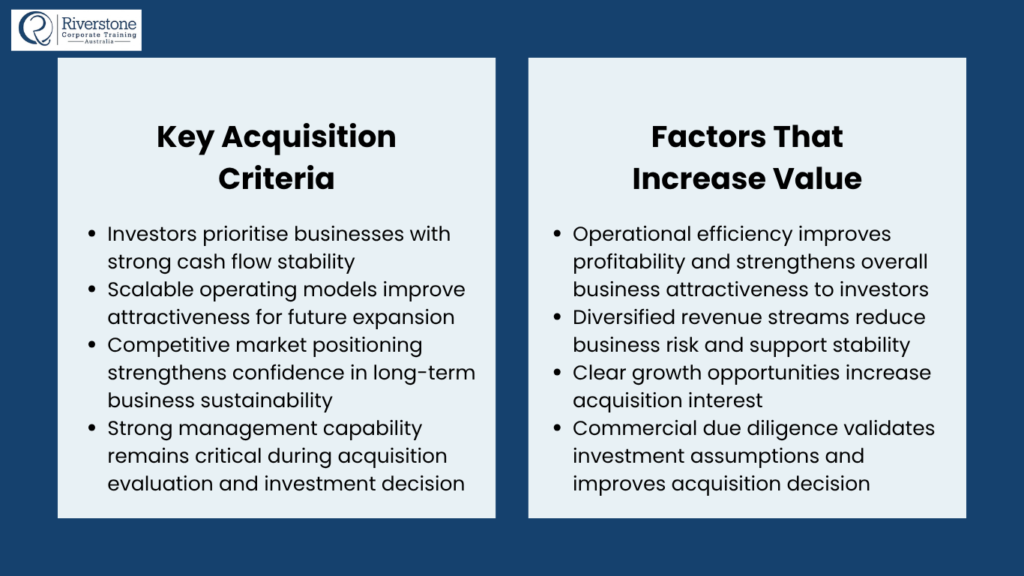
Australian investors typically look for businesses with strong growth potential, sustainable competitive advantages, stable cash flows, experienced management teams, and opportunities for value creation. Factors such as market position, scalability, and alignment with long-term investment objectives are also important when evaluating acquisition opportunities.
Industries such as technology, financial services, healthcare, infrastructure, energy, digital infrastructure, and businesses linked to the energy transition continue to attract strong investor interest. Companies with recurring revenue models and strong growth prospects are often viewed as attractive acquisition targets.
Business valuation helps investors determine whether a target company is fairly priced and whether the acquisition has the potential to generate acceptable returns. Valuation methods such as Discounted Cash Flow (DCF) analysis, comparable company analysis, and transaction multiples are commonly used to support acquisition decisions and negotiations.
Investors typically review revenue growth, profitability, cash flow generation, debt levels, working capital requirements, and future growth projections. They also conduct financial due diligence to identify potential risks, assess earnings quality, and validate the assumptions supporting the investment opportunity.
Businesses can enhance their attractiveness by demonstrating consistent financial performance, strong governance, scalable operations, diversified revenue streams, and a clear growth strategy. Maintaining accurate financial records, reducing operational risks, and establishing a sustainable competitive advantage can also improve acquisition appeal and valuation outcomes.