


Table of Contents
01
Introduction to Project Finance Model
04
A Practical Framework for Building the Skill
02
Why Project Finance Models Are Structurally Different
05
Real Cases and Lessons from the Field
03
Five Critical Elements Most Professionals Get Wrong
06
Conclusion
Introduction to Project Finance Model
Understanding Project Finance Model
The capability gap in project finance modelling skills is one of the most commercially important in the Australian infrastructure and energy finance market. The need for project finance modellers has increased significantly as the pipeline of renewable energy investments grows, with the involvement of multiple classes of lenders, government support mechanisms, and hybrid revenue arrangements. The reason professionals can have a problem with modelling in project finance specifically is not necessarily a lack of modelling experience in general, but rather a lack of experience in which modelling is not applicable. The structural gap is that project finance models are based on a fundamentally different logic than corporate finance models that most analysts were trained on.
To build the models of project finance, it is necessary to understand the specifics of the non-recourse debt, the debt service coverage ratio that governs the financial constraint, the interrelation between the revenue structure and debt sizing, and the iterative nature of the model structure that makes circular references a feature rather than a bug. These are not challenging but rather specific concepts that are seldom taught in most financial modelling training programmes, which are more often based on a corporate or M&A setting.
This article is intended for finance analysts, infrastructure professionals, and others entering the project finance space who want to know which common project finance errors to avoid and how to close the gap in their practical project finance training. It not only presents the five most important aspects that most analysts overlook, but also provides a systematic approach to developing true, real-world project finance skills.
Why Project Finance Models Are Structurally Different
The non-recourse logic that changes everything in building project finance models
To construct project finance models with a corporate finance background, it is necessary to shift the analytical orientation. In corporate finance, the lending decision is mainly based on the borrower’s creditworthiness, which is determined by the balance sheet, earnings history, and credit rating. In project finance, the project is the borrower: the debt is secured against the project’s assets and cash flows, rather than against the balance sheet of the project sponsor. This non-recourse structure implies that the model itself is not presented to show the project’s enterprise value or returns on equity alone.
• Financing modelling skills differences between corporate finance practitioners and project finance practitioners are most evident in the handling of debt: corporate models treat debt as a balance sheet entry and have a maturity date; project models treat debt as a cash flow constraint that must be sized against the free cash flow generating capacity of the project.
• The way to enhance the modelling capabilities of project finance would be to ensure that the debt service coverage ratio (DSCR) is maintained at above a certain minimum throughout the life of the loan, and that all other elements of the model, including the amount of debt and the repayment schedule, should be designed with that constraint in mind.
Why the revenue structure matters more than the headline revenue figure
Revenue is often modelled in corporate finance as a growth rate relative to a historical base. In project finance, revenue should be modelled at the component level: what proportion is contracted (under what terms), what proportion is merchant or semi-merchant, how the contracted revenues step up or down over time, and how the revenue structure interacts with the debt service obligations in each period. The modelling of infrastructure finance involves constructing this revenue disaggregation before analysing debt sizing and equity returns.
• A model that makes a single blended revenue assumption for a project with a 70 per cent contracted revenue base, and 30 per cent merchant exposure is not a project finance model; it is a corporate model applied to a project situation, and it will give false results under stress.
Five Critical Elements Most Professionals Get Wrong
Typical project finance errors in model construction have been grouped into five elements that are systematically missing from project finance training. Each of them is a certain modelling skill that should be actively trained.
| Critical Element | What Most Professionals Miss | Finance Modelling Skill Gaps: Consequences | How to Build It Correctly |
| 1. Debt sculpting vs. equal instalment repayment | Most corporate finance models use equal instalment or bullet repayment; project finance debt is typically sculpted: the repayment in each period is set at the level that produces the target DSCR, given the free cash flow available in that period | Common project finance mistakes with equal instalment assumptions: the model either understates the debt capacity (if cash flows are front-loaded) or overstates it (if cash flows are back-loaded); the DSCR constraint is not properly modelled | Build a sculpted repayment schedule: in each period, calculate the cash flow available for debt service after all operating costs, taxes, and required reserves; size the debt repayment to produce the target minimum DSCR; the total debt quantum is then the sum of the discounted repayments |
| 2. Reserve accounts and their cash flow impact | Project finance structures typically include a debt service reserve account (DSRA), a maintenance reserve, and sometimes an operation and maintenance reserve; each represents a cash outflow during the construction or early operation period and a source of liquidity under stress | Project finance training needs that do not include reserve account modelling produce analysts who cannot correctly model the liquidity position of the project or assess the adequacy of the reserve sizing under stress scenarios | Build each reserve account as a separate schedule; model the funding mechanics (typically six months of forward debt service for the DSRA), the drawdown conditions, and the replenishment obligation; ensure the reserve account balances are correctly reflected in the free cash flow to equity calculation |
| 3. Construction-period interest during drawdown | In corporate finance, interest during construction is typically capitalised to a fixed cost; in project finance, interest during construction (IDC) is drawn down progressively as the construction cost schedule draws, using the same credit facility; the IDC itself compounds during the construction period and must be modelled accurately | Why professionals struggle with modelling construction-period interest: they capitalise a fixed IDC estimate rather than modelling the progressive drawdown schedule; the error can be material in long-construction projects with large facilities | Build a construction drawdown schedule that reflects the actual construction payment timing; calculate IDC on the progressive outstanding balance using the facility interest rate; compound IDC over the construction period to establish the opening operational-period debt balance |
| 4. Circular references in the tax shield calculation | Project finance models frequently require circular references: the interest expense affects the taxable income, which affects the tax payment, which affects the cash available for debt service, which affects the debt balance, which affects the interest expense; this circularity cannot be resolved by the standard Excel approach of breaking the link | Real-world project finance skills: project finance modellers use Excel’s iterative calculation setting to resolve the circularity, or build a macro-resolved structure; analysts trained on corporate models that avoid circular references do not know how to handle this in a project context | Enable iterative calculations in Excel for project finance models; build a clear logic for the iteration sequence; test that the model converges to a stable solution by checking that the circular reference resolves to the same output across multiple recalculations |
| 5. Gearing optimisation under the DSCR constraint | The target leverage ratio does not determine the optimal debt-to-equity ratio in a project finance context; it is determined by the maximum debt that can be serviced while maintaining the minimum DSCR in each period across all stress scenarios | Practical project finance training that uses a fixed leverage assumption misses the fundamental analytical insight of project finance: the debt level is an output of the model (determined by the cash flow and the DSCR constraint), not an input | Build the model so that the debt quantum is derived from the sculpted repayment schedule rather than from a fixed leverage ratio; test the gearing optimisation across the base, downside, and upside scenarios to establish the maximum debt consistent with maintaining the DSCR minimum across all scenarios |
The most fundamental structural dissimilarity between the corporate and project finance models, and the one that most completely alters the analytical logic of the model, is critical element 1: debt sculpting vs. equal instalment repayment. A project finance model has not been built by an analyst who constructs a model with equivalent instalment repayments; the analyst has built a corporate model with project cash flows. The skills gap in project finance modelling resulting from this single error is that it produces models that cannot be used to secure debt, determine compliance with the DSCR covenant, or assess the effect of revenue stress on debt service capacity. The precondition for all other constituents of real project finance modelling capability lies in building the sculpted repayment schedule.
A Practical Framework for Building the Skill
A development pathway for real-world project finance skills
Modelling learning infrastructure finance would require a systematic development pathway that guides the analyst from understanding the concepts to developing models from scratch using actual project data. The four-step process below shows how analysts who develop real-world project finance modelling capability do so deliberately.
| Phase 1 | Phase 2 | Phase 3 | Phase 4 |
| Structural Understanding | Component Construction | Integrated Model | Stress Testing and Presentation |
| Study the non-recourse debt logic, the DSCR constraint, and the sculpted repayment mechanics conceptually before touching a spreadsheet; read the financial model sections of two or three publicly available project finance information memoranda to understand how practitioners structure the analysis | Build each of the five critical elements as standalone models: a sculpted repayment schedule, a DSRA reserve account, a construction drawdown and IDC schedule, a circular reference tax shield, and a gearing optimisation tool; test each until you understand exactly how the mechanics work | Combine the five components into a single integrated project finance model using publicly available data from a disclosed infrastructure or energy project; build from the revenue structure through to the equity return waterfall without using any template or pre-built structure | Run the model under base, downside, and upside scenarios; prepare a one-page DSCR profile and equity return sensitivity table; present the model to a practitioner and invite challenge on every structural assumption and mechanic |
Real cases: the gap in live transaction settings
A project finance model presentation provided by the project sponsor on the financing of a solar farm was sent to an infrastructure debt fund analyst. The analyst has a strong background in corporate finance modelling but lacks experience in project finance modelling. She spent four hours reviewing the model before she discovered that the repayment schedule was based on equal quarterly instalments instead of sculpted repayments, the DSRA was funded as a single upfront deposit instead of being modelled as a progressive drawdown, and the construction-period interest was capitalised as a fixed cost estimate instead of being modelled as a progressive drawdown. The individual errors were bearable, but the combination of these errors resulted in a debt size approximately 12 per cent higher than what would have been supportable under the target DSCR constraint with a properly structured model. The project finance modelling skills gap was not evident in her CV; it was evident in the transaction setting.
Before joining a project finance team, the second analyst had spent three months developing project finance models using publicly available infrastructure transaction data. She discovered all three structural problems in 45 minutes and made a fixed model in two hours when the same model review was assigned to her six months into her job. It was not a question of intelligence or of general modelling ability – both analysts were technically competent. The distinction was pragmatic project finance education that had cultivated the particular structural knowledge that the task demanded. In this area, the development of modelling skills is the focus of special practice rather than an overall modelling experience.
Conclusion
The skills gap in project finance modelling is a real, specific and addressable skills gap in the Australian market. The difference lies not in overall analytical ability or Excel skills, but rather in the five structural elements specific to project finance and not taught in corporate finance training: debt sculpting, reserve account modelling, construction-period interest, circular reference resolution, and gearing optimisation subject to the DSCR constraint. Developing project finance models that are truly fit for practice requires conscious practice across all five components, rather than just conceptual knowledge of the project finance structure.
Hypothetically, for someone moving into the project finance space, the analyst who can create a correctly structured project finance model starting with a blank slate in a professional environment is in a very different market position than one who cannot. The investment in developing this particular capability is directly career-advancing.
The most common e project finance error is almost always structural: the model applied to the question that is actually being asked by the lender during due diligence.
The modelling of learning infrastructure finance is best achieved by constructing integrated models based on publicly available transaction data, rather than by studying tutorials or filling in templates.
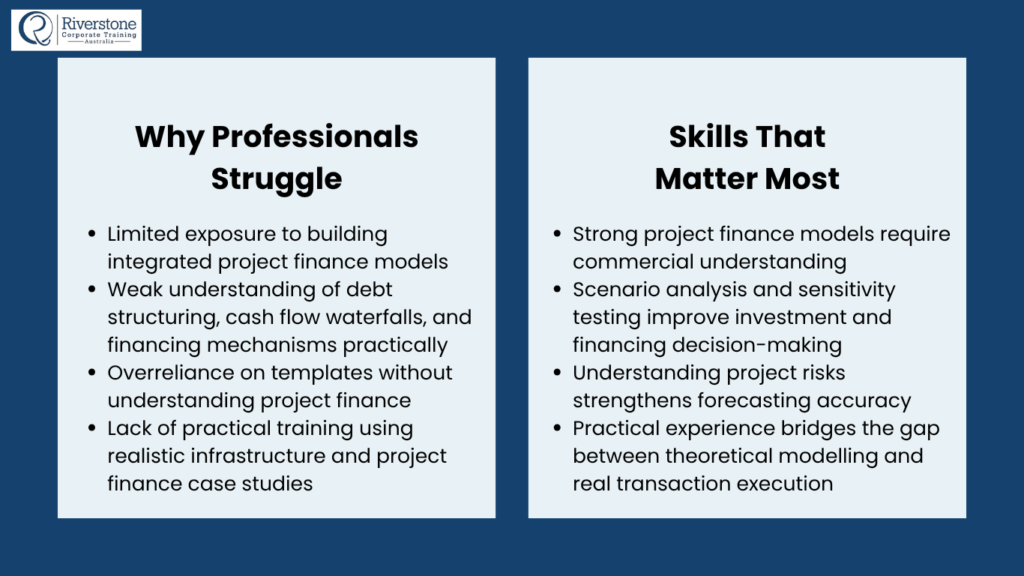
A project finance model is a financial tool used to evaluate the feasibility, profitability, and financing structure of a specific project. It forecasts future cash flows, funding requirements, operating performance, debt repayment capacity, and investor returns, helping stakeholders determine whether a project is financially viable.
A project finance model typically includes assumptions, capital expenditure forecasts, revenue projections, operating costs, debt and equity financing structures, cash flow statements, and key performance metrics. These components work together to assess project risks, returns, and long-term sustainability.
Common project finance metrics include Net Present Value (NPV), Internal Rate of Return (IRR), Debt Service Coverage Ratio (DSCR), Loan Life Coverage Ratio (LLCR), and equity returns. These measures help lenders and investors evaluate a project's ability to generate sufficient cash flow and deliver acceptable investment returns.
Sensitivity analysis helps assess how changes in key assumptions such as revenue, costs, interest rates, demand forecasts, or construction timelines affect project outcomes. By testing different scenarios, decision-makers can better understand potential risks and the resilience of a project's financial structure.
Project finance modelling is valuable for finance professionals, investment bankers, infrastructure specialists, project developers, lenders, consultants, and corporate finance teams. Developing these skills can improve an individual's ability to evaluate investment opportunities, structure financing solutions, and support major project decisions across industries such as infrastructure, energy, transportation, and real estate.