


Table of Contents
01
Introduction to Infrastructure Deals in Australia
04
How to Build Infrastructure Development Finance Expertise
02
What Makes Infrastructure Transactions Structurally Different
05
Real Cases and Lessons from the Field
03
Five Advanced Skills That Infrastructure Deals in Australia Specifically Require
06
Conclusion
Introduction to Infrastructure Deals in Australia
There is a real shortage of infrastructure development finance skills in Australia, given the size and speed of the infrastructure investment pipeline. Things are getting bigger in Australia: from major renewable energy projects under the CSP to water treatment plants under PPP, port and airport assets are being privatised, and so are the roads, etc., and the amount of capital being invested in infrastructure projects requires finance professionals to possess the depth and breadth of skills that conventional corporate finance training lacks. As in all other project finance sectors, the complex project finance deals in this sector feature multi-party contractual arrangements, long-dated cash flows projections, multi-tranche debt facilities, government support mechanisms, and risk allocation frameworks, none of which most analysts have encountered in the corporate finance setting in which they have been trained.
The need for more than simple financial literacy in infrastructure transactions becomes apparent within days of involvement in a live transaction. The financial model should reflect the unique revenue characteristics of a contracted infrastructure asset; the debt service coverage ratio (DSCR) rather than a leverage ratio should be the benchmark to size the debt; include reserve accounts and understand how they affect cash flows; and model the interplay between construction risk, ramp-up uncertainty and operating performance over a 20-30 year asset life. An analyst with corporate finance modelling capabilities and general financial knowledge will not be able to perform any of these analytical tasks without significant capability building.
It is written for finance professionals looking to build skills for a career in infrastructure development finance, as well as for those already in infrastructure development finance who wish to understand which capabilities are missing from their skill set and what they need to acquire to excel. It defines the five advanced skills particularly needed for infrastructure investment analysis and outlines a structured approach to developing them.
What Makes Infrastructure Transactions Structurally Different
The structural features that demand advanced finance skills for infrastructure
Three structural characteristics of infrastructure transactions lack direct counterparts in corporate finance and require advanced finance skills. First of all, cash flows from infrastructure assets are complex and have multiple contractual structures (availability payments, usage-based revenues, capacity charges, and hybrid models), each of which needs to be modelled individually in terms of growth rates. Second, infrastructure debt is sized to the project’s cash flows, not the sponsor’s balance sheet, so the amount of debt is an output of the model and is based on the DSCR constraint across a variety of stress scenarios. Thirdly, for infrastructure projects, there are risks unique to the construction phase of the project that are not unique to the operation phase of the project (cost overrun, delays, and default), which must be modelled separately from the operating phase, and specific financial protections (completion guarantees, cost overrun facilities, performance bonds) that affect the model’s structure.
• The financing structure considerations in the development phase are significantly underestimated due to infrastructure investment analysis that assumes that construction risk is the same as operating risk, and the reliability of debt service in the early years of operation is overestimated.
• Understanding the financial model is not enough for the financial analysis of an infrastructure project; the contractual framework supporting this financial model, including the off-take, construction, operations and maintenance contracts, and the government support mechanism, all give rise to a particular set of cash flows obligations and protections, which must be captured in the financial model.
Why the regulatory and policy environment matters in project finance expertise in Australia
Literacy in the regulatory and policy context that impacts the infrastructure transaction environment is a key skill required in project finance across Australia and is less applicable to corporate finance. The rules of the National Electricity Market define how generation assets are connected to the electricity grid and how they are paid; the environmental approval process defines the timeline and conditions under which projects are developed; the government procurement process in a PPP transaction defines the allocation of risks between the public and private sector; and the long-term concession agreements define the revenue certainty that the lender needs to finance the project. Without understanding these regulatory aspects, an analyst has no way to evaluate a project’s risk or offer meaningful input into the due diligence process.
Five Advanced Skills That Infrastructure Deals Specifically Require
Five key skills are not typically learned in corporate finance training and cannot be gained from financial analysis experience, yet are essential for large-scale project finance. They are each a specific modelling, analytical, or trading capability required for infrastructure transactions.
| Advanced Skill | Why Infrastructure Specifically Requires It | Infrastructure Deal Structuring Skills Application | How to Build It |
| 1. Sculpted debt repayment modelling | Corporate finance models use equal instalment or bullet repayment; infrastructure debt is sculpted: the repayment in each period is set at the level that produces the target DSCR given the free cash flows available in that period across a specific stress scenario | Complex project finance deals: the debt quantum in an infrastructure transaction is determined by the sculpted repayment schedule, not by a target leverage ratio; an analyst who cannot model the sculpted repayment cannot size the debt, assess DSCR covenant compliance, or evaluate the impact of revenue stress on debt service capacity | Build a sculpted repayment schedule from scratch for a real infrastructure transaction using publicly available data; vary the DSCR floor and observe the impact on debt quantum; practise explaining the mechanics verbally without referring to the model |
| 2. Revenue structure disaggregation | Infrastructure revenues are typically not a single growth rate applied to a historical base; they are composed of contracted payments (availability, capacity, take-or-pay), demand-sensitive revenues, and government support mechanisms, each with different risk profiles and cash flows timing characteristics | Infrastructure development finance skills Australia: Modelling a blended revenue assumption for a project with 70 per cent availability payment revenue and 30 per cent demand-sensitive revenue produces materially incorrect DSCR profiles under stress scenarios because the two revenue streams respond differently to the same economic conditions | Model the revenue structure of a real infrastructure project at the component level: availability payment schedule, demand forecast and sensitivity, escalation provisions, and any government backstop mechanisms; demonstrate how the disaggregated model produces different stress scenario results from a blended assumption |
| 3. Construction period financial modelling | Infrastructure projects involve a construction phase with progressive drawdown of equity and debt, capitalisation of interest during construction, contractor performance monitoring, and completion guarantee mechanisms that affect the opening balance of the operational phase model | Why basic finance knowledge is not enough: the construction period model is the foundation for the operational period model; errors in the construction drawdown schedule, the interest during construction calculation, or the completion guarantee mechanics propagate into every subsequent period of the analysis | Build the construction period model for a real infrastructure project: equity and debt drawdown schedule, interest during construction on the progressive outstanding balance, contingency mechanisms, and opening operational period debt balance; test the sensitivity of the opening balance to construction cost overruns |
| 4. Regulatory and contractual risk assessment | Infrastructure transactions are governed by long-dated contracts that allocate specific risks between the public sector, the private sector, the constructor, and the operator; understanding how these contracts allocate risk assessment, and how that allocation affects the model’s sensitivity to specific scenarios, requires specific legal and commercial literacy | Project finance expertise Australia: the analyst who cannot read a concession agreement, an off-take contract, or an operations and maintenance agreement cannot identify the specific risk assessment that the model must reflect or the specific contractual protections that mitigate those risks | Read the publicly available concession agreement or off-take contract for two or three disclosed infrastructure transactions; identify the specific risk assessment allocations; map them to model inputs and sensitivity scenarios; discuss the risk assessment allocation logic with a practitioner who has worked on the transaction type |
| 5. Multi-tranche debt structuring analysis | Infrastructure transactions typically involve multiple debt tranches with different risk assessment profiles, interest rates, security rankings, and repayment priorities; understanding how the multi-tranche structure affects the returns for each lender class and for the equity investor requires specific modelling capability | Infrastructure investment analysis that uses a single blended debt cost cannot assess the impact of replacing one tranche with another, the effect of a subordinated debt facility on equity returns, or the intercreditor dynamics that arise when the project is under financial stress | Model a two-tranche infrastructure debt structure with senior and mezzanine debt; calculate the returns for each lender class and for the equity investor; test the impact of varying the senior-mezzanine split on the equity IRR and the senior DSCR. |
The most common materially misleading infrastructure models are gained when this advanced skill is missing: revenue structure disaggregation. If a project has a blended revenue assumption due to differences between contracted revenues and demand-sensitive revenues, a stress scenario profile will have a less negative impact on debt service capacity than a pure stress scenario profile generated by a pure bottom-up approach. The skills to structure infrastructure deals without this disaggregation ability are not sufficient for any deal where the revenues are not uniformly contracted, which is most Australian infrastructure deals in this market.
How to Build Infrastructure Development Finance Expertise
A structured pathway for infrastructure development finance career skills
Infrastructure development finance career skills are developed through a structural understanding, the creation of models from real transaction data, and access to real transactions, where the commercial and contractual aspects, as well as financial analysis, are present. The four-step journey below illustrates how finance professionals with a true infrastructure mindset are building infrastructure.
| Phase 1 | Phase 2 | Phase 3 | Phase 4 |
| Structural Foundation | Component Model Building | Integrated Analysis | Regulatory and Contractual Literacy |
| Study the non-recourse debt logic, the DSCR constraint, the construction period financial mechanics, and the revenue structure disaggregation approach conceptually; read the financial model sections of two or three publicly available infrastructure information memoranda to understand how practitioners structure the analysis | Build each of the five critical components as standalone models using publicly available transaction data: sculpted repayment, revenue disaggregation, construction period drawdown, multi-tranche debt structure; test each until the mechanics are fully understood | Combine the components into an integrated project finance model for a real infrastructure transaction; build the stress scenarios and DSCR profile; prepare a one-page summary of the debt sizing rationale and the key risks that the model captures | Read the publicly available contracts and regulatory framework for two infrastructure transactions in your target sector; identify the specific risk assessment allocations; connect them to the model structure; discuss the contractual logic with a practitioner in the sector |
Real cases: when basic finance knowledge meets infrastructure complexity
A corporate finance analyst with 4 years of experience, in particular M&A, was seconded for a 6-month, renewable engagement with a new infrastructure advisory team, working on project financing for a renewable energy project. During the first two weeks, she was asked to consider an initial project finance model submitted by the sponsor. Her M&A modelling abilities were good, but she had not seen a debt service reserve account, a repayment schedule sculpted, or a revenue disaggregation between availability payments and merchant generation revenue. It took her three weeks of learning mode to understand the model’s structure and the contractual framework before she could meaningfully contribute to the analysis. It was absolutely avoidable: she had five specific modelling skills understood before the engagement, the benefit of three months of targeted practice, and would have been a team member from the off. The need for more than just basic finance knowledge in infrastructure transactions is apparent in just such an engagement.
One of the analysts had been researching the five specific modelling elements for 3 months before joining the infrastructure debt fund, using public transaction data. He was able to review and critique the same model of sponsor in his first week, identify a revenue disaggregation issue in the preliminary DSCR profile, and prepare a revised stress-scenario analysis that corrected the blended revenue assumption in his first two weeks on the team. The financial analysis capability for infrastructure projects was also developed before coming to work, resulting in an entirely different onboarding trajectory than would have been the case if general corporate finance experience had been used to build that capability.
Conclusion
The skills required for infrastructure development finance are specialist, structural, and acquired specifically through experience in infrastructure development finance rather than through broad corporate finance experience. These five advanced skills listed in this article need to be deliberately developed and practised on actual infrastructure transaction data: sculpted debt-repayment modelling, revenue structure disaggregation, construction-period financial mechanics, regulatory and contractual risk assessment, and multi-tranche debt structuring. Basic finance knowledge is insufficient for infrastructure deals, as evidenced by each live deal win in which an analyst trained only in corporate finance is faced with the analytical requirements of non-recourse project finance.
Pre-role capability development investment is always a career-enhancing investment for anyone entering the infrastructure sector, and it can materially distinguish them from the analyst who enters with only general corporate finance skills.
Corporate finance modelling conventions are not enough to solve large-scale project finance challenges; the logic for sizing the debt, the revenue structure, and the risk assessment allocation structure differ, each of which demands specific modelling skills that have to be deliberately developed.
The five capabilities are the most important for infrastructure development finance career skills development; the difference between “good” and “excellent” is almost always in one or more of these five areas.
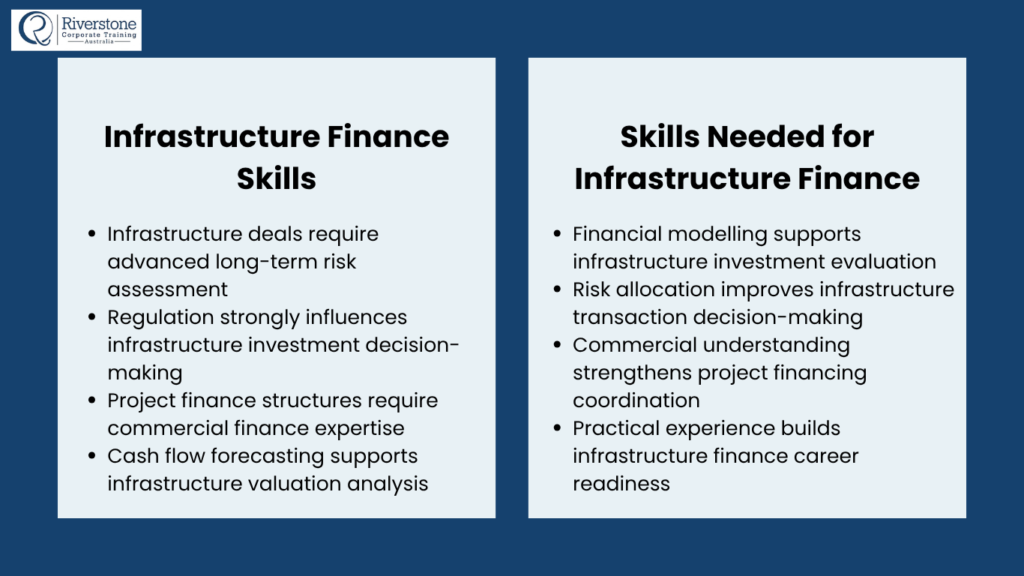
Australia is considered an attractive infrastructure investment destination due to its stable economy, transparent regulatory environment, growing population, and ongoing demand for transport, energy, utilities, and digital infrastructure projects. Long-term government investment plans and public-private partnership opportunities also continue to attract domestic and international investors.
Infrastructure transactions in Australia commonly involve transport networks, renewable energy projects, utilities, telecommunications infrastructure, airports, ports, and social infrastructure assets. Investors are increasingly focusing on sectors that offer stable cash flows and long-term growth opportunities, particularly those linked to energy transition and digital connectivity.
Investors assess infrastructure opportunities through detailed financial modelling, cash flow forecasting, risk analysis, due diligence, and valuation techniques. Factors such as project revenues, operating costs, financing structures, regulatory risks, and long-term demand projections play a significant role in investment decisions.
Project finance is commonly used in infrastructure deals because it allows projects to be funded based on their expected future cash flows rather than the balance sheet strength of the project sponsors. This approach helps allocate risks among stakeholders while providing a structured framework for funding large-scale infrastructure developments.
Professionals involved in infrastructure transactions benefit from skills in project finance, financial modelling, business valuation, investment analysis, risk assessment, and due diligence. A strong understanding of infrastructure funding structures and long-term asset evaluation can help support successful deal execution and investment decision-making.