


Table of Contents
01
Introduction Why Employers Prefer Candidates with Practical Finance Training
04
How Practical Training Changes the Hiring Conversation
02
What Employers Are Actually Looking For in Finance Hires
05
Real Cases and Lessons from the Field
03
Five Reasons Practical Training Produces Better Candidates
06
Conclusion
Introduction to Why Employers Prefer Candidates with Practical Finance Training
Why Employers Prefer Candidates with Practical Finance Training
Employers can see the benefits of practical finance training, whereas they can’t see the benefits of theoretical qualifications. Of two candidates who have an equal academic profile – the same degree, the same professional qualification, a similar GPA – the hiring manager will almost always look at the candidates’ practical, rather than theoretical, knowledge – that is, how well the candidates can do what the role entails. The notion that employers care more about real skills than theoretical knowledge is not that they prefer one method over the other, but that finance is a practical discipline in which value is created through its application, not through the possession of knowledge.
The difference between job-ready and not is that a job-ready finance candidate can help the team get up to speed in the first week on the job. In contrast, a candidate who needs extensive training before they can produce independent work is not job-ready. The difference is significant to small, lean finance departments — which is most of the finance recruiting in the Australian mid-market — as the expense of a lengthy onboarding process will be felt in both the time spent training the new hire and the lost productivity from time not spent working. Over the last five years, trends in finance hiring in Australia have been consistent: more emphasis on applied experience over theory, especially in jobs that require immediate contributions.
This article is for finance candidates, to help them understand what skills are required in finance roles, and what employers look for in candidates; for graduates deciding on which development programme to attend, who want to understand how practical training adds value to employment; and for those designing finance training programmes, to help them understand the employer’s point of view on what skills constitute a workforce readiness finance capability.
What Employers Are Actually Looking For in Finance Hires
The assessment gap in practical vs theoretical finance skills
In a hiring process, practical vs. theoretical finance skills are evaluated very differently, and it is imperative to understand the distinction and present oneself appropriately. Knowledge is described by a candidate who can explain the theory of financial modelling, and capability is shown if a candidate can construct a model within the room. A candidate who can talk about the principles of credit analysis shows knowledge; a candidate who can take a normal set of management accounts and tell you what the key credit risks are shows capability. The second type of person the finance employer is looking for is not someone without theory, but rather someone who can put it into practice himself, without supervision, in reality and under real conditions.
• Application changes the nature of the hiring conversation. When the training is about finance, it is out of the question to ask the candidate, Do you know about X?” Instead, it is “What have you done with X?” and the candidate with the practical experience can answer the second question in ways the candidate with the theoretical training cannot.
• Employers report that the vast majority of the finance skills they observe in their interviewees lack the following skills and knowledge required by industry in 2026: Applied modelling using real financial data; Normalisation of management accounts; Derivation of WACC using observable market data; and Linking financial analysis to a commercial recommendation.
What hands-on finance experience means for the hiring decision
The value of hands-on finance experience is most evident in the interview assessment. When an employer asks a candidate to explain a financial model they’ve developed, they’re trying to determine whether the candidate has real-world experience or is explaining a theoretical concept of what it means to build a financial model. The candidate who explains where they included/excluded which owner add-backs and why, and who discusses how sensitive the valuation is to that decision, is more applied than the candidate who explains the methodology without applying it to a specific set of management accounts.
Five Reasons Practical Training Produces Better Candidates
Employability-focused finance training that is truly applied yields candidates who are stronger in five key elements that employers directly test in their hiring process and that they see first-hand in the onboarding phase. These dimensions capture different and more valuable hiring outcomes provided by applied training.
| Reason | Why Employers Value It | Practical Finance Training Benefits for Candidates | How to Demonstrate It |
| 1. Immediate contribution without extended onboarding | Practically trained candidates can produce independent analytical output in the first week of a role; theoretically prepared candidates typically require two to four weeks of structured onboarding before they can work without significant supervision | Job-ready finance candidates reduce the cost of hiring: the supervisor’s time during onboarding is not available for their own work, and the new hire’s output during an extended onboarding period may require significant rework; the candidate who can contribute immediately is worth materially more to a lean finance team | Demonstrate immediate contribution capability in the interview: offer to complete a short practical exercise as part of the hiring process; be specific about the types of financial analysis you can complete without supervision and the types of data you can work with independently |
| 2. Ability to work with imperfect real-world data | Practically trained candidates have encountered and resolved the specific data quality issues that real financial statements present: inconsistent classifications, missing information, owner add-backs, and non-arm’s-length transactions; they know how to identify these and what to do about them | Why employers value real skills: the candidate who has only worked with pre-formatted teaching data will encounter their first real set of management accounts in a professional setting and not know how to begin; the practically trained candidate encounters this situation as familiar rather than novel | Describe specific examples of working with imperfect financial data: what was the specific issue, how did you identify it, what did you do about it, and what was the impact on the analysis? The specificity of the answer signals genuine applied experience |
| 3. Demonstrated judgment in ambiguous situations | Practical training develops the ability to form and defend a position on ambiguous analytical questions where the correct answer is not retrievable from a formula or a textbook; this judgment capability is what most hiring managers are testing when they ask open-ended “what would you do?” interview questions | Industry-relevant finance skills: the finance role that has no ambiguous situations is the one that does not require professional judgment; the candidate who can think through an unfamiliar analytical problem out loud and arrive at a defensible position is demonstrating exactly the capability that the role requires | Walk through your analytical reasoning out loud in the interview when presented with a novel question; do not wait to be certain before speaking; demonstrate the judgment process, not just the answer; the interviewer is often more interested in the quality of the reasoning than in the specific conclusion |
| 4. Faster integration into team workflows | Practically trained candidates are familiar with the types of deliverables, analytical frameworks, and communication formats that professional finance teams use; they adapt to a new team’s specific processes more quickly than candidates who are encountering these formats for the first time in the role | Hands-on finance experience is important in team integration: every week a new hire spends learning the format of a deliverable they have never produced is a week they are not contributing to the team’s output; practical experience compresses the time from hiring to full contribution | Describe the types of deliverables you have produced and the audiences you have produced them for; be specific about the analytical formats you are familiar with (investment memos, credit assessments, board presentations, valuation reports) and the level at which you produced them independently |
| 5. Credibility in client and stakeholder interactions | Candidates with demonstrated practical experience can engage with clients and stakeholders about specific analytical situations rather than just describing their general approach; this credibility is visible from the first client interaction and is one of the primary determinants of early-career professional reputation | Practical vs theoretical finance skills: the candidate who can say “when I was working on a similar situation, I found that…” is engaging as a practitioner; the one who can only say “the theory suggests that…” is engaging as a student; the employer hires practitioners for client-facing roles | Develop two to three specific analytical examples from your experience that you can use in client conversations: what was the situation, what analysis did you do, what was the conclusion, and what was the outcome? Practise telling these stories concisely and connecting them to the client’s situation |
Employers consistently report that they can’t judge a CV on reason 3 – demonstrated judgments in ambiguous situations, and this is, naturally, the only one that they can assess in an interview or during a probation period. The candidates who have completed their training and were required to establish and justify a position on less clear-cut analytical questions are clearly better prepared for this type of interview than those who completed all of their training and produced correct answers to clear-cut questions. In an interview, the question “If management accounts for an acquisition target revealed that 60 per cent of revenue came from a single customer whom you knew was mulling a move to another provider, what would you do?” doesn’t have a single correct answer. It would be virtually impossible to predict the quality of the answer received, given that the candidate has never faced such an analytical challenge.
How Practical Training Changes the Hiring Conversation
A framework for demonstrating finance training for employability
Any finance training for employability should result in specific, describable examples that can be used in the interview when the candidate demonstrates applied ability. The four phases described below reflect how candidates who turn their training into a career path approach their application and interview process.
| Phase 1 | Phase 2 | Phase 3 | Phase 4 |
| Build the Evidence | Translate to Interview Stories | Target the Right Roles | Demonstrate in the Room |
| Identify two to three specific pieces of practical work that demonstrate your most employable capabilities: a normalisation exercise on real management accounts, a valuation you completed from raw data, or a financial model you built without a template. Document what you did, how you did it, and what the output was | Convert each piece of practical work into a structured story: situation, analysis performed, specific judgments made, outcome achieved; practise telling each story in two minutes and in five minutes, with and without a supporting exhibit | Identify the roles where your specific practical experience is most directly relevant; tailor your CV to emphasise the applied dimensions of your capability rather than the theoretical dimensions; use the language of the role description to connect your experience to the employer’s specific requirements | Offer to complete a practical exercise as part of the interview process if one is not provided; answer hypothetical questions with specific references to your practical experience; walk through your analytical reasoning out loud rather than presenting only the conclusion |
Real cases: how practical training changes employment outcomes
A finance graduate applied for an analyst job at an advisory firm, but had one selling point: she had been conducting normalisation exercises on real management accounts from publicly listed business sales for 4 months before the job hunt. She explained a typical normalisation exercise she has performed: the adjustments she made, why she made them, and how the normalisation affected the target EBITDA. The hiring manager said that the best way to see a true application during the interview process is to do it fully through this. She was offered the job above three candidates with equal academic qualifications, who could only describe the normalisation approach in theory, not a specific exercise they had done. Employers appreciate real skills rather than theory: being able to explain a particular work application rather than just theory made all the difference.
The second scenario is a mid-career professional who was struggling to switch from corporate FP&A to an advisory career. He was very analytical. He had a good academic record, but he had no work experience outside his own organisation and no idea how to describe analytical work he did not have first-hand experience with, or with businesses he had not worked for. He spent four months developing a portfolio of practical projects: the first involved valuing real businesses using publicly available financial data, the second involved comparing completed transactions in a particular industry, and the third involved conducting a credit assessment for a hypothetical loan application. He submitted this portfolio as part of his subsequent applications. Three of the five companies he called about offered him an interview based on his portfolio; two offered him a job. While he was learning practical finance, his analytical capability had not noticeably improved, but he had developed evidence of applied capability that employers were seeking to make a hiring decision.
Conclusion
The reason employers prefers candidates with practical training is more about the value of real skills in finance hiring, not about one type of education over another, and about recognising that finance is a practical subject and that the value of the finance professional lies in their ability to apply knowledge to real situations under realistic conditions. The advantages of practical financial training are evident in the interview, onboarding process, and the workplace, where young people who invest in developing applied skills continuously outperform those who only have a financial qualification.
If candidates are investing in development, the most productive development investment is one that communicates, clearly and concretely, examples of applied work rather than further knowledge of theory; develop a portfolio of demonstrable evidence of the capabilities desired by employers.
Finance candidates who are ready for the job will be able to talk about applied work as opposed to theory. The best interview preparation will focus on specific applied work, which is what all candidates will be asked to discuss when asked, “What have you done with X?” rather than “Do you know about X?”
In every instance, industry-relevant finance skills lie in the applied and commercial aspects; practical training that builds normalisation capacity, applied modelling, commercial judgment, and communication with stakeholders equips candidates with greater employability than those with equivalent knowledge at the theoretical level who have no applied experience.
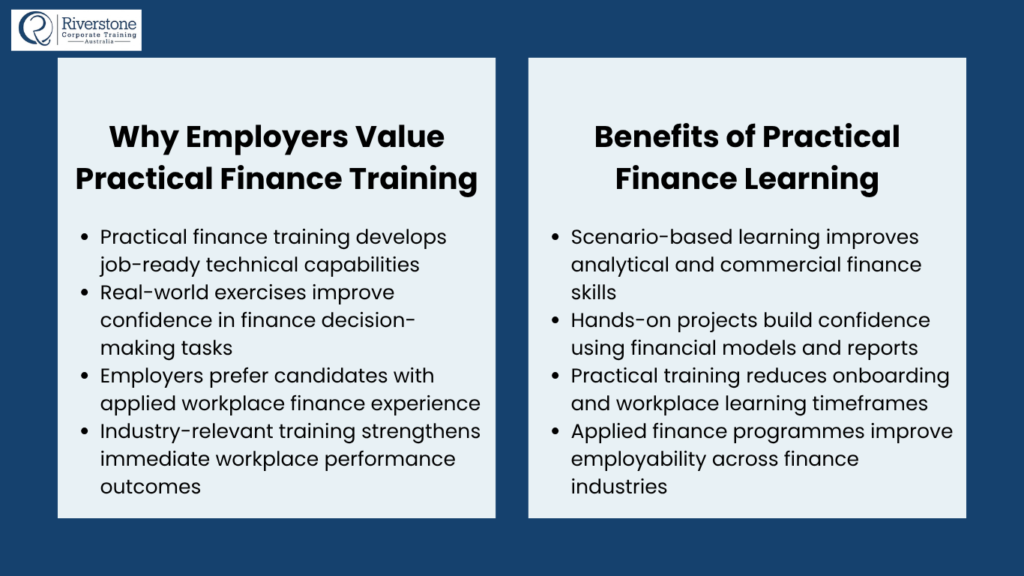
Practical finance training focuses on developing real-world finance skills through hands-on exercises, case studies, financial modelling, valuation projects, and business scenarios. Unlike purely theoretical learning, practical training helps participants apply finance concepts directly to workplace situations and decision-making.
Practical finance training is valuable for finance professionals, accountants, analysts, managers, graduates, business owners, and non-finance professionals seeking to improve their financial understanding. It can also help individuals preparing for careers in corporate finance, banking, investment analysis, and financial planning.
Employers increasingly seek candidates who can apply financial knowledge to solve business problems, analyse data, build financial models, and support strategic decisions. Practical finance skills often help professionals contribute more effectively from the start of their careers and adapt more quickly to workplace challenges.
Practical finance training programmes often cover financial modelling, business valuation, financial statement analysis, budgeting, forecasting, investment analysis, project finance, and risk assessment. These skills help participants gain confidence in applying finance concepts in real business environments.
Practical finance training can improve job readiness, strengthen technical capabilities, and enhance professional confidence. Individuals who combine theoretical knowledge with practical experience are often better positioned for career progression, leadership opportunities, and specialised finance roles in a competitive job market.