


Table of Contents
01
Introduction to Corporate Finance Training ROI
04
Metrics, Real Cases, and the Measurement Workflow
02
Why ROI of Corporate Finance Training Is Rarely Measured Well
05
Conclusion
03
Five Steps to Measure Finance Training ROI Effectively
Introduction to Corporate Finance Training ROI
Return on investment (ROI) for corporate finance training is one of the most talked about and least measured ideas in corporate training and development. Almost all organisations can report on training costs, participation, and satisfaction. Fewer can tell you whether the skills and knowledge of their finance team improved, whether this improvement led to better business results, or whether the return on training was better or worse than the opportunity cost of the training.
This is not a problem of information, but design. A ROI of Corporate Finance Training system can only be built before the training, not after. If the training goals are set as “attend a financial modelling workshop”, there is no foundation for measuring training return. If they are defined as “analysts can construct a three-statement model and deliver scenario analysis to a business unit leader within eight weeks,” it can be.
This article will help you develop a practical finance L&D performance metrics system, link training activity to business performance, and identify the best ways to measure the impact of employee training. It is intended for finance managers, L&D partners, and early-career professionals interested in quantifying the investment in development.
Why ROI of Corporate Finance Training Is Rarely Measured Well
The satisfaction survey problem in corporate training effectiveness metrics
The most widely used measuring ROI of finance training programs is the post-training satisfaction survey: a brief survey that asks participants whether they liked the learning content and the facilitator, and whether they thought it was a good use of their time. This is a measure of satisfaction, not learning. When the effectiveness of corporate training is measured solely in terms of satisfaction, it informs the organisation whether the participants liked the training, not whether it made a difference. We all know that people can give a high satisfaction rating to a training session and not use any of it.
• Kirkpatrick’s four levels of evaluation – reaction, learning, behaviour, results – is the most common model used to go beyond satisfaction and into training effectiveness measurement finance; organisations tend to focus on Level 1 (reaction) measurements.
• ROI of learning and development at the business impact level (Level 4) means that performance data was captured before the training, and that there is a time delay after the training before the performance measurement is taken – neither is part of a typical training design.
The design-first principle for tracking training outcomes finance
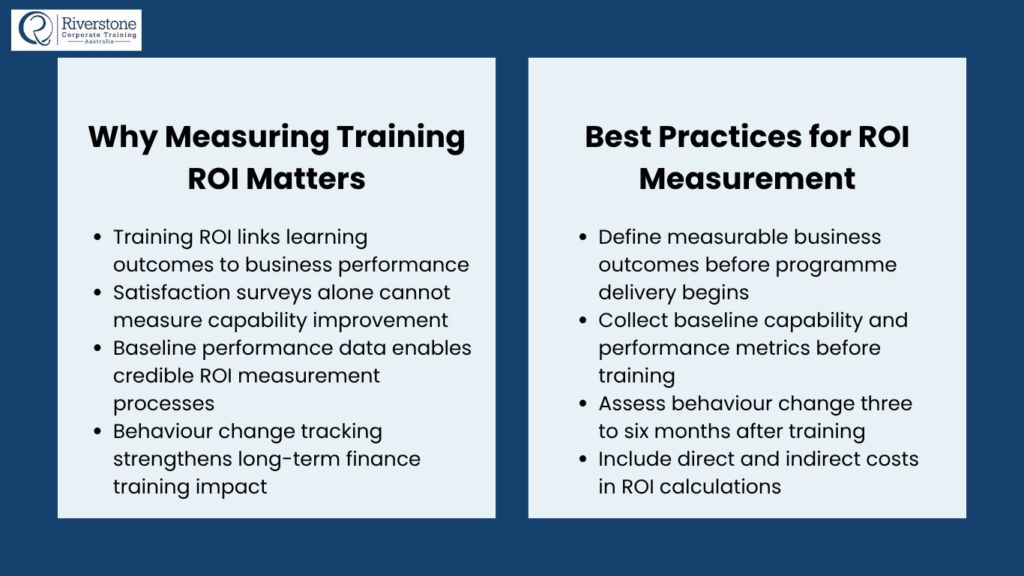
The best way to measuring ROI of finance training programs outcomes finance is to do so when the training is being designed, not after it has been delivered. This involves deciding, before any training is delivered, what behaviour change is required as a result of the training, how it will be measured, when it will be measured, and what business impact will be delivered if the behaviour change is achieved. This logic chain can be designed at the beginning (making measurement easy), or after training (making measurement more difficult and less accurate).
• The business impact logic chain: Training activity → Capability improvement → Behaviour change → Business outcome.
• Each link in the chain needs to be measured; the business impact of finance training can only be claimed if the capability improvement is measured and the behaviour is observed.
Five Steps to Measure Finance Training ROI Effectively
Credible, feasible measuring ROI of finance training programs follows a five-step process from design through to 1 year after delivery. The process below is tailored to the typical corporate Finance L&D Performance and finance resources.
| Step | What It Involves | Finance L&D Performance Metrics Produced | Common Shortcut to Avoid |
| 1. Define the business impact logic chain | Before designing the training, identify the specific business outcome the capability improvement should drive; work backward from the outcome to the behaviour change, to the capability improvement, to the training design | Clear statement of expected outcome, with a measurable indicator (e.g. reduction in analyst revision cycles, improvement in business unit NPS, faster close cycle) | Defining the outcome as the training itself (“attend the workshop”) rather than as the business result the workshop is designed to produce |
| 2. Collect baseline data before training | Measure the relevant corporate training effectiveness metrics before the programme begins: current performance on the target indicators, participant self-assessment, manager assessment, stakeholder satisfaction scores | Baseline data set for comparison, pre-training capability assessment, and existing performance indicators in the relevant area | No baseline collected; post-training comparison has nothing to compare against; ROI cannot be calculated without a before-and-after data set |
| 3. Assess learning at programme conclusion | Immediately after the training, assess whether the learning objective was achieved: a practical assessment, a presentation, a completed work product, or a facilitated debrief with structured feedback | Evidence of learning: assessment scores, competency ratings, facilitator observations | Assessment limited to a quiz at the end of the workshop; no assessment of whether the participant can apply the skill to a real work context |
| 4. Assess behaviour change 3–6 months post-training | Survey managers and stakeholders on whether the target behaviour has been observed; review the relevant performance indicators; conduct a reassessment against the pre-training baseline | Post-training capability assessment; stakeholder feedback on behaviour change; performance indicator trends | No follow-up assessment; the assumption is made that the training produced the change without verification; evaluating employee training impact at this stage is the most commonly skipped step |
| 5. Calculate the finance training return on investment | Quantify the business outcome achieved (time saved, errors reduced, revenue impact, compliance cost avoided); compare to the total cost of the programme (facilitation, materials, participant time, opportunity cost); calculate ROI | ROI figure expressed as a percentage or multiple; cost-benefit narrative for leadership reporting; basis for programme investment decisions | ROI calculation limited to direct costs (facilitator fees) without including participant time as a cost; business outcomes estimated rather than measured; result is not credible to a finance audience |
The step that most organisations neglect in their training performance measurement (TPM) finance exercise is step 4 – measuring behaviour change three to six months after the training. The delay is deliberate: behaviour change takes time to become apparent in changed output and stakeholder interactions; three to six months is the time it can take, but it is also short enough to be reasonably attributable to the training intervention.
Metrics, Real Cases, and the Measurement Workflow
What to measure: a training cost vs benefits analysis framework
A training cost-benefit analysis for a finance training programme involves measuring the cost side (direct and indirect) and the benefit side (financial and non-financial) to calculate a credible return on investment (ROI) metric. The table below provides some useful examples of the most relevant metrics.
| Category | What to Measure | How to Quantify | Measurement Timing |
| Direct Training Cost | Facilitator fees; programme materials; technology platform; external provider costs | Sum of invoices and contracts | At programme completion |
| Indirect Training Cost | Participant time (hours × fully loaded hourly cost); manager time for assessment and coaching; opportunity cost of work not done during training time | Participants × hours × average hourly cost; manager involvement estimated separately | At programme completion |
| Productivity Benefit | Reduction in time taken for key finance deliverables (close cycle, forecasting cycle, report preparation); reduction in revision cycles for key outputs | Before-and-after comparison of time metrics; manager-reported time savings | 3–6 months post-training |
| Quality Benefit | Reduction in errors in key deliverables; improvement in stakeholder satisfaction with finance outputs; reduction in compliance incidents | Error rate tracking, stakeholder NPS, compliance incident log | 6–12 months post-training |
| Talent Benefit | Retention improvement among programme participants; reduction in external hiring costs where internal development replaced external hire | Retention rate comparison; cost per hire reduction | 12 months post-training |
Real cases: business impact of finance training in practice
A financial services organisation developed a business partnering capability-building programme with a measuring roi of finance training programs. The initial average turnaround time for financial analysis requests from analysts was 4.2 days, and the NPS for the finance team’s responsiveness in the business units was 38. By the end of the programme, 6 months later, the turnaround time was 2.9 days, and the NPS was 57. The benefit of finance training was estimated by assessing the absolute improvement in productivity (reduction in analyst hours per request × volume × hourly cost) and the improvement in NPS (linked to rework and escalations). The overall benefit was calculated as three times the programme’s cost. The assessment was credible to the CFO because the baseline information was collected before the training, not inferred retrospectively.
| Pre-Programme | At Completion | 3-6 Months | 12 Months |
| Baseline & Design | Learning Assessment | Behaviour Assessment | ROI Calculation & Reporting |
| Define business impact logic chain; collect baseline data on target indicators; complete pre-training capability assessments; document programme costs (direct and indirect) | Assess whether learning objectives were achieved; collect participant and facilitator feedback; record assessment scores and work product quality indicators | Survey managers and stakeholders on observed behaviour change; reassess capability against baseline; review target performance indicators for improvement trends | Quantify business outcomes achieved; calculate Training Cost vs Benefits Analysis; prepare ROI report for leadership; recommend investment decisions for the next programme cycle |
Conclusion
The measuring roi of finance training programs process is a design process, not a measurement process. The companies that successfully report credible evidence offinance training return on investment are those that design the measurement before the training is delivered – even before the first one – by defining the business impact logic chain, taking baseline data and setting up post-training measurements. This not only produces better measurement, but also creates a better programme outcome, because the design discipline of defining the desired training outcomes before the training begins inevitably leads to clearer articulation of learning objectives and better job performance.
• The most credible corporate training effectiveness metrics are those that link training activity to visible business results through a tangible logic chain; training satisfaction and completion reports are necessary but not sufficient evidence of corporate training effectiveness.
• Corporate training benefit vs cost analysis should include indirect costs (time), not just direct costs (facilitation fees); undercosting the Finance L&D Performance programme results in a higher return on investment (ROI) that is not credible to finance professionals who understand cost models.
• For L&D and finance leaders: the best change you can make to your measurement framework is to gather data before the programme starts; it is the foundation for all credible Finance L&D Performance metrics comparisons that follow.
The ROI (Return on Investment) of corporate finance training measures the value an organisation receives from its training investment compared to the costs incurred. Benefits can include improved employee productivity, stronger financial decision-making, reduced errors, faster problem-solving, and enhanced business performance. ROI is typically evaluated by comparing measurable business outcomes against training costs.
Organisations can assess training effectiveness by tracking metrics such as employee performance, productivity improvements, financial analysis accuracy, time savings, employee retention, and business results. Many companies also use pre- and post-training assessments, behavioural observations, and performance indicators to evaluate training impact.
Effective finance training can improve forecasting accuracy, financial modelling capabilities, budgeting processes, strategic decision-making, and cross-functional collaboration. Organisations may also benefit from fewer reporting errors, improved operational efficiency, and stronger financial management across teams.
Practical finance training focuses on real-world applications rather than theory alone. Employees can immediately apply newly acquired skills to workplace challenges, helping organisations realise benefits more quickly through improved performance, faster execution, and better decision-making. Training programmes that emphasise hands-on learning tend to have a greater impact on job performance and productivity.
Research consistently shows that employee training contributes positively to organisational performance by strengthening workforce capabilities and improving business outcomes. Ongoing finance training helps organisations adapt to changing market conditions, develop future leaders, close skills gaps, and maintain a competitive advantage in increasingly complex business environments.