business valuation course

Risk Management gives professionals the tools to identify, evaluate and manage risks at every level of the business.

Key Issues Facing Professionals:

  • Recognising and prioritising risk in ever-changing, dynamic organisational environments
  • Establishing reliable, yet practical methods of risk assessment
  • Effectively communicating with stakeholders, boards and executives
  • Fostering a risk-aware culture across roles and the organisation
  • Effectively handling risk events and their impact on the organisation

About This Course

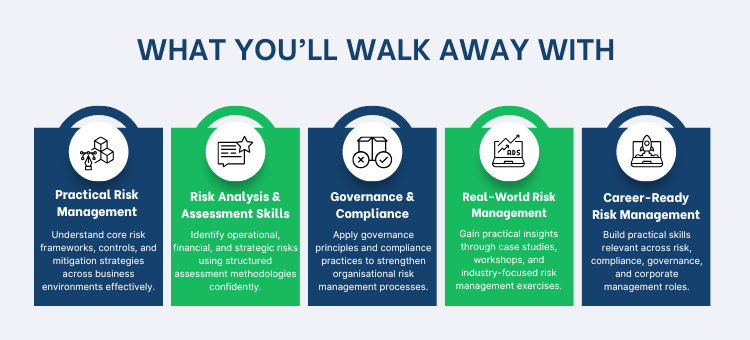
Riverstone’s Risk Management course offers a practical and systematic approach to risk management in organisations. The course explores the fundamentals of risk identification, assessment and treatment, creation of risk registers, risk appetite statements and risk monitoring and reporting. Students gain insights into the use of risk management within various aspects of business and decision-making, and learn how to embed a systematic approach to risk across the organisation. This course is hands-on, with case studies and workshop exercises to apply risk management approaches to business challenges.

  • Develop an integrated, organisation-wide view of risk identification and management
  • Enhance decision making through the integration of risk thinking throughout the organisation
  • Enhance risk governance, reporting and processes
  • Minimise the risk of negative events impacting business
  • Explore the concepts and approaches to managing risks
  • Apply risk identification, evaluation and prioritisation techniques
  • Create risk registers, risk statements and risk treatment plans
  • Incorporate risk management in strategic planning, operations and project management
  • Effectively report risk to a variety of stakeholders

Module – 1

Living with Risks and Embracing ERM

  • Why risk management is everybody’s business in the enterprise
  • The Intent of Risk Management – loss avoidance, value creation, value enhancement or….
  • From a Galaxy … to Relevant Risks and their inter-connectivities
  • Anticipating the Unknowns – Mapping the shapes of risks to come


Module – 2

The Evolving Story of ERM

  • COSO 2004, 2013 and 2017 – what they entail
  • ISO 2009 and 2017 – what they entail
  • Basel, – what they have to say about ERMs


Module – 3

The Nuts and Bolts of ERM

  • The Language and Framework of ERM
  • Who’s who in ERM? – the parties and their roles
  • The Must-Haves and the Mustn’t-Haves of ERM


Module – 4

Makings of a Workable ERM framework

  • The importance of workable processes and a Proper Risk Culture
  • The need to integrate ERM with strategic planning
  • Taking an     informed    view    of     risks confronting the enterprise
  • The challenges    and    pitfalls    in    ERM Implementation
  • The Hard and Soft aspects of a Risk Management framework
  • Facts, Figures and a lot of Common (Business) Sense


Module – 5

ERM in practice

  • Assessing and prioritizing risks
  • Extending Risk considerations from typesto other risk characteristics including speed of onset and momentum of risks aswell as their likelihood and impact
  • The importance of Risk Responses on an Ongoing basis
  • Risk reporting, Key Risk Indicators and Risk Triggers


Module – 6

ERM – before, during and after the Global Financial Crisis

  • Lessons from Mishaps – including Enron, MF Global, General Motors, Lehman Brothers..
  • Where to from here – stages of maturity of ERM in an enterprise

Delivered as a public program at selected locations in Australia, in-house program at your workplace or e-learning program. Program duration and delivery can be customised to suit your team’s requirements.

  • Wednesday, September 16, 2026.
  • Wednesday, December 9, 2026.