


Table of Contents
01
Introduction to In-House Finance Training in 2026
04
What Best-Practice Finance Training Investment Looks Like
02
What Is Driving Increased Investment in Finance Training
05
Real cases: What Works and What does Not
03
Five Reasons Companies Are Investing More in Finance Development
Introduction to In-House Finance Training in 2026
There has been a material shift in the investment case of trends in corporate finance training and upskilling over the last two years. What was previously positioned more as a talent retention instrument, good to have but optional, is now viewed by CFOs and business executives as a direct trigger of financial performance. Teams that are better at converting data into commercial decisions more quickly, interact with AI-enabled analytics more efficiently, and adjust more quickly to evolving regulatory needs deliver better results than those that do not. The trends in corporate finance training in 2026 capture this change: organisations are discontinuing irregular, compliance-based training in favour of structured, results-oriented finance capability-building programmes.
The scenario behind this investment is particular. The finance role in 2026 works in a world with AI tools that have automated much of the transactional and analytical work that was the junior jobs five years ago, with mandatory sustainability and climate disclosure requirements that have introduced new technical needs that most teams are not trained to service, and with competition on experienced finance talent making internal development a more certain route to capability than recruitment. The reasons why companies train their employees have shifted from a talent-management justification to a strategic-capability justification.
The article is aimed at finance professionals interested in understanding the drivers behind investing more in workforce development for finance teams, and L&D professionals and advisors interested in explaining why structured upskilling finance professional 2026 programmes should be implemented in their respective organisations.
What Is Driving Increased Investment in Finance Training
Technology disruption and the demand for finance skills training
Automation of routine finance activities has created both an opportunity and a requirement for finance teams. The opportunity: as more and more transactional work is handled by automated systems, finance professionals have the room to do more valuable work involving analytical and advisory work. The requirement: that ability will only be of value when the team can utilise it. Training in financial skills is most in demand in areas that are poorly automatable, such as commercial judgment, strategic communication, stakeholder engagement, and critical work with and interpretation of AI-generated outputs.
• Likewise, finance professionals who are unable to collaborate with AI tools are structurally disadvantaged: those whose technical finance skills are complemented by AI-enhanced analytical skills are disproportionately productive.
• Trends in corporate finance training 2026 indicate an increasing emphasis on data literacy, proficiency with analytics tools, and the capacity to create and interpret automated models – skills that were considered peripheral in most finance teams three years ago.
Regulatory complexity and the new technical requirements
The compulsory sustainability disclosure framework, growth in privacy and AML requirements, and ongoing development of financial reporting standards have generated a technical upskilling need that finance teams cannot resource solely through external recruitment. The trends in corporate finance training and upskilling in 2026 involve significant investment in ESG reporting literacy, climate risk scenario analysis, and the capacity to incorporate non-financial data into financial planning and reporting.
• Now, however, financial departments without sustainability reporting ability are not only a skills deficiency, but also a compliance risk; non-compliance with the AASB S2 framework is material.
• Partly defensive (to avoid penalties) and partly strategic (to develop the analytical ability that the new disclosure requirements require), business investment in employee learning, in the compliance and regulatory space, is both.
Five Reasons Companies Are Investing More in Finance Development
The rationale for employee training in the finance function has shifted from a single factor (talent retention) to a more complex set of motivations. The following five drivers are what CFOs, HR leaders, and finance managers continue to report when describing their greater training investment.
| Driver | What It Means in Practice | Finance Capability Building Importance | Common Mistakes Organisations Make |
| 1. Hiring scarcity makes internal development the primary capability source | Experienced finance talent is both expensive and scarce in 2026; organisations that cannot grow capability internally are entirely dependent on the external market | Workforce development finance teams become the primary talent pipeline, not just a supplement to external hiring | Training investment is not connected to a succession plan; development builds capability that is then lost when individuals leave because no internal career pathway was created |
| 2. AI adoption requires new skills across the entire team | Finance teams adopting AI-enabled FP&A, close automation, and reporting tools need new capabilities to use them effectively and critically | Demand for finance skills training in AI literacy, prompt engineering for finance workflows, and output validation is now mainstream rather than specialist | AI tools deployed without corresponding training investment; teams under-utilise the tools or produce unreliable outputs because no one was trained to use them well |
| 3. Business partnering expectations have increased | Finance teams are increasingly expected to be active business partners, not just reporters; this requires communication, commercial judgment, and influencing skills that most technical programmes do not develop | Upskilling finance professionals 2026 must address professional and commercial skills, not only technical competence; the gap between technical and partnering capability is the most common constraint on finance team contribution | Training budget allocated entirely to technical CPD; professional and business partnering skills addressed informally or not at all |
| 4. Trends in Corporate Finance Training ROI show measurable returns | Research consistently shows that structured internal development programmes produce lower hiring costs, higher retention, and improved productivity; the ROI is measurable and material | Why companies invest in employee training is increasingly supported by hard data: training investment has a demonstrable return that justifies the budget allocation | ROI measurement is limited to training completion rates and satisfaction scores; no measurement of whether the capability improved or whether the improvement produced a business outcome |
| 5. The regulatory environment creates new capability requirements | Sustainability disclosure, privacy law changes, and AML expansions create specific, non-negotiable technical requirements that require systematic training | Trends in corporate finance training 2026 include regulatory upskilling as a core training investment category; organisations that defer this training investment until the compliance deadline face a more expensive and less effective catch-up exercise | Regulatory training is treated as a compliance checkbox: minimum required, delivered once, not embedded; capability gaps persist despite training completion records |
Driver 4 – the quantifiable training investment payback – is the one that has changed CFO behaviour the most over the last few years. Training investment was competing on equal terms with other capital priorities, as corporate training ROI metrics indicated only satisfaction surveys and completion certificates. The business case has become substantively stronger as organisations increasingly systematically link training activities to business outcomes, such as reducing the cost of hiring, increasing the productivity of analysts, decreasing the number of compliance incidents, or raising the satisfaction scores of business partners. The significance of financial capability building is no longer a matter of opinion; it is increasingly supported by facts.
What Best-Practice Finance Training Investment Looks Like
The shift from events to programmes in the future of finance training programmes
The most apparent change in the trends in corporate finance training 2026 is the replacement of single training with a structured training programme or a multi-month programme with clear outcomes, application elements, and measurement systems. A training programme is a one-day workshop on financial modelling; a training event is a 12-week programme that integrates a modelling workshop with a managed project to apply the skills in a live business case, followed by a peer review. The difference is important, since business training investment in employee learning, which yields only short-term awareness rather than long-term application, generates little long-term improvement in capabilities.
• Future of finance training programmes are becoming more blended: facilitated workshops with coaching, learning within peer groups, stretch assignments, and online reinforcement as opposed to classroom delivery.
• Measurement is becoming a norm: the major organisations establish learning outcomes in advance of programme design, assess whether the outcomes were attained, and use the results to set the next cycle.
Real cases: What Works and What does Not
Real cases: what works and what does not
One mid-sized technology firm funded a 18 months workforce development finance teams programme based on business partnering capability. The programme consisted of skills training sessions (monthly) to be provided by the CFO and senior business executives, an organised mentoring programme between the analysts and senior finance business partners and quarterly presentations where the participants would apply their training to actual divisional P&L analyses. The Net Promoter Score for the finance team to business unit stakeholders was 28 points higher at the end of the programme, and the programme resulted in the promotion of two analysts to formal business partner positions. The CFO explained the improvement through the sustained application component: the presentations asked participants to apply the skills to real-life situations, which developed real ability rather than theoretical knowledge.
| Stage 1 | Stage 2 | Stage 3 | Stage 4 |
| Needs Analysis & Business Case | Programme Design | Delivery & Application | Measurement & Iteration |
| Identify specific capability gaps connected to business outcomes; quantify the cost of the gap (recruitment cost, lost productivity, compliance risk); build the business case using Corporate training ROI trends data | Define learning outcomes (not activities); select modalities matched to objectives; build application components; schedule across 12 months; identify internal SMEs and external partners | Deliver structured workshops; facilitate peer learning and coaching; assign stretch projects applying skills to live business contexts; collect participant feedback at each stage | Measure outcomes against learning objectives; assess business impact (hiring cost, productivity, compliance); report ROI to leadership; update programme for the following year |
An opposite example: a professional services company spent its entire training budget on an external certification programme for all finance personnel. The programme was technically excellent but generic, not specific to the firm’s context and capability priorities. There was a high completion rate, but the post-programme survey revealed that fewer than 40 per cent of respondents believed the content was relevant to their daily work. Business training investment in employee learning that is not related to particular, contextualised capability requirements is always underserved in terms of its anticipated outcomes.
Conclusion
The trends in corporate finance training 2026 indicate the start of a new era of capability thinking in organisations: no longer is capability development a discretionary training investment in people, but rather a strategic business capability which is directly related to performance, compliance, and competitive positioning. The reasons why companies invest in employee training are no longer so much about retention or employee satisfaction, but rather about developing the capabilities specific to the 2026 finance function that will create value and manage risk effectively.
• The organisations that are getting the highest returns on the trends of traning investment in corporate finance upskilling are those that have ceased basing training on events and have shifted to structured programmes with clearly defined results, application elements and measurement systems; the transition is not costly, it is more a design discipline.
• To upskill finance professionals 2026: the skills of finance professionals with technical ability and commercial judgment, AI literacy, and regulatory expertise are becoming increasingly in demand than supplied; systematic development therein is the surest way to secure a promotion.
• To organisations assessing their training investment: quantify trends in ROI of corporate training, in particular, tie your training activity to business results like lower cost of hiring, higher productivity, or compliance incidents and use the information to construct the business case on the importance of long-term investment in building finance capacity.
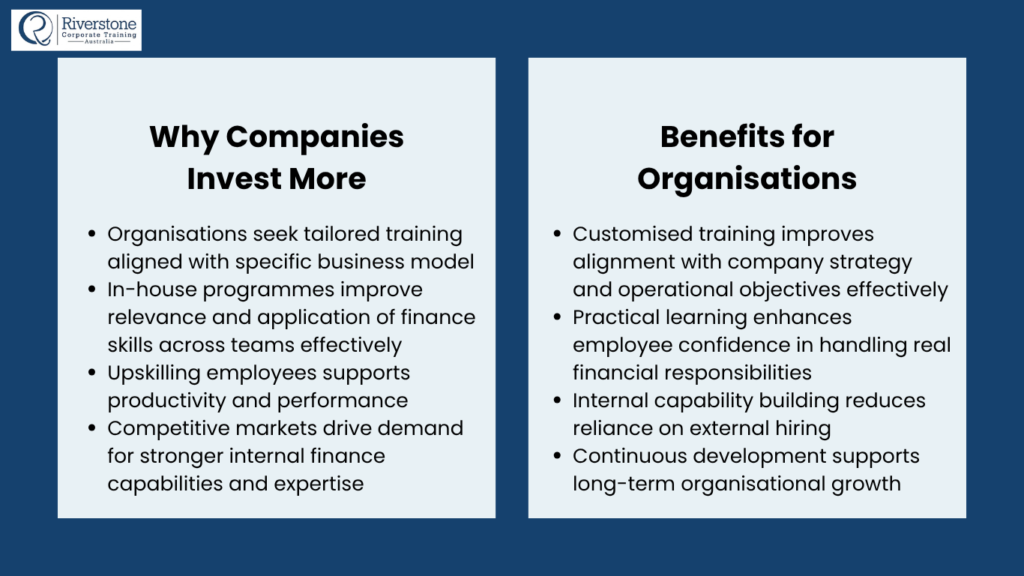
In-house finance training is a customised learning programme delivered exclusively to employees within an organisation. It helps businesses address specific finance skill gaps, align training with company objectives, and improve employees' ability to apply financial concepts directly to their day-to-day responsibilities.
In-house finance training can benefit finance professionals, accountants, managers, team leaders, business owners, and non-finance staff who need a better understanding of financial information. Programmes can be tailored to suit different levels of experience and job functions within the organisation.
Training programmes can cover a wide range of topics, including financial modelling, business valuation, budgeting, forecasting, financial statement analysis, project finance, corporate finance, and finance for non-finance professionals. The curriculum is typically customised to meet the organisation's specific requirements and learning goals.
In-house training allows organisations to customise content, incorporate company-specific examples, schedule sessions around operational needs, and train multiple employees simultaneously. This often leads to greater relevance, stronger engagement, and more consistent learning outcomes across teams.
Success can be measured through improvements in employee knowledge, decision-making capabilities, workplace performance, and the practical application of finance skills. Organisations may also evaluate training effectiveness through assessments, participant feedback, productivity improvements, and achievement of predefined business objectives.