


Table of Contents
01
Introduction to Credit Risk Analysis
04
How to Develop Genuine Credit Analysis Capability
02
What Bank Credit Analysis Actually Involves
05
Real Cases and Lessons from the Field
03
Five Core Skills of Bank Credit Assessment
06
Conclusion
Introduction to Credit Risk Analysis
One of the more challenging skills in banking is credit risk analysis, and many non-credit finance professionals do not realise how difficult it is. Most finance professionals with general corporate finance professionals backgrounds can say only part of the answer to the question above: “Can you actually assess credit risk assessment like a bank analyst?” They can perform financial ratio analysis, which provides the quantitative basis for a credit risk assessment; they generally are unable to perform the commercial, structural, and qualitative analysis that constitute the “bites” of credit judgment, which most often make or break a credit.
A is a multi-dimensional process that begins with the financial statement risk analysis, but also includes the commercial dynamics of the business, the quality and depth of the management team, the competitive position of the borrower in its industry, the nature of the risk allocation of the proposed credit structure and the stress scenarios in which the credit would be unable to meet its commitments. The financial analysis component is a relatively simple part of the broader skill of being a good credit analyst. Still, the practical credit risk analysis skills that encompass this entire analytical process are much more difficult to develop and are what actually set good credit analysts apart from good financial analysts who can read a balance sheet.
The article was written to help finance professionals determine whether their credit analysis capabilities match actual bank analyst credit analysis standards, and to help those seeking to create a credit analysis training program master all aspects of professional credit analysis.
What Bank Credit Analysis Actually Involves
The three analytical layers in real-world credit risk analysis
In practice, the professional bank credit department conducts real-world credit risk analysis across three layers. The first is financial – quantitative analysis of borrowers’ financial statement risk analysis, including earnings quality, cash conversion, leverage, working capital trends and historical trends of DSCR. The second layer is commercial – the qualitative assessment of the business model, competitiveness, management, and the financial performance, as these documents cover. The third layer is structural – the evaluation of the credit structure (security, covenants, tenor, amortisation, pricing) and how it controls the risks identified in the first two layers. Professional credit analysts perform well across all three layers; financial analysts brought into credit roles are usually good on the first layer, but inadequate on the second and third.
• Technologies limited to financial statement risk analysis of lending risk have been proven to fail to capture the most important credit risks: the business dynamics that will dictate the borrower’s financial performance and ability to service the debt throughout the life of the loan.
• At the bank analyst standard, borrower risk evaluation techniques involve the credit professional in making and documenting a particular assessment of the borrower’s commercial resilience – not simply if the borrower’s current financial ratios meet the covenant thresholds, but whether a business model that generated those ratios can sustain in the commercial conditions that will be the case during the term of the loan.
Why are the credit risk assessment frameworks that banks use more structured than most people realise
Professional bank credit departments have credit risk assessment frameworks that focus on the analytical needs of the credit department, and extend beyond financial ratio analysis, including structural assessment, stress scenario and risk assessment sections that document the borrower’s capacity to service the credit under each of the material risks, and how the credit structure addresses the risk. It can come as a surprise to professionals who haven’t been involved in a formal bank credit environment that the requirements can be.
Five Core Skills of Bank Credit Assessment
Five specific skills are clustered at the professional level for credit analysts and together represent true bank-level credit risk assessment capability. Each is an aspect of credit judgment that is systematically missing from financial analysis that does not include a specific credit rating.
| Core Skill | What It Requires | Practical credit risk analysis Skills Standard | Development Approach |
| 1. Earnings quality assessment and normalisation | Identifying and adjusting for all items that distort the borrower’s reported earnings from the sustainable, transferable earnings base: owner remuneration above market rate, personal expenses in the P&L, related-party transactions at non-market rates, and one-off items that inflate or deflate the earnings trend | Credit risk analysis like a banker: the normalised EBITDA is the foundation of the debt sizing and coverage analysis; a credit assessment built on unnormalised earnings is not a credit assessment; it is a ratio analysis applied to an unreliable input | Practise normalisation on five sets of real management accounts from diverse sectors; for each, identify every adjustment required; document the rationale for each adjustment and the impact on the normalised EBITDA; compare your result with an independent practitioner’s reconstruction |
| 2. Cash flow quality versus earnings quality distinction | Analysing the gap between reported earnings and free cash flow generation: working capital movements, maintenance capex requirements, tax payments, and the timing differences between revenue recognition and cash receipt that can make a profitable business a poor credit risk | Real-world credit risk analysis: A business with strong EBITDA and weak cash conversion — whether due to growing debtors, building inventory, or high maintenance capex — has materially lower credit quality than the earnings ratio suggests; the cash flow available for debt service is the number that matters, not the EBITDA | Build a cash flow bridge from EBITDA to free cash flow for each of the five normalisation exercise businesses; identify the specific sources of divergence; calculate the DSCR on free cash flow rather than on EBITDA; assess the credit quality difference that the cash flow adjustment produces |
| 3. Commercial sustainability assessment | Forming a specific view on whether the borrower’s revenue base is sustainable under the conditions that will prevail during the loan term: the revenue concentration, the contractual certainty, the competitive position, and the commercial dynamics of the sector | Borrower risk evaluation methods: the commercial sustainability assessment is the most judgment-intensive component of the credit analysis and the one most frequently absent from the credit files of impaired credits; the financial statement risk analysis reflect past commercial performance; the commercial assessment is the prediction of future performance | Write a specific commercial sustainability assessment for each business: what is the revenue concentration? What commercial forces could reduce the revenue by 20 per cent? What is the borrower’s competitive position and trajectory? What would management need to do to navigate a 20 per cent revenue reduction without defaulting? |
| 4. Stress scenario construction and DSCR sensitivity | Building specific adverse scenarios that reflect the material risks identified in the commercial assessment, and calculating the DSCR impact of each scenario, the stress scenarios must be calibrated to risks that could realistically materialise during the loan term, not to the analyst’s intuitive range of reasonable outcomes | How banks assess credit risk: stress scenarios at professional bank standards are designed to identify the conditions under which the credit would fail to service its obligations, not to confirm that the credit can withstand a moderate adverse scenario; the question is: ‘ at what stress level does this credit break?’ not ‘can it withstand mild stress?’ | Build stress scenarios for each business that reflect the specific commercial risks identified in step 3; calculate the DSCR at each stress level; identify the stress level at which the DSCR breaches the target minimum; assess whether the credit structure provides adequate protection at the identified break point |
| 5. Covenant design appropriateness for the specific risk profile | Assessing whether the proposed financial covenants are calibrated to provide actionable early warning of deterioration in the specific risk profile of this credit, rather than set at a level that only triggers when the impairment is already irreversible | Lending risk assessment techniques: the covenant is the bank’s primary early warning mechanism; a covenant set at a level that the borrower will breach only after the impairment is already effectively irreversible provides no protection; the covenant must be set at the level at which a breach provides time for the lender to act before the position is unrecoverable | Assess the covenant level proposed in each credit structure: at what level of earnings or cash flow deterioration does the covenant trigger? How much deterioration has already occurred by the time the covenant is breached? Is there sufficient time and capacity for the lender to act after the breach? |
Skill 3 — commercial sustainability assessment — is the skill that consistently distinguishes a for-profit analyst from a person who does not have a focus on credit. The lack of a specific commercial sustainability assessment renders the bank analyst’s credit evaluation incomplete, even if the financial ratio analysis is excellent. The biggest credit risks are nearly always commercial, not financial: a revenue concentration that makes the business weak and vulnerable, a management that is weak and won’t be able to weather the storm, the competitive environment that will squeeze margins ahead of the next round of financial statement risk analysis. Such risks can be seen in commercial analysis but not in financial ratio analysis.
How to Develop Genuine Credit Analysis Capability
A structured pathway for credit risk analysis course australia training that builds all five skills
To produce a true bank-standard credit assessment capability, the credit analysis training must be structured to cover all five dimensions of skills and feature real financial data and real commercial analysis – not simplified teaching cases. The four stages outlined below are the ones that professionals who become proficient at creating genuine credit capability follow.
| Phase 1 | Phase 2 | Phase 3 | Phase 4 |
| Financial Foundation | Commercial Assessment | Stress Scenarios | Full Credit Write-Up |
| Build fluency in earnings normalisation, cash flow quality assessment, and DSCR calculation from source documents for five businesses across different sectors; build a cash flow bridge from EBITDA to free cash flow for each; calculate the coverage ratio on both metrics | Write a full commercial sustainability assessment for each business: revenue concentration and contractual certainty, competitive position and trajectory, management capability, and the specific conditions that would cause the revenue to increase by 20 per cent; get feedback from a credit practitioner on the quality and completeness of the commercial reasoning. | Build three stress scenarios for each business, calibrated to the specific commercial risks identified in Phase 2; calculate the DSCR at each stress level; identify the break point; assess whether a standard covenant structure would provide actionable early warning before the break point. | Produce a complete credit assessment for one business in the format of a professional bank credit submission: financial summary, commercial assessment, risk assessment, stress scenarios, structural recommendation, and covenant rationale; get feedback from a credit practitioner against professional bank standards. |
Real Cases and Lessons from the Field
Real cases: when customisation made the difference
A corporate finance professionals with 4 years of experience in M&A advisory joined a mid-market lender as a credit analyst. His financial analysis was quite good, given his M&A background. The financial analysis portion of the first credit assessment was comprehensive and well-documented. It did not provide any borrower- or management-team-specific opinion on the sustainability of the borrower’s revenue base or the management team’s ability to withstand a market downturn. His boss gave credit and with feedback: “Would make by the percentage drop by 20 per cent?” How many years would it take a 20 per cent cut in revenues to cause a DSCR covenant violation? So what would management do when this happened? The feedback was focused and targeted to specifically address the disconnect between M&A analytical standards and bank analyst credit evaluation standards. In six months, he had acquired the skills, knowledge, and expertise he needed for commercial assessment, the skills needed by the credit role. In six months, he had the skill (commercial assessment), knowledge and expertise needed for the credit role.
A second case involves a credit officer with 3 years of tenure at the bank (i.e., a credit line) who was requested to evaluate the credit rating of a technology services company. Her financial analysis showed that it had a good DSCR, a manageable leverage ratio, and a manageable policy. The commercial assessment she conducted revealed the borrower earned about 65 per cent of its income from one government agency client. She felt the risk of concentration was moderate, given that the government is a creditworthy counterparty. She did not realise that the government agency had recently announced that the services the boulder would provide would be provided in-house. The negative trend in the revenue mix was evident in public-domain data at the time of the credit assessment. It is not enough for the credit analyst to merely record commercial context supporting his financial statement risk analysis; he must actively seek out commercial information that differs from the bank-standard of bank-standard practices, demonstrating credit risk analysis skills.
Conclusion
credit risk analysis course australia, as a form of risk evaluation, is a multidimensional professional skill and is far more complex than simply analysing financial ratios. The five core skills of bank credit assessment — assessment and normalisation of earnings, distinction of cash flow quality, commercial sustainability assessment, construction of stress scenarios, and appropriateness of the covenant — are all part of a standard of analysis that most corporate finance professionals do not possess on entering credit roles, and that must be built through deliberate practice or courses of structured learning on real commercial and financial data.
• The commercial assessment layer (the judgment dimension for determining whether the financial performance recorded in the financial statements exists under the commercial conditions of the loan term) is the most judgment-intensive and consequential dimension in which banks assess credit risk and is built upon the basic layer of the financial statement risk analysis.
• The credit risk most likely to cause an impairment is nearly always apparent in the commercial analysis before it is apparent in the financial statements, and real-world credit risk analysis course australia at a bank analyst standard is characterised by proactively looking for information that contradicts the financial statement risk analysis as well as that which supports them.
• The capability development investment that has the greatest impact for those entering a credit career is the commercial sustainability assessment, not the financial ratio analysis; the person who has developed the capability to respond to the question, “What would cause revenue to decline by 20 percent and what would management do?” has developed the capability that leads to credit judgment, which is the root of all success in a credit career.
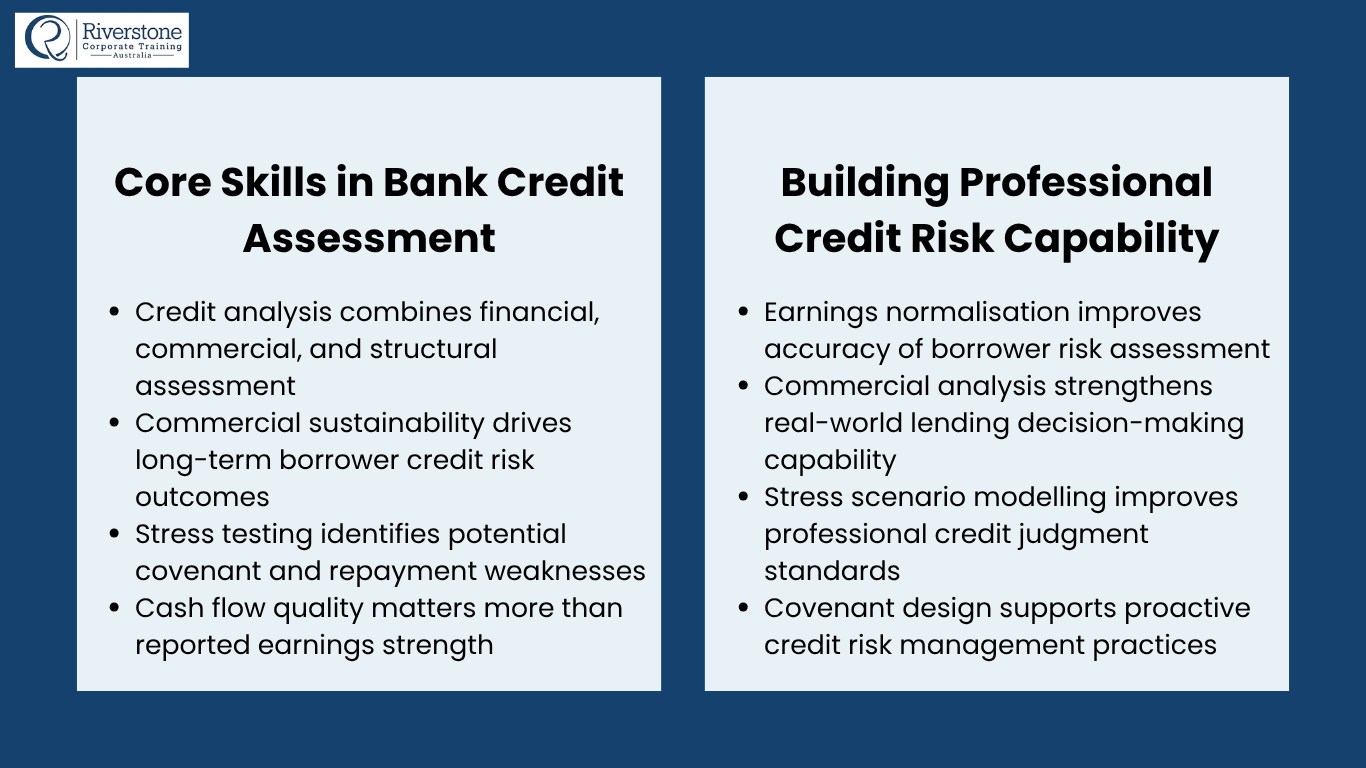
Credit risk analysis is the process of evaluating a borrower’s ability and willingness to repay debt obligations. It involves assessing financial performance, cash flow generation, leverage, repayment capacity, and other risk factors to determine the likelihood of default and potential losses.
Credit risk analysis helps lenders make informed lending decisions, manage portfolio risk, and minimise potential losses. By accurately assessing creditworthiness, banks and other financial institutions can allocate capital more effectively and maintain the quality of their loan portfolios.
Credit analysts typically evaluate a borrower's financial statements, cash flow strength, debt levels, profitability, industry outlook, management quality, and overall business risks. Both quantitative and qualitative factors are considered when determining creditworthiness and assigning risk ratings.
Effective credit risk analysis requires strong financial statement analysis, ratio analysis, cash flow forecasting, risk assessment, and analytical thinking skills. Credit professionals must also be able to identify emerging risks, interpret financial data, and communicate their findings clearly to decision-makers.
Credit risk analysis is valuable for bankers, credit analysts, risk managers, relationship managers, lenders, corporate finance professionals, and investment analysts. Developing these skills can improve decision-making, support career growth in financial services, and enhance an organisation's ability to manage credit-related risks.