

Finance business partnering involves a close working relationship between the finance function and the operational/commercial function to help convert the financial information into decisions that the business can make. Today, finance teams are required to go beyond historical reporting and be involved with planning, forecasting, performance enhancements and strategic decision making. This transition is changing the definition of a “good finance” within expanding organisations.
What Is a Finance Business Partner?
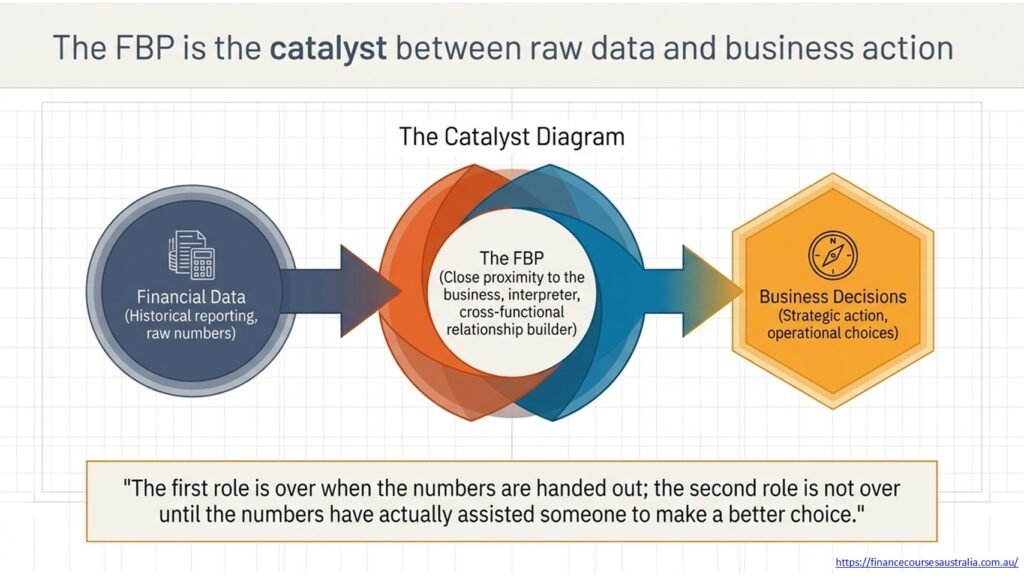
A Finance Business Partner is a finance person who has a very close proximity to the business, and is able to provide useful financial input to the teams that make decisions around business and operations. They do not work in isolation within the finance function, but instead create strong, long-term relationships with other functions, including sales, marketing, operations, HR, procurement and senior management, to ensure that financial thinking is there when decisions are being made, not just after.
It’s not just about creating financial statements and handing them down. A Finance Business Partner facilitates stakeholders to follow a natural progression of what has occurred, why it has occurred, what might occur in the future and what the business should do about it. It is this evolution that makes a financial information provider a decision-support partner. The first role is over when the numbers are handed out, the second role is not over until the numbers have actually assisted someone to make a better choice.
How Is Finance Business Partnering Different From Traditional Finance?
Traditional finance tasks focus on reporting and accounting, controls and compliance, and historical performance. These functions are crucial — a lack of proper book closes and reliable number control are the foundation for any organization to work together going forward. This is not a replacement for finance business partnering – it’s an extension of it: decision support, forecasting, commercial analysis, strategic discussion and performance improvement, all on top of solid financial fundamentals.
Reporting vs Decision Support
The easiest way to tell the difference is to compare the same fact communicated. The conventional way of reporting would only be to report a revenue drop of 8%. A business-partnering approach takes it one step further: Revenue has fallen by 8% – mainly as a result of reduced customer numbers in one segment – and the finance team can play a key role in identifying pricing and customer acquisition opportunities to help offset this fall. This is the same underlying number but the second version shifts from reporting information to interpreting and applying it, the core of finance business partnering.
Historical Analysis vs Forward-Looking Analysis
Historical data is what has already occurred, but these days, management has a need for finance to help them answer questions about the future. This is why business partnering heavily relies on forecasting, scenario analysis, budgeting, driver-based planning, sensitivity analysis, and testing of business assumptions. Historical figures are important, for they give context and baseline on which forward-looking analysis will rely, but on their own they will not necessarily answer the question the business leader is asking.
Finance Function vs Business Partnership
Relationships between business functions and finance professionals go beyond output production to active collaboration. It involves a joint effort of cross functional collaboration, an awareness of commercial issues, effective communication and challenging assumptions and taking risks rather than taking it on the chin. However, importantly, finance business partnering is not about the loss of finance’s independence. A good Finance Business Partner should be able to challenge assumptions and be politically, financially savvy but not be limited to just the commercial team’s perspective.
What Does a Finance Business Partner Do?
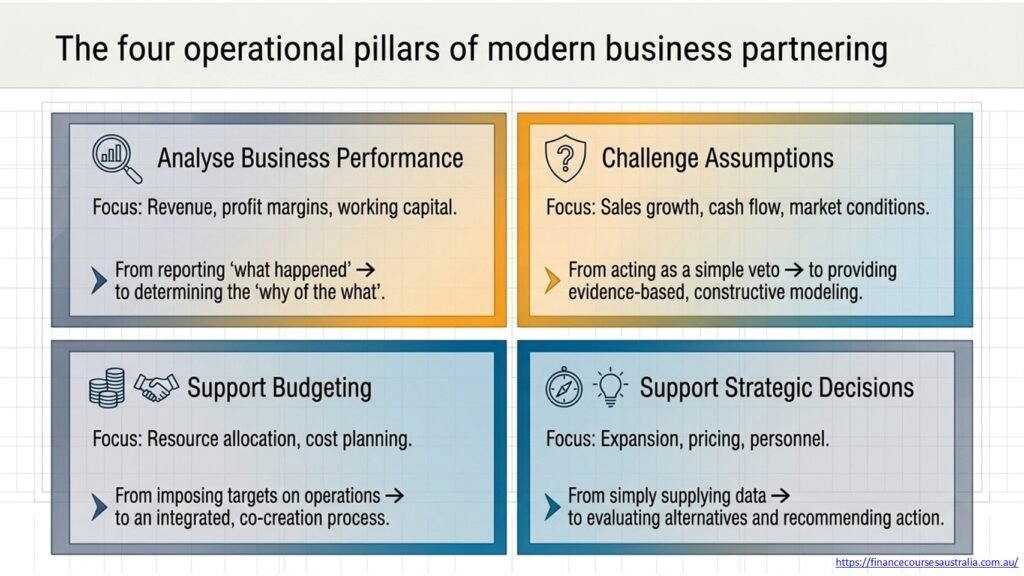
Analyse Business Performance
Some of the key areas that are reviewed on a regular basis with Finance Business Partners by the company include revenue, profit margin, costs, working capital, key performance indicators, product or service profitability, variances and customer performance. The purpose of this analysis is not just to tell what the numbers tell you, but to determine the “why” of the “what.
Challenge Assumptions
A part of the job will be to determine if any of the assumptions employed in a plan are realistic. Will the expected sales growth be realized under market conditions? Will it be financially feasible to hire employees in the current cash flow? Do the proposed cost savings really become available? Will a new investment likely provide an acceptable return? Do price assumptions reflect market conditions? In this context, effective challenge is not merely a veto but evidence-based and constructive with the goal of making a better decision.
Support Budgeting
Finance Business Partners are involved in budgets, departmental budgets, updates to forecasts, decisions to allocate resources, cost planning and revenue targets, all at an annual budget level. Budgeting becomes much more meaningful if finance is used alongside operations to create it as a co-creation process, rather than imposing financial targets on operations teams to work back from.
Support Strategic Decisions
Finance input is relevant in making decisions about expansion, pricing, personnel, product development, marketing expenditure, cost reduction, and even capital expenditure. In both cases, finance is responsible for data analysis, scenarios and the financial impact of the various alternatives involved, and then makes a recommendation (without taking the final decision for business leaders).
What Skills Does a Finance Business Partner Need?
The key to effective performance in this role is technical finance skills, analysis, commercial awareness, and interpersonal skills. None of the skills can stand alone.
Financial Analysis
The first step is to have a solid understanding of financial statements, profitability, margins, cash flow, working capital, financial ratios and variance analysis. The rest is the art of interpreting financial data to produce insight that the non-finance stakeholder can use.
Forecasting
Revenue forecasting, cost forecasting, cash flow forecasting, scenario planning and driver-based forecasting ensure that management is not caught off guard by a single unexpected event when it comes to planning for multiple scenarios.
Commercial Awareness
Having some financial knowledge doesn’t do the trick when the business itself is not understood. This includes understanding the commercial context of numbers and what drives revenues, customers, pricing, the market and competition, product economics and operational drivers.
Communication
Financial information has to be shared in a way that is understandable, whether that means in a presentation, a management report, a financial story, variance explanations, or a formal recommendation to senior level stakeholders. A Finance Business Partner must tailor the extent of detail to the audience – perhaps a CFO might want a different level of analysis from a sales manager or operations manager working on the same numbers.
Stakeholder Management
Cross-department working involves trust building, listening, asking questions, challenging in a constructive way, managing disagreement and understanding the priorities of each department. Relations with clients are important but must not be at the expense of financial objectivity.
Financial Modelling Skills Requirement
Financial modelling skills support Finance Business Partners in evaluating different business scenarios before a decision is made rather than only assessing the outcome afterward. Revenue forecasting, cost forecasting, investment analysis, scenario analysis, sensitivity analysis, cash flow forecasting and budget planning are common applications.
Knowing some Excel formulas is not enough to be useful in financial modelling. But for professionals, it’s also important to have insight into the business drivers, the financial assumptions, the structure of the model, the connections between financial statements, what the results of the scenario mean, and — most importantly — what the results mean for a decision.
This can be well seen in a practical example. Assume that a sales team is forecasting increased sales in the upcoming year. Using this excellent financial modelling tool, a Finance Business Partner with some knowledge of the financials can construct a model that will show the whole effect: an increase in sales will create additional hiring needs, which will generate additional operating expenses, plus increased revenue creating increased profits and cash flow. This is because a chain is not evaluated individually—it is evaluated as a whole chain allowing management to appreciate the overall financial impact of a single commercial decision prior to its implementation.
Finance Skills Gap Requirement
Many organizations experience a finance skills gap where finance professionals have strong accounting or reporting capabilities but lack capabilities such as commercial analysis, forecasting, financial modelling, strategic thinking, data interpretation, communication, and stakeholder management.
This gap does not necessarily mean finance professionals lack technical knowledge. More It does not necessarily imply that finance professionals are not technically knowledgeable. More frequently, it is a distinction in terms of technical finance skills versus business decision support skills, which are complimentary but not identical and often developed separately. With the increased responsibilities of finance professionals in the business decision making process, it may be necessary to move beyond the mere creation of accurate financial information and learn to interpret data, evaluate business performance, explain the data, and participate in business discussions. This is where the finance skills gap can become more apparent.
These gaps can be discovered via skills assessments, manager feedback, performance reviews, capability frameworks and business partnering maturity assessments. Recognizing the finance skills gap early makes it considerably easier to address through targeted training and professional development rather than relying solely on reactive hiring.
How Can Finance Teams Develop Business Partnering Skills?
Structured Training
Financial analysis, forecasting, financial modelling, scenario analysis, commercial awareness and communication skills can be developed in a formal, consistent manner through formal training, rather than acquired inconsistently on the job.
Practical Case Studies
Realistic business scenarios, whether it’s about the pricing decision, the investment in marketing, the planning of the workforce, expansion, or cost reductions, tend to be much more effective in the learning process than pure theory, as they reflect the ambiguity of business decisions in practice.
Cross-Functional Exposure
Collaborating with sales, marketing, production, HR and purchasing helps finance professionals create the business environment for which technical training is not enough.
Coaching and Mentoring
More knowledgeable finance leaders can support less experienced colleagues in developing their commercial judgement, communication, stakeholder management and strategic thinking by providing personal feedback and exemplifying good practice.
On-the-Job Application
The advantage of training is derived from the application of the knowledge gained directly to real problems that can be faced by the individual and his organisation shortly after training, rather than waiting for the next one to be available.
Examples of Finance Business Partnering in Practice
Marketing Investment
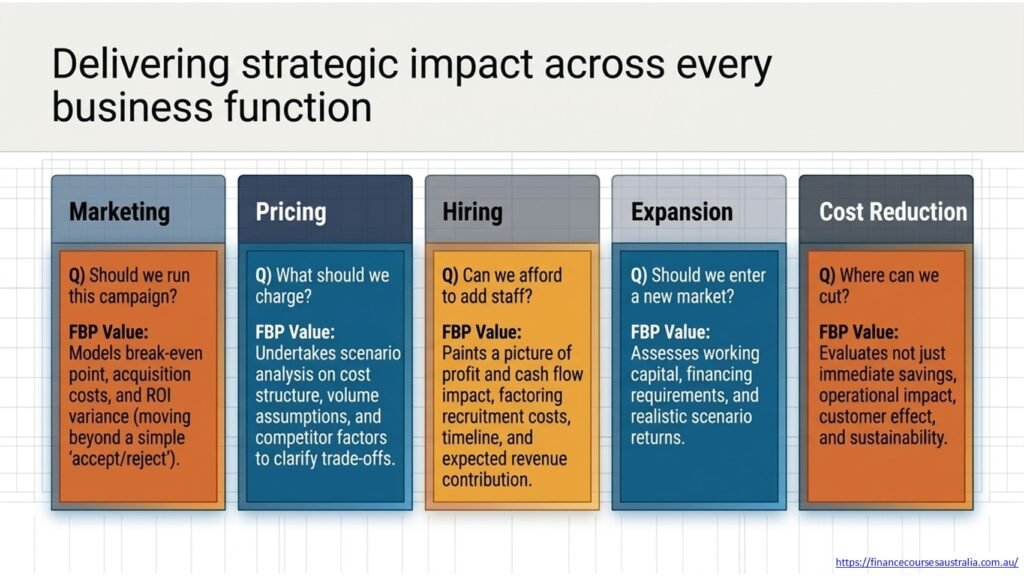
A Marketing team can identify the amount of revenue they can expect to generate from a campaign, the cost of a customer acquisition, the historical performance of their campaigns, the break-even point and what range of ROIs they can anticipate. The finance person doesn’t just say “accept” or “reject” the idea, but makes management aware of how the idea will affect finances and the variation of expected results.
Pricing
Finance can assist the pricing team with the maintenance of cost structure, gross margin, customer behaviour, volume assumptions and competitor factors to then undertake scenario analysis of pricing levels to enable the commercial team to clearly understand the trade-offs.
Hiring
There are several factors to consider when assessing the economic return of adding staff to the business: salaries, employee benefits, recruitment expenses, expected productivity, contribution to revenue, and when they are needed. A robust model can help paint a picture of what that hiring will mean for profit and cash flow, not just a singular fixed cost line.
Expansion
The investment, revenue forecast, operating costs, working capital, financing requirements, scenario analysis and returns in a new market or new setting are all key elements of assessment that should not be considered individually.
Cost Reduction
It’s not what the immediate saving is that should be the basis for evaluating a cost-saving initiative. Finance Business Partners should also take into account the operational impact, impact on the customer, revenue implications, implementation costs and sustainability of the change.
Practical Business Partnering Framework
A simple framework can help finance teams apply finance business partnering consistently:
1. Understand the Business Question — What decision does management need to make?
2. Gather the Relevant Data — Identify the financial and operational information required.
3. Analyse the Drivers — Determine what is influencing the outcome.
4. Build Scenarios — Model realistic alternatives.
5. Challenge Assumptions — Test whether key assumptions are reasonable.
6. Communicate the Insight — Explain the financial impact clearly.
7. Support the Decision — Help stakeholders understand the options and trade-offs.
8. Monitor the Outcome — Compare actual performance against expectations.
Applied consistently, this process turns finance into an ongoing decision-support function rather than a once-a-month reporting exercise.
Traditional Finance vs Finance Business Partnering
| Traditional Finance Focus | Finance Business Partnering Focus |
| Historical reporting | Forward-looking analysis |
| Financial accuracy | Financial and commercial insight |
| Reporting results | Explaining performance drivers |
| Budget preparation | Business planning support |
| Finance function | Cross-functional partnership |
| Variance reporting | Action-oriented analysis |
| Financial information | Decision support |
Skills a Finance Business Partner Needs
| Skill | Why It Matters |
| Financial Analysis | Understand business performance |
| Forecasting | Support forward-looking decisions |
| Financial Modelling | Evaluate scenarios |
| Commercial Awareness | Understand business drivers |
| Communication | Explain financial insights |
| Stakeholder Management | Build cross-functional relationships |
| Strategic Thinking | Connect finance with business objectives |
Closing the Gap: A B2B Perspective
Reporting capability and business-partnering capability are not the same thing. An organization can have a technically strong finance team — accurate, controlled, compliant — and still need development in commercial finance, financial modelling skills, forecasting, decision support, communication, and stakeholder management. This distinction is important because it changes the development conversation – it’s not so much if a finance team is competent, it’s if it’s competent in the areas where finance business partnering is required. This distinction is often the first question finance and HR leaders ask themselves when deciding on the investments they should make in structured commercial finance and financial modelling training.
Conclusion
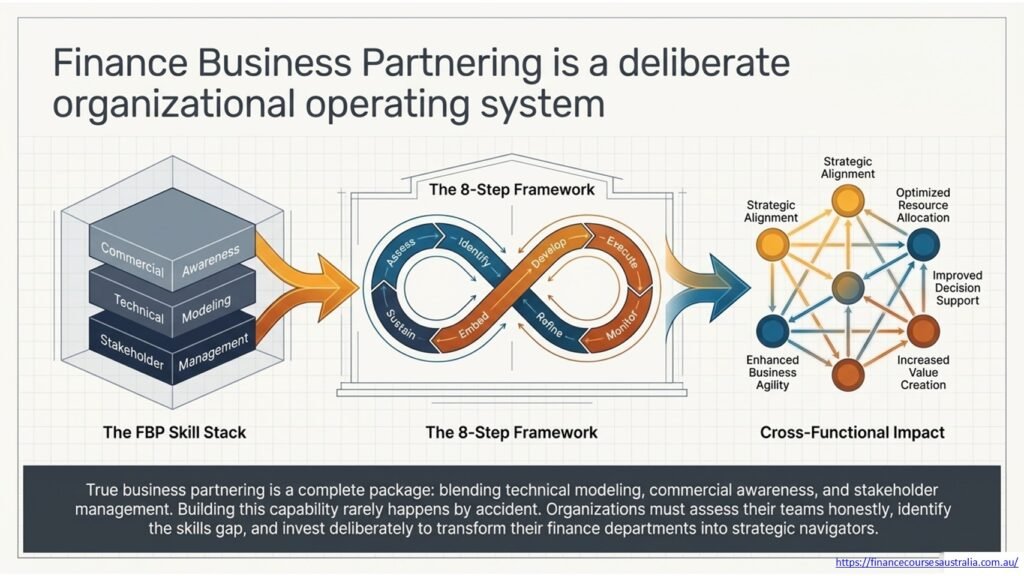
Finance business partnering is about getting finance closer to business decisions—closer to the operational and strategic decision-making process—and not to just reporting. True business partnering involves more than just delivering accurate financial reports; it’s about the financial analysis, forecasting and modelling, commercial awareness, communication and stakeholder management — it’s a whole package and all in one.
Building this capability rarely happens by accident. It usually requires organizations to look honestly at where a finance skills gap exists — often in financial modelling skills, forecasting, or commercial communication — and to invest deliberately in closing it. If they want to improve their financial performance, it’s important for them to assess if they have the right teams to become more than reporters of financial information and more into helping the business understand and react to it.
Finance business partnering is a practice that brings the finance professional into close collaboration with the operational/commercial teams to convert financial data into meaningful business decisions. It doesn't just make reports; it helps to predict, develop scenarios and keep collaborating with other departments like sales and marketing, operations, HR, etc., for planning and performance improvement.
A Finance Business Partner evaluates business performance, challenges assumptions when considering plans and forecasts, assists with planning, and participates in the decision-making process such as expansion, pricing and employment. Instead of just reporting financial transactions, they assist stakeholders in understanding the events that took place, how they did, and what the company needs to do next.
Conventional finance focuses on reporting, accounting, controls and compliance in terms of past performance. The key to Finance business partnering is that it is based on these principles and then extends to the analysis, forecasting, commercial input and decision support to help management interpret and act on financial information, rather than simply review it.
Financial analysis, financial forecasting, commercial awareness, communication and stakeholder management are key elements of the role. Financial modelling is a key skill for assessing scenarios, and the ability to communicate financial insight clearly to non-finance people is as important as being correct.
Financial modelling skills enable Finance Business Partners to assess the financial implications of various business scenarios prior to making decisions on revenue, cost, cash flow and investment results. In addition to formulas, it also requires a grasp of business drivers, assumptions, and an understanding of the actual impact of a model on a real decision.
Closing a finance skills gap typically starts with identifying where capability is missing through skills assessments, manager feedback, or capability frameworks, then addressing it through structured training, case-study-based learning, cross-functional exposure, coaching, and opportunities to apply new skills on real business problems soon after learning them.