

Project cash flow modeling involves using operating, financing, and contractual assumptions to structure a revenue and operating cost model along with a debt service model, reserve model, tax model, and investor distribution model throughout a project’s life. This skill is developed by many professionals by taking a special cash flow waterfall course, which helps them understand the sequencing and allocation of project cash to the project’s financing structure.
What Is a Project Cash Flow Model?
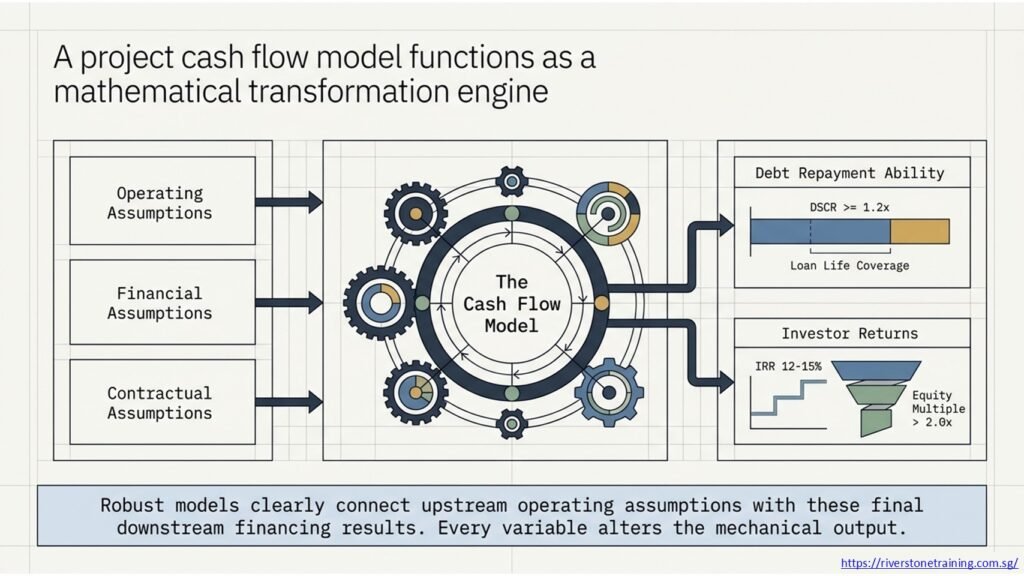
A project cash flow model is a financial model that shows the flow of cash through the project during the construction and operating phases, as well as during financing. It turns assumptions on revenue, costs, capex, and financing into a cash flow timeline. Typically, the model will run the entire life of the project, from construction drawdowns and years of operation, to the final debt servicing.
The cash flows of infrastructure and renewable energy projects depend on long-term contracts, financing covenants, and progress with construction, the classic requirements of which are reliant on this structure. A robust model will clearly connect operating assumptions with financing results and enable analysts to recognize how a change in revenue or cost assumptions will impact the debt repayment ability and investor return.
Why Is Project Cash Flow Modeling Important?
Project cash flow modeling is crucial as it will help to determine whether the project can return cash for the operating costs and repayment of debt, and also provide the investor with the return they want. They are essential to the process of feasibility analysis by lenders and equity investors before they invest. Financing terms can’t be structured and negotiated without a reliable cash flow model.
If the small forecasting errors are magnified in large capital projects like a toll road, power plant, or renewable energy project, then the impact on financing ability can be huge. That’s why cash flow modeling is not a one-time thing that finance professionals do but a continuous analytical process and why it’s important to practice it on real-life project scenarios during training.
What Information Is Needed to Build a Project Cash Flow Model?
Before any forecasting begins, a set of operating, financial and contractual assumptions must be made to help build a project cash flow model. The time and the price of construction are usually collected, as well as the revenue conditions or market prices and the operating expense estimates, tax rates, and financing conditions like the tenor of debt and interest rate. These inputs are the basis for all the downstream calculations in the model.
Table 1: Project Cash Flow Components
| Component | Purpose |
| Project Revenue | Determines operating cash inflows |
| Operating Costs | Measures recurring project expenses |
| Taxes | Accounts for tax obligations |
| Debt Service | Models interest and principal payments |
| Equity Distributions | Determines cash available to investors |
The contract details of the project, such as offtake contracts, concession terms, and financing covenants, are also important to understand by practitioners as these have a direct impact on the modeling of revenue and debt obligations. Errors in the assumptions at this stage will add up to larger errors later in the model.
How Do Professionals Forecast Project Revenue?
Project revenue is estimated by professionals using assumptions regarding pricing, volume, and structure of contracts for the duration of the project. This typically involves modeling long-term offtake agreements, tariff structures, or market-based pricing with escalation assumptions for infrastructure and energy projects. Ramp-up periods and the seasonal nature of the business must be taken into account for revenue forecasts, and renewal risk must be considered if applicable.
The first and most important part of the cash flow model is an accurate revenue forecast, as all calculations downstream from that point are dependent on the accuracy of these revenue forecasts, such as debt service coverage and equity returns.
How Are Operating Costs Incorporated Into the Model?
Operating costs are included by making predictions of recurring costs (maintenance, staffing, insurance, administration, etc.) for the project’s operating life. These costs are usually represented as a percentage of the revenue or as fixed and variable costs depending on the type of project undertaken. Escalation assumptions (e.g., inflation-related cost increases) are used consistent with revenue assumptions.
Once you deduct the operating costs from the revenue, you have operating cash flow, which will be used to calculate taxes, debt service capacity and ultimately distributable cash for investors.
How Are Taxes and Working Capital Modeled?
When modeling taxes, taxable income is calculated as a company’s income subject to tax after deducting the project-specific interest expense and depreciation, and then applying the appropriate corporate tax rate to the taxable income. Effects of working capital movements (including timing differences between billing and collection) are included to show the real cash effect, not just accounting profit.
These changes are important because they can cause differences between the taxable income and cash flow, which is especially true in the early years of operation when depreciation is at its peak. Experts carefully make this distinction so as not to overstate the debt service or distributions that can be made from the cash available.
How Does Debt Financing Affect Project Cash Flow?
Debt financing has an impact on the cash flow of a project as it has scheduled interest and principal payments that have to be fulfilled before cash gets to equity investors. Senior debt generally is repaid in a specific order according to the operating cash flow of the project, and where subordinate debt exists, it is paid after the senior debt. The model should be able to record a debt drawdown in construction and repayments over the operating life of the project.
A debt service coverage ratio (DSCR) is computed at each period to ensure that the project is generating enough cash to cover its debt service, which is a part of the terms and conditions of financing and is also a part of the covenants of financing.
What Is a Cash Flow Waterfall?
A cash flow waterfall is the orderly manner in which cash is spent for the project, including operating expenses and realization of equity returns. It sets the priority of costs and financing needs so that the most critical needs are satisfied before any cash flows to investors. This safeguards the lender’s interests in two ways: by making sure debt service and reserve requirements are met before equity shareholders get any cash, and by ensuring that the cash is available to meet those requirements.
The exact sequence of the waterfall depends on the nature of the project, since it is determined by financing agreements and contractual arrangements set out in the project, and is not a formula. These agreements need to be read carefully by the professionals so as to form an accurate model rather than relying on a generic structure.
How Does a Cash Flow Waterfall Allocate Project Cash?
A typical cash flow waterfall allocates project cash in a defined order: project revenue first covers operating costs, then taxes, followed by senior debt service, reserve account requirements, subordinated debt or other financing obligations, and finally equity distributions. Each layer must be satisfied before cash moves to the next, which is why the sequence directly affects how much cash ultimately reaches investors.
Table 2: Cash Flow Waterfall
| Priority | Cash Allocation |
| 1 | Operating expenses |
| 2 | Taxes |
| 3 | Senior debt service |
| 4 | Reserve requirements |
| 5 | Other financing obligations |
| 6 | Equity distributions |
Note: the actual waterfall sequence depends on the project’s financing agreements and may vary between transactions.
Learners develop the ability to structure and interpret this sequence through a dedicated cash flow waterfall course, which typically covers how to build waterfall logic in Excel, apply reserve mechanics, and test how changes in assumptions affect cash available at each priority level.
How Are Debt Service and Reserve Accounts Modeled?
Reserve accounts, like the debt service reserve account (DSRA), are established to provide for a predetermined number of debt service payments in anticipation of a deficiency, and debt service is modeled by making interest and principal payments based on the amortization schedule of the loan. The model determines the necessary reserves for each period and displays the reserve balance over time.
Usually, lenders establish reserve requirements as a lending condition, and breaches of the covenant can occur if the requirements are not met. These are precisely the mechanisms modeled by professionals, as it is the cash in the bank that is the cost of equity distributions in a given period.
How Do Equity Distributions Appear in the Cash Flow Model?

Equity distributions are the net cash left after operating expenses, taxes, debt payments, and reserve requirements. This cash is paid out of the funds available and is called free cash flow to equity and is distributed to investors by the terms of the shareholder or partnership agreement. The model considers cumulative distributions in addition to initial equity investments to calculate total investor returns.
The distributions are at the bottom of the Cash Flow waterfall and are highly sensitive to changes in revenue, costs, or financing analysis, which is why it is important to have accurate upstream modeling.
How Do Professionals Test Project Cash Flow Assumptions?
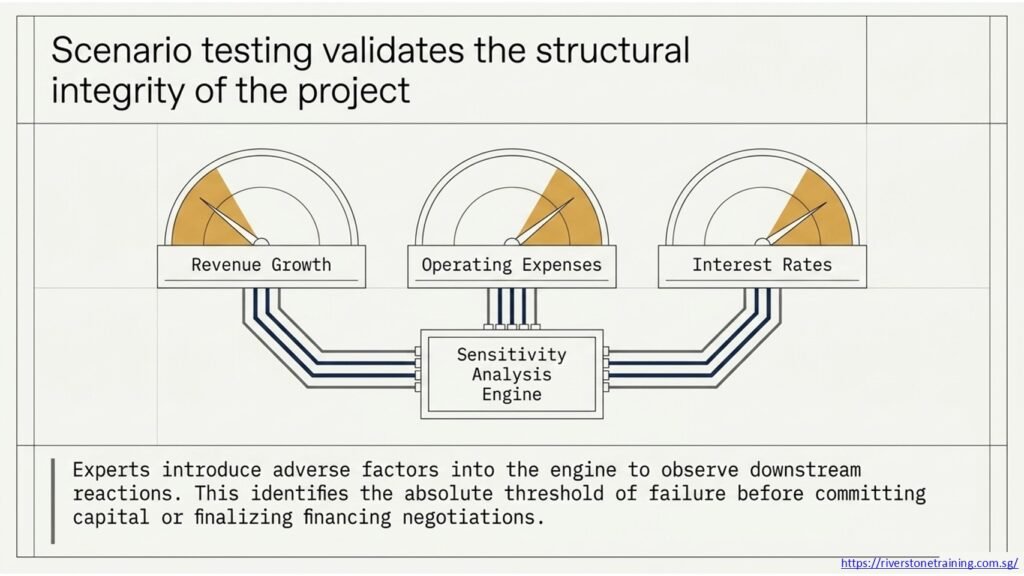
Experts validate their assumptions by conducting scenario and sensitivity analysis; by making changes to the major factors like revenue growth, operating expenses, or interest rates and observing the model’s results. This shows the insensitivity of the project to adverse factors, such as the demand being lower than anticipated or the construction expenses increasing.
Sensitivity analysis of DSCR, NPV, and IRR determines what assumptions are critical to project feasibility, which can inform the process of negotiating financing and decision-making around risks prior to committing capital.
How Do Project Cash Flow Models Support Investment Decisions?
Project cash flow models help with the investment decision process by quantifying and revealing operating and financing assumptions and translating them into NPV, IRR, DSCR, etc., that can be used by investors and lenders to assess feasibility. These metrics can be used to compare projects, check project funding capacity, and decide if the project returns are worth the risk.
Table 3: Project Finance Metrics
| Metric | Purpose |
| DSCR | Measures ability to service debt |
| NPV | Assesses project value |
| IRR | Measures investment return |
| Debt/Equity Ratio | Evaluates financing structure |
Since the model incorporates all the assumptions and presents the final return, it serves as a key element to negotiate financing terms, discuss alternative structures, and share project viability with the stakeholder and financing committee.
How Does Financial Modeling Training Develop These Skills?
These skills are taught through financial modeling training, beginning with forecasting and moving on to more advanced waterfall and financing skills. A broad-based financial modeling course Australia can build the underlying Excel, forecasting, and financial analysis capabilities that apply across corporate finance, investment banking, and project finance contexts.
These are then followed by more specialized project finance training, with specific emphasis on how debt is structured, how reserves are calculated, and how the cash flow waterfalls apply to infrastructure and other large capital projects.
Why Is Excel Important for Project Cash Flow Modeling?
There are many reasons to use Excel; it is the standard platform in the finance industry for cash flow models of projects to be built, audited, and presented. It is flexible enough to provide analysts the capability to create their own waterfall logic, dynamically connect assumptions, and conduct scenario and sensitivity analysis without using computer software templates. Lenders and investors also want models delivered in Excel for their review and stress-testing.
There is therefore a strong focus on Excel skills as part of project finance training that involves structured formulas, circularity management skills for calculating interest, and evident formatting skills.
Table 4: Skills Summary
| Skill | Why It Matters |
| Revenue Forecasting | Builds reliable project cash flows |
| Debt Modeling | Determines financing obligations |
| Waterfall Modeling | Establishes cash allocation priorities |
| Scenario Analysis | Tests project resilience |
| Excel Modeling | Builds flexible financial models |
Table 5: Project Cash Flow Building Process
| Step | Modeling Activity |
| Operating Assumptions | Define project drivers |
| Revenue Forecast | Estimate future cash inflows |
| Cost Forecast | Estimate operating expenses |
| Financing Model | Calculate debt obligations |
| Waterfall | Allocate available project cash |
In practice, professionals move through this process step by step: defining operating assumptions, estimating construction and capital expenditure, forecasting revenue and operating expenses, calculating operating cash flow, incorporating taxes and working capital, modeling debt drawdowns and repayments, calculating debt service, applying reserve requirements, building the cash flow waterfall, determining cash available for equity, calculating investor returns, and finally testing scenarios and reviewing the model for consistency.
Conclusion
Project cash flow models are created by finance professionals, which include operating assumptions, revenue projections, operating expenses, taxes, financing requirements, reserve needs, and investor payments over the life of the project in one organized forecast. The cash flow waterfall is at the heart of this process as it dictates how available cash is used to pay operating expenses, to service the debt, to replenish the reserves, and to pay the equity holders, based on the terms of the financing agreements.
A cash flow waterfall course develops these special skills in structuring and analyzing these priorities, and a financial models course in Australia reinforces the broader skills in Excel, forecasting, and financial analysis that underlie project finance. Structured training combined with hands-on Excel practice and real-world infrastructure or investment case studies will help finance professionals enhance their modeling skills and ensure they are job-ready.
A project cash flow model is a financial model to predict the cash flow of a project over construction and operation stages, including revenue, operating costs, taxes, debt service, reserves, and equity distributions. It enables financial professionals to evaluate feasibility, financing potential, and investor returns from a consistent series of operating and financing assumptions.
A cash flow waterfall, which is the prioritization of cash available to spend by the project on competing demands, generally includes operating expenses and taxes, senior debt service, reserve requirements, other financing payments, and equity distributions. The order will vary depending on the financing arrangements of the project.
Debt service is added because most large capital projects require some debt financing and lenders want to be sure that the cash flow from a project can meet interest and principal payments. Debt service modeling is a critical component in ensuring that accurate debt service calculations are performed, and that the terms of financing are sustainable based on their expected performance.
In a cash flow waterfall course, students are likely to learn how to set up and work through cash allocation of a project finance model, how cash is allocated within a reserve account, and how cash is determined for equity distributions. It is targeted specifically at creating and understanding waterfall logic in Excel.
Financial modeling training is designed to develop the skills and techniques that enable the creation of a project cash flow that is reliable. These are the transferable skills that are taught in a broad-based financial modeling course, and the specialized project finance training further enhances the understanding of transferable skills such as debt structuring, reserve accounts, and cash flow waterfalls for large capital projects.
Finance professionals commonly evaluate project cash flows using DSCR to measure debt service capacity, NPV to assess overall project value, IRR to measure investment returns, and the debt-to-equity ratio to evaluate financing structure. These metrics are typically tested under multiple scenarios to confirm the project remains viable under varying conditions.