How Financial Modelling Supports
Better Business and Investment Decisions

01 Introduction

A financial model is not a solution – it is a structured way to test whether certain assumptions about the future, if they turn out to be true, support a particular decision today. The model is only as good as the assumptions and the reasoning that link them to the output.

02 What Financial Modelling Actually Does in Practice

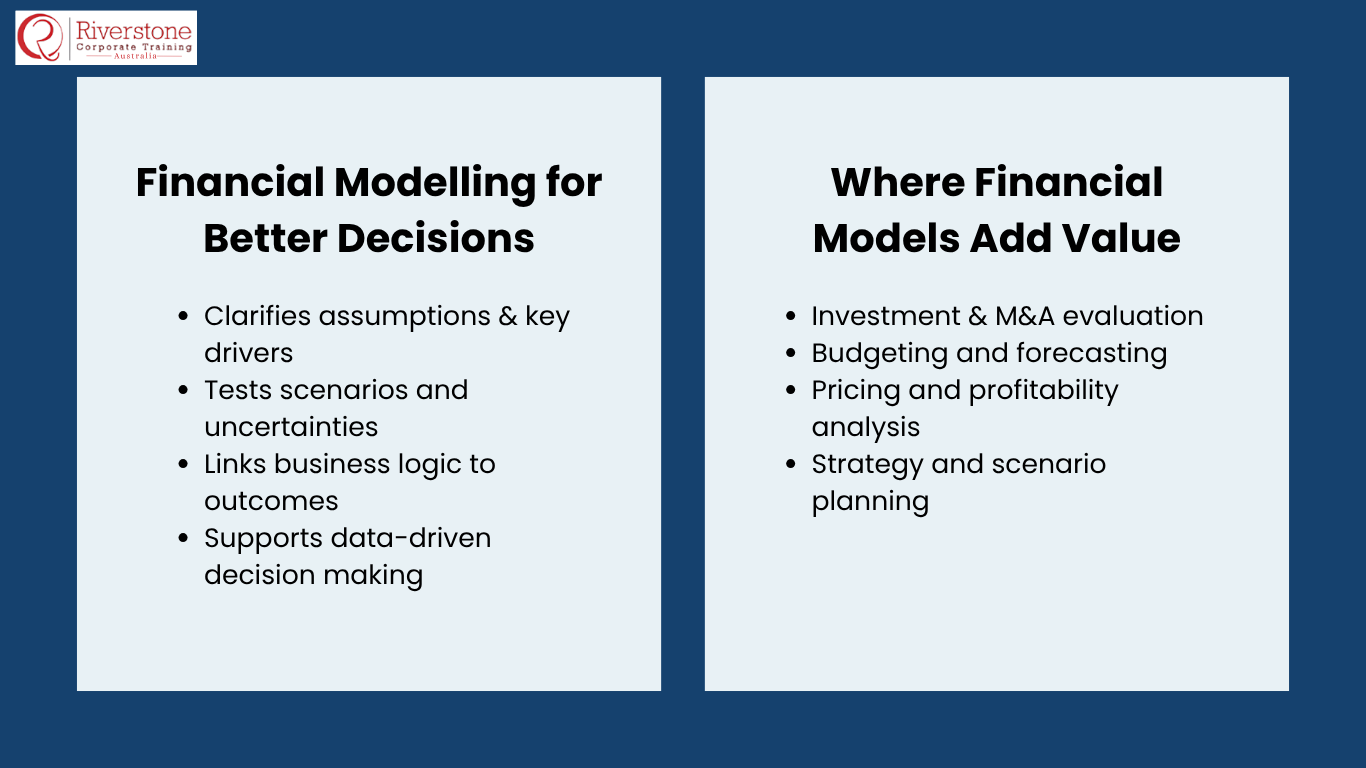
The actual application of financial modelling in the commercial world is not well understood, even by those who regularly develop financial models. The typical misunderstanding is that the key use of a financial model is to generate a number – a value, a return, a profit – that the decision-maker can use to guide action. The real value of a financial model is not the output number but the process of thinking through the model that is required to build it: to make assumptions explicit, to understand the logical links between business drivers and financial consequences, and to understand which variables are the most critical for the decision’s success or failure.

  • Financial modelling for investment analysis generates insights that are not available through intuition: specifically, the systematic identification of which assumptions are the most critical – the variables where a 10% change in the assumption results in a 30% change in the output – and which can be used to focus analytical attention and risk management effort on the most critical uncertainties rather than spreading it across all the inputs.
  • Modelling for financial forecasting supports strategy by providing an organisational common language for effective strategic discussion. When the management team is considering a decision to expand into a new market, to launch a new product line, to acquire a business, having a financial model that quantifies the economic consequences of the decision under various scenarios changes the nature of the debate from a qualitative debate about the merits of competing opinions to a quantitative debate about the merits of competing assumptions: a debate that is more likely to lead to a well-informed, well-argued decision.

Modelling for business planning is not modelling for reporting – it is predictive and conditional, not descriptive and historical. A financial report describes the past; a financial model describes the future under certain conditions. This is the strength of a model: it enables the decision-maker to explore the entire space of possible futures without being locked into the most recent history or the best-case scenario.

  • Finance tools for better decision-making work by translating the complexity of the real world into a simple yet structurally valid model that can be analysed. The simplification is deliberate and necessary – a model that incorporates all possible variables in a real business would be too complicated to build, too difficult to analyse, and too hard to explain. The art of modelling is the art of getting the right simplifications – those that capture the essential structure of the decision, filtering out the distractions.
  • The most valuable insights from a financial model are not the base-case projections but the sensitivity analysis and scenario analysis that define the model’s limits: the circumstances under which the decision is no longer right (is it still right if revenue growth is 20% below the base case?), the factors that have the most influence on the decision (a 1% change in WACC has a greater impact than a 5% change in operating costs), and the irreversible decisions that should be postponed until certain uncertainties are resolved.

03 The Decision Contexts Where Financial Models Add Most Value

The use of financial modelling for decision-making is valuable in more business contexts than many people think. The most well-known – valuation for mergers and acquisitions – is only one of many. Capital investment appraisal, business planning and budgeting, pricing decisions, restructuring analysis, debt capacity assessment, and scenario analysis are all examples of decision contexts where a sound financial model provides insights that intuition or rules of thumb can’t.

Table 1: Financial Modelling Applications — Decision Contexts and Key Model Types

Decision Context Type of Model Required Key Output Required Primary Decision Supported
Capital investment appraisal Project financial model — NPV, IRR, payback period NPV at hurdle rate; IRR vs WACC; payback period; sensitivity to key variables Invest or decline; prioritise between competing projects; identify optimal timing
M&A acquisition valuation DCF + market multiples; LBO model for PE acquisitions Enterprise value range; equity value per share; price vs value assessment Bid price; structure of consideration; walk-away price
Business planning and budgeting Integrated three-statement model; driver-based budget model Revenue, cost, and margin projections by period; cash flow and working capital requirements Resource allocation; headcount planning; financing needs; performance targets
Pricing and margin analysis Unit economics model; contribution margin analysis Gross margin by product/segment; breakeven volume; price sensitivity Pricing strategy; product mix decisions; cost reduction priorities
Debt capacity and restructuring Debt capacity model; debt service coverage analysis Maximum sustainable debt; DSCR under base and downside; refinancing risk Optimal capital structure; dividend policy; debt facility design
Market entry and expansion Market sizing model; new venture financial model Revenue potential; time to profitability; capital required; risk-adjusted return Enter or decline; phased entry strategy; required investment scale
Strategic scenario planning Long-range planning model; scenario comparison framework Financial outcomes under multiple scenarios; value at risk; strategic option value Strategic choice between alternatives; contingency planning; trigger conditions

Better decision-making through financial analysis means choosing the right model for each decision, rather than using a standardised approach regardless of the decision context. A company that uses an acquisition DCF model for a pricing decision, or a sensitivity table for a restructuring decision, is misusing its model. Knowing what model type is suitable for what decision context – and why – is one of the most important decisions in the practice of data-driven business decisions in finance.

  • The most widely applicable model type is the scenario comparison model. This model structure explicitly develops two or three different sets of assumptions (representing different commercial scenarios). It maps their financial consequences, enabling the decision-maker to understand how the decision shifts under different future scenarios. This approach to scenario analysis is valuable for all important business decisions, regardless of the quantitative method applied.
  • The most misused model type is the DCF valuation, which is extremely useful for decisions where the value of future cash flows is the major value driver (ongoing businesses, capital investments, long-term contracts) but misleading for decisions where optionality, competitive positioning and relationships are the major value drivers. It is critical to understand the limits of each method’s application, just as it is critical to understand how to build the method.

04 The Anatomy of a Decision-Useful Financial Model

Knowing how to use financial models in practice means understanding what makes a model useful for decision-making, rather than simply providing numbers for a report. It is not the model’s complexity; it is its structure and analysis that make its logic visible, its assumptions testable, and its results directly relevant to the decision question.

  • A decision-useful model is based on a decision question – a specific question that the model answers. ‘Should we buy this business for $200 million, creating value for our shareholders?’ is a decision question. ‘What is the value of this business?’ is not – it is too vague to guide model development. Writing the decision question explicitly before designing the model results in a more targeted and useful model.
  • All assumptions in a decision-useful model are sourced, documented and verifiable. This means not only documenting the number used for an assumption (8% annual revenue growth rate) but also why that number was used (the average of the last three years’ growth rates of the comparable peer group as sourced from Bloomberg), what the range of alternative plausible numbers is (the comparable peer group ranges from 4% to 14% annual growth) and what the model’s conclusion is sensitive to, given that range.

Finance tools for better decisions are effective when they are designed from the perspective of the reader – when the model’s structure, naming conventions and presentation of results anticipate the questions that the decision-maker will want to ask and present the requested information as directly as possible. A model that forces the reader to search through 15 tabs, infer results from underlying data, and request additional calculations to answer the next set of questions is unlikely to have an impact on the decision-making process.

The most critical aspect of designing a decision-useful model is separating assumptions from calculations. When assumptions are baked into formulas – as literal constants in the calculation sheets – the model can’t be updated, can’t be audited, and can’t be stress-tested. When assumptions are collected on a single input sheet, clearly identified, and called from the calculation sheets, the model becomes an adaptable tool that can be readily re-configured to explore different scenarios.

  • Scenario design – how a model transitions between sets of assumptions – is the model design feature that is most directly linked to decision-usefulness. A model with a scenario toggle (a single cell that switches the entire model between Base, Upside and Downside assumption sets) lets the decision-maker quickly explore the full range of possible outcomes without having to reconfigure the model.
  • Sensitivity analysis tables – in particular, the two-variable data tables in the What-If Analysis tool in Excel – are the most decision-useful output of a financial model, because they provide a direct visual representation of the change in the key output metric across the entire range of combinations of the two most significant assumptions. This is usually a table of enterprise value across combinations of WACC and terminal growth rate for a valuation, and NPV across combinations of revenue growth and margin for an investment.

05 Five Key Steps: Building Models That Support Better Decisions
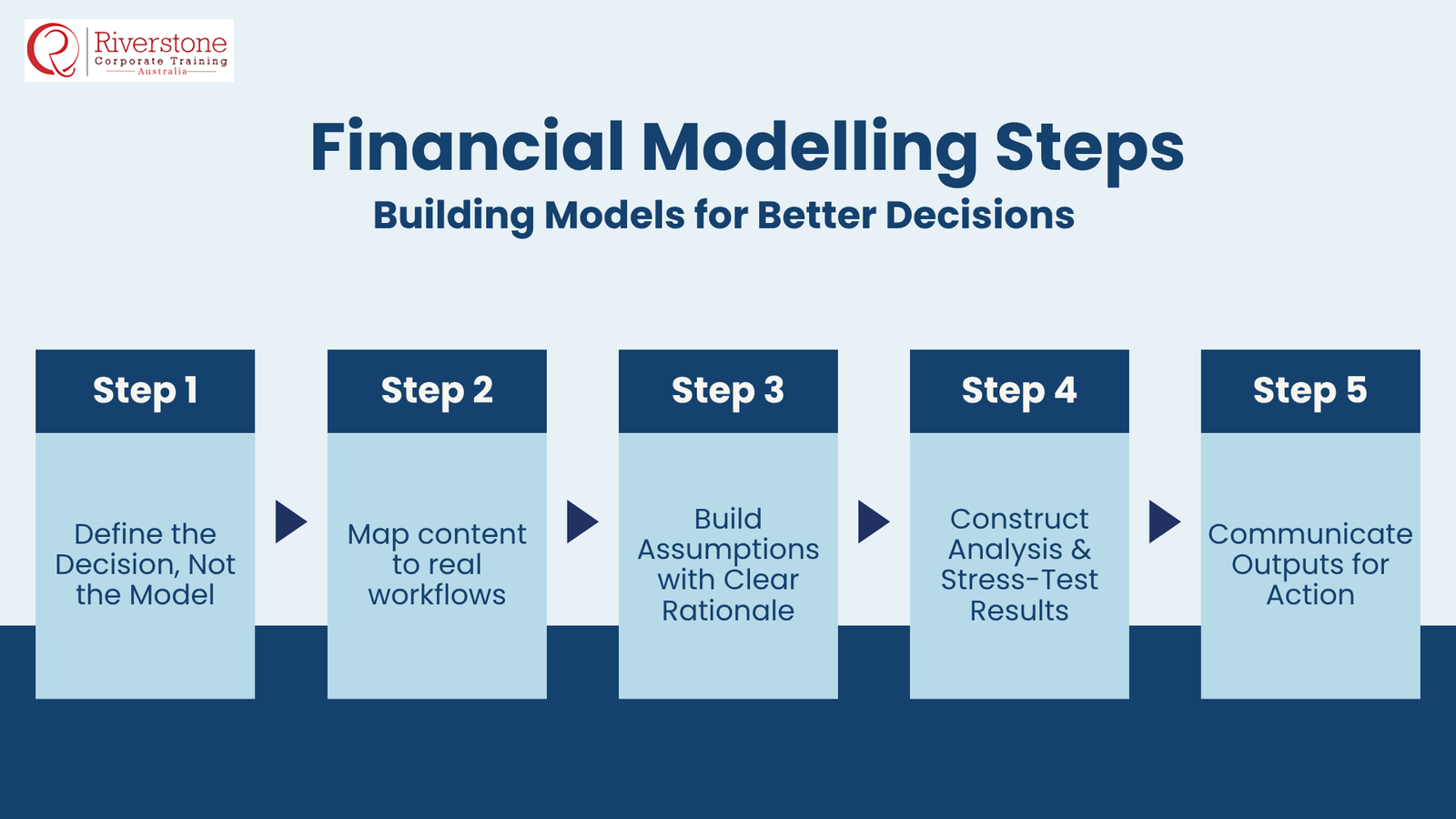
The process of financial modelling for decision making breaks down into a five-step sequence, from decision to model delivery. Knowing this process – and the specific analytical skills required to get the job done – provides an operational guide to building models that support better decisions, rather than generating analytical results that are not relevant to the decision-making process.

Step 1 — Define the Decision, Not Just the Model

The first – and most critical – step in developing a decision-useful financial model occurs before the model is ever created: the explicit definition of the decision that the model will be used to support, the intended users, and the information needed to make that decision.

  • Specifying the decision means answering three questions: What is the decision? Who is making the decision, and what do they need to know? And what might change the recommendation – what alternative scenario or assumption would lead to a different decision? The answers to these three questions shape the model’s structure, the level of detail, and the outputs required.
  • Building a model before the decision question is fully defined is the most common error in modelling for business planning – it usually results in a model that is too complex, that answers questions that the decision-maker does not need answered, at a level of detail that is not required, and does not address the uncertainties that make the decision complex.

Step 2 — Map the Business Logic Before Opening Excel

Data-driven business decisions in finance mean the model should reflect the business reality of the decision, not a financial model template. The analyst should draw a diagram or write out the causal chain from business drivers (number of customers, price, cost per unit, market share) to financial results (revenue, margin, cash flow) before creating formulas.

  • Mapping the business logic is important for two reasons: first, it ensures that the model reflects the correct causal relationships (avoiding the common pitfall of modelling revenue as a top-line growth rate, but not connecting it to the business drivers), and second, it highlights the most important value drivers – those elements in the causal chain where the business reality is most uncertain and where the financial results are most sensitive.
  • The model architecture decisions at this point – the level of detail in the revenue build, treatment of working capital, tax and depreciation – will be costly to alter in the future without rebuilding the model. Time spent on architecture before adding content is the most effective use of time in the model development process.

Step 3 — Build the Assumptions Layer with Documented Rationale

The assumptions layer is the analytical core of any model for financial forecasting for strategy – it is where the analyst’s commercial judgement is translated into quantitative terms, where the model’s quality is made or broken. Each assumption should be traced to its source, benchmarked against evidence (if possible) and documented in enough detail to allow a sceptical reader to evaluate its reasonableness.

  • The quality of assumptions is measured along four lines of questioning: is it evidence-based (historical, industry, management)? Is it consistent with other assumptions in the model? Does it make sense in the circumstances of the decision? And is it clearly documented so that another analyst would make the same decision?
  • The budget accuracy test – comparing the previous year’s assumptions with the actual results – is the most effective way to test the quality of assumptions in recurring models (such as annual budgets or strategic plans). Any assumptions that have been consistently optimistic or pessimistic should be adjusted, and the adjustment documented.

Step 4 — Construct the Analysis and Stress-Test the Conclusions

With the assumptions on the table, the analytical construction of the model turns them into financial outcomes that answer the decision question. The construction should follow the logic detailed in Step 2, from drivers to revenues, costs, earnings, and cash flows, in a logical, arithmetically verifiable sequence.

  • When financial models are used for investment analysis, the analytical construction should be followed by a stress test – running the model under a downside case to test the decision’s resilience to adverse conditions. The downside case is not the worst case (which would paralyse all decision-making) but a plausible adverse case that the decision-maker should be prepared to deal with.
  • Sensitivity analysis should be run on the two or three assumptions that most affect the output, determined by a simple one-variable sensitivity analysis that measures the change in the output for a given change in each assumption. The assumptions that cause the biggest changes in the output are the ones that should be most closely scrutinised, benchmarked and managed.

Step 5 — Communicate the Outputs for Decision Action

An analytically sophisticated model cannot be used to improve decision quality if its outputs are not communicated in a way the decision-maker can easily understand, challenge, and put into action. Finance decision support tools for business that are technically sound but poorly communicated are one of the most frequent – and avoidable – sources of value destruction in finance practice.

  • Communication of decision support should present the conclusion first (the model’s recommendation, and why it should be followed) before the analysis. If a 20-page model output is presented to a decision-maker before he or she knows what the model recommends, then the decision-maker will have already developed an opinion about what is best and is less likely to be persuaded that the model is correct.
  • The optimal format for communicating decision support is a one-page summary that includes the recommendation, the three most important assumptions underlying it, the sensitivity of the recommendation to changes in those assumptions, and the risks that could change the recommendation. It saves the decision-maker’s time and provides the information required to make a decision.

06 Real Applications of Financial Modelling Across Business Contexts

Real applications of financial modelling across different business settings show how the same decision analysis principles – clear assumptions, scenario design, sensitivity analysis, and communication focused on the decision – lead to better decision-making in as different settings as the first pitch to investors for a new business, the capital allocation meeting of a global corporation, and the acquisition decision for a mid-sized company.

The Capital Investment Decision — A Manufacturing Expansion

A European manufacturing company was considering a $45 million investment in a new plant to support export growth. The original business case prepared by the operations team had a 4-year payback and a positive NPV. Still, the financial analysis team felt that the revenue estimates were based on existing export demand without any sensitivity analysis for demand and exchange rate ranges.

  • The financial modelling for decision making exercise re-built the investment model with three additions: a demand sensitivity analysis (showing the IRR and payback period at 60%, 80%, 100% and 120% of the projected export demand), an exchange rate sensitivity analysis (showing the impact of a 15% adverse movement in the currency pair on both NPV and payback), and a phased investment option (the option of staging the investment – committing to the first half of the facility and optioning the second half – to reduce downside risk while keeping most of the upside).
  • •The result was that the full investment was justified at the base case, but that the phased investment option had significantly superior risk-adjusted returns because the downside (with a 20% shortfall in export demand) was reduced from a negative NPV to a break-even NPV. The choice to go ahead with the phased investment was driven by the scenario and sensitivity analyses made possible by the financial model. This is a typical example of better decision-making using financial analysis: not making a different decision, but making a better decision about the structure of the underlying decision.

The M&A Assessment — Evaluating a Bolt-On Acquisition

A North American technology services firm was considering acquiring a smaller rival with some common customers in a market where the acquirer had a weak presence. The target was profitable, with $8 million in EBITDA on $40 million in revenue, and had an indicative price of $60 million (7.5x EBITDA).

  • The investment analysis with financial models showed that the target business was worth around $55-65 million on a DCF basis (in line with the indicative price) but that the target with the revenue synergies (70% retention of target’s customers, cross-selling of the acquirer’s high margin services to that customer base, and removal of redundant costs) was worth $80-90 million to the acquirer. The model was designed to highlight the contribution of synergy and to test it separately, by including a clearly identified synergy module that could be switched on and off with a simple checkbox.
  • The lesson: data driven business decisions finance in an M&A context requires that the model separate the standalone value of the target (what it would be worth to a financial buyer with no synergies) from the strategic value to the specific acquirer (what it is worth with the acquirer’s specific synergies) – because conflating the two produces a bid price that either overpays for synergies that may not materialise or undersells the strategic benefit of the acquisition.

The Budget Model — Driver-Based Forecasting for a Retail Group

A 45-store regional retailer was disappointed that the annual budget process was not yielding accurate forecasts: budgeted revenue was consistently overrun by 15%, and costs were consistently underestimated. The CFO thought this was due to a problem with the methodology: the budget was a percentage increase on the previous year’s numbers, rather than being based on the drivers of the business that drove the financial performance.

  • The financial forecasting for the strategy model was reconstructed from store-specific drivers: average transaction size by category, transactions per store by store type, foot traffic by store location, cost of labour per hour, and store-specific fixed costs. This driver-based structure resulted in a forecast that was 40% more accurate in its first year of use – not because the assumptions underlying the individual drivers were any better, but because the model structure brought them to the surface for discussion at the management level, rather than hiding them in the top line growth rate.
  • The take-out: modelling for accurate business planning is not about the complexity of the analytical methods used; it is about the fit of the model structure to the business. A model that maps how the business makes and spends money will be more accurate than one that applies a mathematical transformation to last year’s results, no matter how sophisticated that transformation is.

07 Common Modelling Mistakes That Undermine Decisions

The errors that undermine financial modelling for decision making in practice can be divided into three broad classes: structural mistakes (mistakes in the way it is constructed that undermine the integrity of the model), analytical mistakes (mistakes in the way it sets assumptions or works its logic), and communication mistakes (mistakes in the way it is presented that undermine its ability to influence the decision).

Table 2: Financial Modelling Process — Phases, Activities and Common Failure Points

Phase Key Activity Common Failure Mode Best Practice Response
Decision definition Specify the decision question, audience, and required outputs Building the model before clarifying the decision — producing outputs that don’t address what the decision-maker needs Write the decision question explicitly before opening Excel; confirm with the decision-maker what outputs they need before beginning
Business logic mapping Map the causal chain from business drivers to financial outcomes Applying a generic model template rather than mapping the specific business logic of the decision Sketch the driver-to-output logic on paper before building; trace the revenue and cost logic through the actual business model
Assumption setting Source, document and calibrate each material assumption Assumptions embedded in formulas rather than on a dedicated inputs sheet; assumptions set without evidence or benchmarking All hardcoded inputs on a dedicated assumptions sheet; every material assumption sourced and documented
Model construction Build from drivers through to outputs using consistent formula discipline Circular references, formula inconsistencies, and links to external files that break when the model is shared Build sequentially from inputs through to outputs; test formulas as you go; minimise external links
Stress testing Run downside scenario and sensitivity analysis Presenting only the base case without scenario or sensitivity analysis — creating false precision Always run a plausible downside case; produce a two-variable sensitivity table for the key output metric
Output communication Present conclusions with supporting evidence in a decision format Leading with methodology and data before the conclusion makes it difficult for the reader to extract the recommendation Lead with the recommendation; follow with the three most important supporting assumptions; present sensitivity in a clean visual format

The single most important mistake that is made in practice when using financial models is to build a model that cannot be audited – whose formulas cannot be traced, whose assumptions cannot be changed reliably, and whose results cannot be traced back to a logical flow from inputs. An unauditable model is not a trustworthy model, and a model that is not trustworthy will not improve the decisions it is supposed to support, even if it is technically sophisticated. Designing auditability into the model from the beginning is not a nice-to-have; it is essential to any model meant to inform important decisions.

  • The false precision error – showing a DCF valuation to two decimal places, or a five-year revenue forecast to the nearest thousand dollars, in a situation where the assumptions underlying the model are subject to ±20% uncertainty – is a frequent communication failure in financial modelling. False precision leads to false certainty about conclusions that should be expressed in ranges, and it implicitly elevates the epistemological threshold for questioning assumptions that should be questioned.
  • The optimism bias in assumptions is the most common analytical error – the tendency to overestimate revenue growth and underestimate cost growth, relative to historical data or industry benchmarks. Finance for better decisions must explicitly counter this bias by explicitly addressing the use of similar historical data, benchmarking and downside scenario analysis.

08 The Human Element — Judgement Behind the Model

Finance for data-driven business decisions is not algorithmic. The financial model, even a good one, does not make decisions – it delivers the quantitative evidence upon which decisions are made. And the quality of those decisions depends on the quality of judgement that the decision-maker brings to the model’s outputs: an ability to judge whether the model’s assumptions are reasonable, to identify the risks that the model cannot measure, and to synthesise the analytical evidence with the qualitative factors – management quality, cultural fit, competitive environment, regulatory risk – that financial models can reveal but not fully account for.

  • The worst possible state for investment analysis with financial models is a decision-making culture where the model is seen as the final arbiter – where the decision supported by the model is the decision that is made, regardless of the qualitative factors that might suggest caution. Models should be used to frame a dialogue about the risk and return, not as a substitute for it.
  • The other dangerous state is a decision-making culture where models are seen as compliance exercises rather than analytical tools – where they are built to support a decision that has already been made, rather than to inform a decision that is still open. A model built to justify a preconceived decision is not a decision-support model; it is a rationalisation tool that gives the appearance of rigour without substance.

The best financial modelling practitioners for decision-making are those who bring a healthy dose of intellectual curiosity and commercial scepticism to the modelling process – who ask themselves questions, look for evidence that contradicts their initial assumptions, and are willing to conclude that the analysis does not support the decision they wanted to support. This integrity is what builds trust in models, and trusted models are used.

  • Business decision support tools in finance that are trusted by senior decision-makers are invariably those whose practitioners dare to tell the truth – to advise the acquisition committee that the price is too high, to advise the CFO that the business plan is over-optimistic or to advise the board that the strategic alternative they hadn’t considered is financially better than their favourite alternative.
  • Developing the courage to challenge conclusions through rigorous modelling, rather than conforming to the conclusions the decision-maker would like to draw, is the most important professional development goal for any finance professional who wants to be a decision-support resource, rather than a technical resource, to the business.

09 Building Your Modelling Capability for Better Decision Support

To support better decision-making with financial analysis, it is essential to develop a modelling capability that integrates technical Excel skills, commercial judgement and communication skills. The journey is not a straight line – technical skills can be developed rapidly through practice. Still, commercial judgment develops over time as experience is gained in decision-making and in observing the dynamics of business. The best approach to development is a combination of technical skills development with exposure to the commercial environment in which models are used.

Table 3: Financial Modelling Capability Development — A Progression Framework

Development Stage Technical Focus Commercial Focus Communication Focus Practice Activity
Foundation (0–6 months) Excel proficiency; three-statement model construction; basic DCF Understanding how businesses generate revenue and incur costs, and reading financial statements analytically Presenting analysis to a manager; writing an analytical memo Rebuild published financial models from scratch using annual report data
Development (6–18 months) Scenario and sensitivity analysis; LBO modelling basics; driver-based forecasting Value driver analysis; business model assessment; industry benchmarking One-page executive summary writing; presenting to a non-finance audience Build 3–4 models for real decisions (capex appraisals, budget revisions, pricing analysis)
Proficiency (18 months – 3 years) Complex scenario architecture; acquisition modelling; project finance basics Investment thesis formation; competitive analysis; strategic option evaluation IC and board presentation support; persuasive written recommendation Lead the modelling on a live transaction or strategic planning process
Advanced (3+ years) Multi-entity consolidation; cross-border valuation; advanced sensitivity frameworks Strategic advisory; capital structure optimisation; sector-specific modelling conventions Presenting and defending conclusions to senior decision-makers Lead decisions end-to-end; review junior modelling work; develop team capability

The most effective single practice activity to build the real use of financial modelling decision support skill is to dissect and rebuild publicly available models – the financial models in scheme booklets, independent expert reports and equity research reports from investment banks and advisory companies. These documents contain models built by professionals for real, critical decisions and examining these models shows the analytical decisions, model structures and communication strategies used by practitioners much more clearly than any classroom example.

  • Building a simple model for all major decisions you come across (even though they may not be part of your official job description) is the best way to develop the business acumen that sets the experienced practitioner apart from the technically competent novice. The model for your personal investment, career choice, or hypothetical business uses the same skill as the model for a corporate acquisition.
  • Soliciting feedback from non-finance colleagues on the outputs of models you build – specifically, whether the executive summary effectively communicates the recommendation and whether the supporting analysis answers the questions they want answered – builds the communication skill component of modelling competency that is impossible to develop through technical skill-building alone.

10 Conclusion and Actionable Insights

Decision-making financial modelling is not most valuable as a technical skill in building spreadsheets, but as a process of structured thinking about the future – a way to make the decision assumptions explicit, the risks transparent and the range of possible outcomes apparent. The use of financial models in practice, as required by today’s finance professionals, is not about how to build models but about why certain model structures and analytical approaches are used to shape decisions, rather than simply provide a quantitative context for decisions that have already been made.

The practitioners who become best known as business decision support tools in finance are those who combine their financial modelling skills with commercial judgement, integrity and communication skills – those who can tell the decision makers what they don’t want to hear, when they are justified in doing so, in a way that gets them to change their decision. Data-driven business decisions: Finance at this level is one of the most highly valued skills in the modern business world, and one that grows in value with every model constructed, every decision supported, and every problem solved.

  • Focus on the decision question – write it down first. The question determines the scope of the model, the usefulness of the results and the likelihood that the analysis will inform the decision.
  • Always start with the assumptions layer and make all material assumptions visible, sourced, and documented. If you can’t find and change the assumptions, you don’t have a decision-support model; you have an unreliable calculation.
  • Always run and report a credible downside scenario. Strategic financial forecasting that only presents the best case leads to overconfident decision-making; the downside case is the insurance policy that stops the worst decision-making.
  • Conclusion before method: Models are not read to be understood – they are ready to make decisions. Organise all communications of outputs to answer the decision question as quickly as possible.
  • Build commercial judgement as well as technical ability – using financial analysis to improve decisions requires an appreciation of the business environment in which the model is being used. Look for opportunities to work on real decisions, real business problems, and real commercial discussions, and view every engagement as an opportunity to develop the analytical judgement that makes technical modelling useful for decision-making.