

- 01 Introduction
- 02 What Is Project Finance and Why Does It Matter?
- 03The Australian Renewable Energy Landscape
- 04 Project Finance Structure and Key Participants
- 05 Five Key Steps: The Project Finance Process
- 06Project Finance Cash Flow Modelling in Practice
- 07 Renewable Energy Case Studies
- 08Common Challenges and Lessons Learned
- 09Building a Career in Project Finance
- 10Conclusion and Actionable Insights
Project Finance in Australia:
Renewable Energy Case Studies and Practical Modelling
Table of Contents
01 Introduction
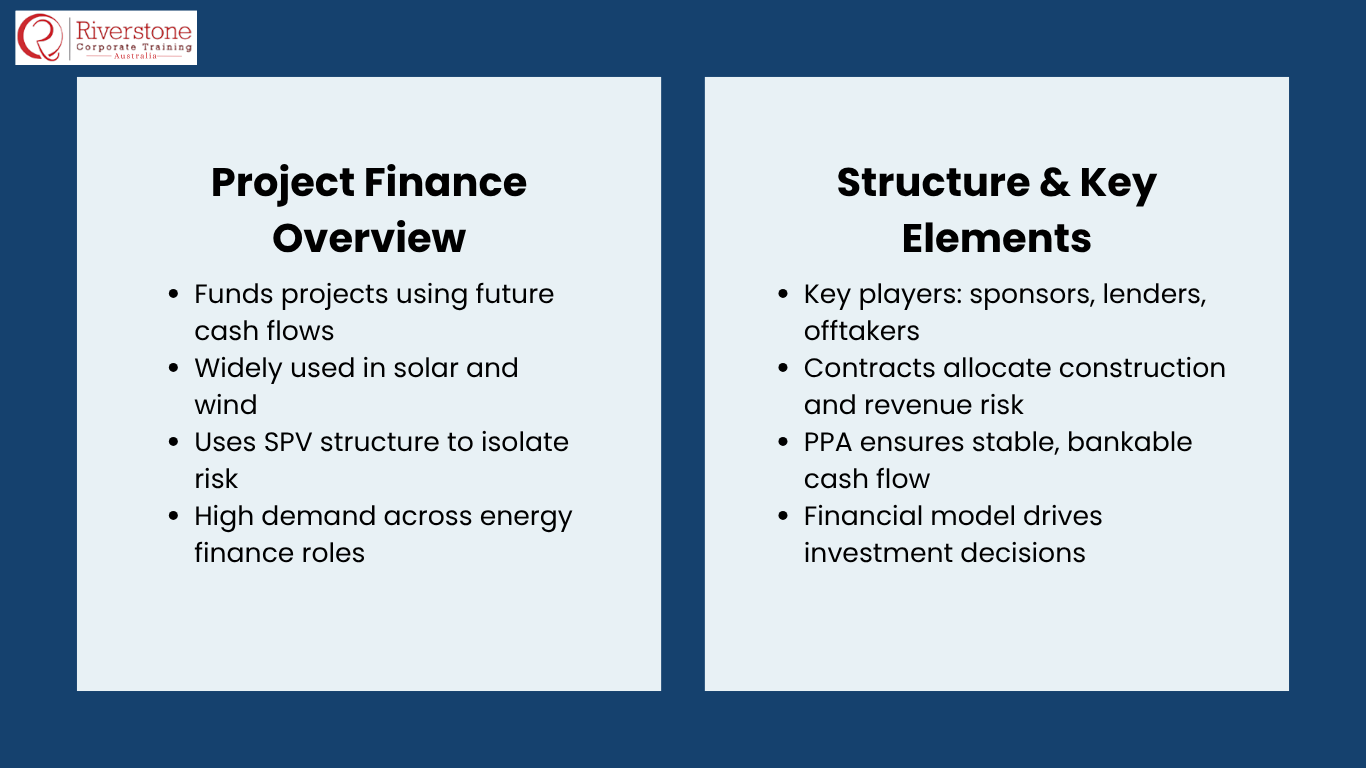
The project finance concept in Australia is straightforward: a way to finance a large infrastructure or energy project through a special-purpose vehicle (SPV), in which lenders rely primarily on the project’s cash flows rather than the balance sheets of the project sponsors for repayment. In reality, this idea leads to one of the most complex, technically challenging and commercially significant areas of finance. For the new generation of energy professionals, infrastructure bankers and advisors being shaped by the rapid shift to clean energy, project finance is not just a fluency; it is the lingua franca of the transactions that will shape the next three decades of Australian infrastructure.
- Large-scale finance of renewable energy projects requires a structure that matches the capital intensity, long-lived nature, and contracted revenue streams of wind, solar, battery, and hybrid energy assets, making project finance the preferred structure for large-scale renewable energy projects worldwide, including in Australia.
- The professionals who develop careers in the energy-finance-infrastructure nexus – in project finance banks, infrastructure funds, energy developers, corporate advisory firms, and government – consistently cite proficiency and knowledge in project finance modelling as the most immediately marketable skills in a sector growing faster than the talent to staff it.
Australia’s infrastructure finance sector is in a structural growth phase as a result of the energy transition, with renewable energy investment the largest new source of infrastructure finance. According to the Clean Energy Regulator, Australia’s large-scale renewable energy capacity has more than tripled over the last 10 years, with billions of dollars in new investment each year in large-scale solar, wind, battery storage, and hybrid projects. Each of these projects needs a project finance structure – a debt package, an equity stake, a revenue contract and an energy investment analysis process to determine whether the project economics justify the capital being put at risk.
- For early- and mid-career professionals, the technical modelling, structural and commercial know-how in the sector that this article delivers is the professional skill set that is needed to work across the project finance ecosystem – from banks and equity investors, to developers, advisers and government authorities.
- This primer covers the entire spectrum of project finance: what it is, how it is structured, how the financial model works, what the case studies reveal about the theory and practice of project finance, and how to develop the skills that the fastest-growing infrastructure sector in Australia is seeking.
|
Project finance is the intersection of engineering and banking, and of the energy transition and capital markets. Those who know both sides of the coin – the real asset and the financial deal that finances it – are among the most in-demand of the modern economy. |
02 What Is Project Finance and Why Does It Matter?
Project finance Australia explained at its core is the structuring of a financing transaction in which the service of the debt – that is, the repayment of principal and interest – is secured by the cash flows of a particular project, rather than the balance sheets of the sponsors that build the project. This non-recourse or limited-recourse structure is what sets project finance apart from corporate debt. It is why the financing structure used for large, capital-intensive assets with long lives and contracted cash flows is.
- Non-recourse means that if the project fails to generate enough cash flow to service the debt, lenders’ recourse is limited to the project assets – not the sponsors’ balance sheets. This means that lenders must be very confident about the revenue stream’s predictability before they will lend.
- Limited recourse – the more common commercial form – provides the lenders with some recourse to the sponsors during the construction period (before the revenue stream has commenced) but becomes almost non-recourse once the project is operating and the cash flows are contracted.
Project finance is used in infrastructure finance in Australia for a simple reason: the types of projects being financed, such as power stations, motorways, pipelines, and desalination plants, are generally too large, too long-lived, and too capital-intensive to be financed solely from the sponsor’s corporate balance sheet. The SPV structure allows sponsors to fund multiple projects without individual sponsors’ balance sheets being tied up. It allows lenders to evaluate each project’s creditworthiness independently of the rest of the corporate group.
- The SPV structure also offers valuable legal safeguards: if one of a developer’s projects runs into trouble, the problem remains confined to the SPV in which it is housed and does not spill over into other projects – an essential risk management tool for sponsors and lenders alike.
- Project finance’s commercial rationale is founded in the concept of bankability: the combination of factors – contractually committed revenue, creditworthy offtakers, proven technology, experienced operators, and appropriate reserve mechanisms – that give lenders confidence in the cash flow predictability of the project, and lead to the provision of long-term debt at an acceptable price.
03 The Australian Renewable Energy Landscape
Energy investment analysis in Australia is embedded in a renewable energy market that has undergone structural change at an unprecedented pace and scale. This combination of declining technology costs, state and federal renewable energy policy and market frameworks, corporate power purchase agreement (PPA) demand from large commercial and industrial electricity users, and the growing capital allocation by global institutional investors to clean energy assets has created a renewable energy pipeline that is one of the most active project finance markets in the Asia-Pacific.
- Large-scale solar PV is the technology of choice for the new generation in the eastern states, with projects ranging from 50 to 400+ MW. The dramatic reduction in the cost of solar cells over the past ten years has established solar as the cheapest source of new generation in most Australian markets – and with that comes both the investment opportunity and the financing challenge of managing the merchant price risk associated with unsubsidised projects.
- Wind (including offshore) remains a major component of the renewable pipeline, especially in regions with high-quality wind resources. While still in its infancy in Australia, offshore wind is also drawing institutional investment as the regulatory environment develops.
The valuation of solar and wind projects in Australia needs to reflect the regulatory and market environment, which differs from that found in Europe and North America. The lack of a national feed-in tariff, the use of wholesale electricity market pricing and PPAs as the main revenue streams, the geographical concentration of renewable resources in areas that are sometimes remote from demand centres, and the particular features of the National Electricity Market (NEM) and Wholesale Electricity Market (WEM) all impact the risk profile and the project finance structure of Australian renewable projects in ways that must be understood.
- Energy storage systems (BESS), whether standalone or integrated with solar or wind generation, are the fastest-growing segment of the project finance market, with ancillary service revenues, capacity market revenues, and wholesale arbitrage opportunities that fill gaps in the intermittent output of renewable generation.
- The transmission and network assets needed to support new renewable generation represent the next wave of Australian infrastructure finance, with substantial government co-investment in the Renewable Energy Zones and transmission upgrades creating a new type of project finance opportunity for infrastructure financiers.
04 Project Finance Structure and Key Participants
Knowing the structure of a project finance transaction – who the players are, what they do, and how the contractual relationships between them result in the risk allocation that makes a project bankable – is the common language that allows anyone in the ecosystem to play their part.
- The project sponsor is the developer or equity investor who conceives the project, develops it, secures approvals, provides the equity investment, and bears the residual risk after debt service. Sponsors can be infrastructure funds, energy developers, utilities, or industrial companies looking to meet their own renewable energy demand with a captive power generation facility.
- Senior lenders, which are usually commercial banks, multilateral development banks (such as the Clean Energy Finance Corporation, Export Finance Australia, or the Asian Development Bank), or institutional debt investors, provide long-term senior debt that typically comprises 60-80% of the project’s capital structure. They have a first call on the cash flows, but accept a lower yield in return for that priority.
The funding of large-scale renewable energy projects involves a thicket of contracts that allocate risk to the party best able to manage it. The offtake agreement (usually a power purchase agreement or a contract for difference) generates the cash flows needed to service the debt. The engineering, procurement, and construction (EPC) agreement allocates construction risk to the contractor through fixed-price, date-certain contracts with performance guarantees. An operations and maintenance (O&M) contract allocates operational risk to an operator. The grid connection agreement allocates grid connection risk to the grid connection company. These agreements are what convert an asset into a project finance deal.
- Technical advisers (often specialist engineering firms) assess the project’s technical aspects for lenders: power output, technology risk, grid connection, and environmental impact.
- Legal advisers, financial advisers, insurance advisers and model auditors round out the professional team for a complex project financing – each with their specialist contribution to the due diligence and documentation process leading up to financial close.
Table 1: Key Participants in a Renewable Energy Project Financing
| Participant | Role in the Transaction | Primary Concern | How They Assess Risk |
|---|---|---|---|
| Project Sponsor / Developer | Originates project; contributes equity; manages development and construction | Returns on equity, development fee, and long-term asset value | Project IRR; equity MOIC; exit value at refinancing or sale |
| Senior Lenders (Banks / Debt Funds) | Provide long-term project debt (typically 60–80% of capital structure) | Debt service coverage, lender protections, security package | DSCR across project life; P90 energy yield; downside case coverage |
| Equity Co-investors (Infrastructure Funds) | Co-invest equity alongside sponsor; may acquire sponsor’s equity at COD | Stable, predictable long-term cash yield; inflation linkage | Equity IRR; dividend yield; portfolio diversification |
| Offtaker / PPA Counterparty | Purchases electricity under a long-term offtake agreement | Price certainty; supply reliability; regulatory compliance | Creditworthiness of counterparty; contract term vs asset life |
| EPC Contractor | Builds the project under fixed-price, date-certain terms | Construction margin, technology performance, cost overrun risk management | Technical risk, supply chain, performance guarantees |
| O&M Operator | Operates and maintains the project over its useful life | Operating fee, performance incentives, and major maintenance obligations | Technology reliability, staffing capacity, and maintenance cost forecasting |
| Government / Regulator | Grants development approvals, grid connection, and policy framework | Policy objectives, community support, and grid stability | Environmental impact; community engagement; grid code compliance |
05 Five Key Steps: The Project Finance Process
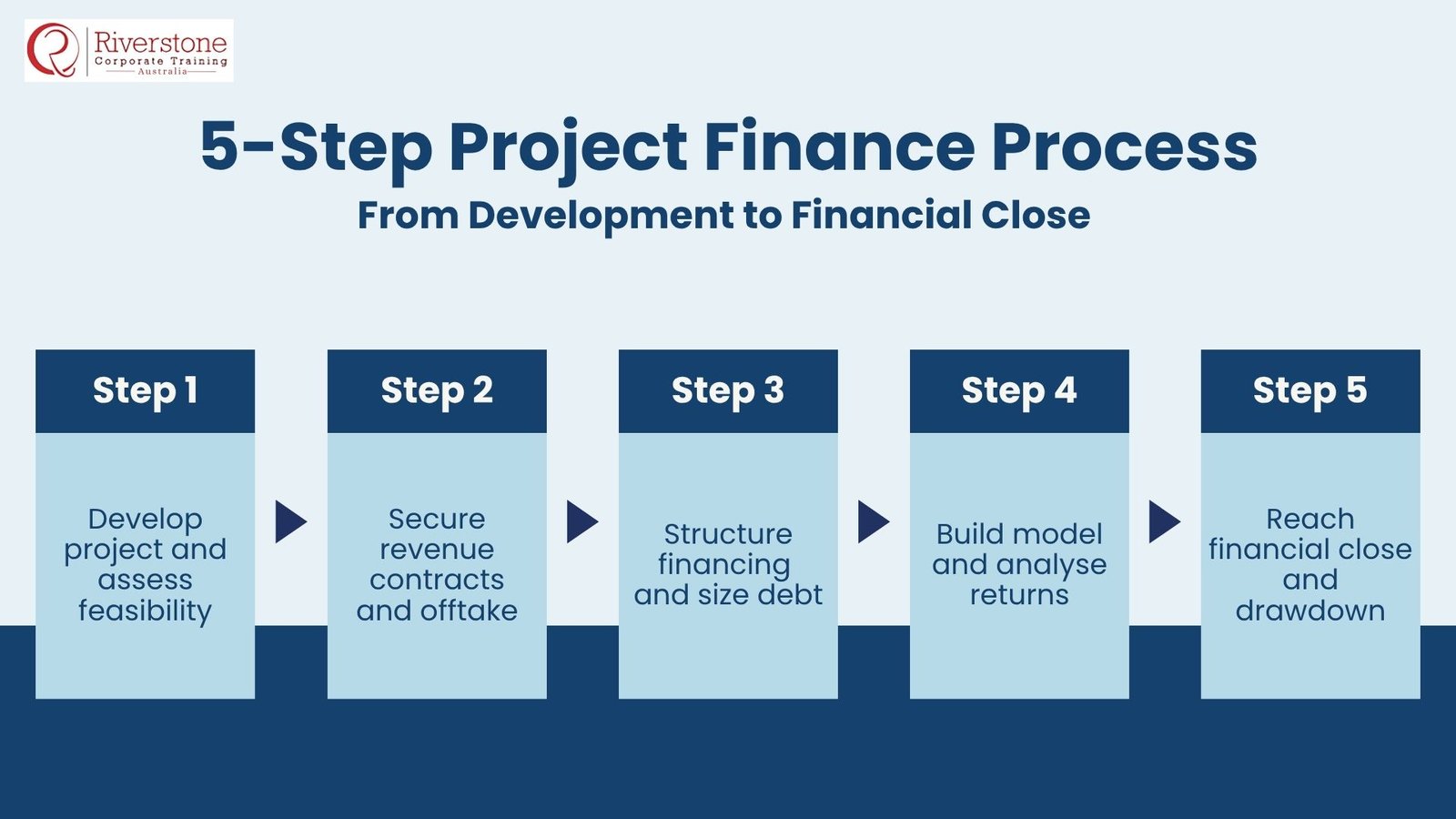
The case studies of project finance examples follow a process of development and financing that runs from project feasibility to financial close and drawdown of construction funding. This process – and the attendant analysis and documentation requirements at each step – is the operational knowledge that allows junior professionals to play an active role from the earliest part of their project finance careers.
Step 1 — Project Development and Feasibility Assessment
This is the stage at which the project is identified and developed, including the development approvals, grid connection and commercial agreements that establish the project’s revenue model. This is usually the longest and most commercially uncertain phase in the project development cycle – the time from site identification to financial close for large-scale renewable projects can be three to seven years.
- The energy yield assessment, usually prepared by an independent expert using long-term wind or solar resource data, energy production modelling software and site-specific data, is the key technical input to the project’s financial model. The P50 (median) yield, P90 (generation exceeded in 90% of years) yield, and P99 yield are used in various ways in the financial model.
- Grid connection and network access are increasingly critical development risks in Australia, where the build-up of the renewable pipeline has led to bottlenecks and uncertainty in connection queues across many areas. The cost, schedule and technical aspects of grid connection have a major impact on the project capital cost and revenue stream.
Step 2 — Revenue Contract and Offtake Arrangement
The revenue contract is the contractual structure that transforms the project’s physical output into a stream of bankable revenue. The structure of the revenue contract has changed dramatically as the Australian renewable industry has evolved, with the Feed-in Tariff regime replaced by a market increasingly dominated by bilateral PPAs and, in some cases, government-supported contracts for difference.
- The presence of a well-structured PPA (with a creditworthy corporate offtaker, fixed or floor price for a substantial portion of a project’s expected output, and at least 10-15 years term) is the most critical factor in determining the bankability of a project, as it provides the revenue certainty needed for long-term debt.
- Merchant price risk – the amount of revenue a project receives from the spot market – is the main source of revenue uncertainty in project finance. Lenders generally limit the amount of merchant exposure they will support, requiring a contracted revenue stream to support the debt, even with conservative merchant price assumptions.
Step 3 — Financing Structure and Debt Sizing
The financing structure specifies the capital stack – the debt-to-equity ratio, type and maturity of the debt – and the financial covenants and security packages that secure lenders’ interests. The size of debt in project finance is determined by the debt service coverage ratio (DSCR), an indicator of the project’s capacity to generate cash flow to cover its debt obligations.
- The minimum DSCR covenant – typically 1.15x to 1.30x for Australian renewable projects (i.e., the project must generate at least $1.15 to $1.30 of operating cash flow for every $1.00 of debt service) – is the key financial covenant that protects the lender. It is the basis for the project finance cash flow modelling.
- Australian renewable project financing arrangements typically have a debt tenor of 12-18 years, covering much of the revenue contract period and ensuring that debt is paid off before the riskiest portion of the project’s revenue stream.
Step 4 — Financial Modelling and Returns Analysis
The project finance modelling guide for renewable energy financing focuses on the project finance model. This comprehensive cash flow model forecasts the project’s revenues, costs, debt service and distributions to equity over the life of the project. It is the financial engine of the financing process and the key vehicle by which all parties analyse the project’s economics.
- The lender’s due diligence begins with the base-case model, which assumes the P50 yield of energy production, the contracted PPA price, a conservative merchant price forecast, and the project’s true cost structure. The model is then tested under the lender’s downside case (typically P90 yield, lower merchant prices, and cost overrun scenarios) to ensure that the project meets the DSCR covenant under these conditions.
- The equity investor’s due diligence is based on the equity IRR and cash yield – the return on the equity invested in the project after debt service over the life of the investment. Levered equity IRRs of 7-11% are typical for operational renewable assets for infrastructure equity investors, depending on technology, revenue contract quality and market circumstances.
Step 5 — Financial Close and Drawdown
Financial close is the point at which the financing documents are executed, and the project’s capital is committed – the end point of the development, negotiation and due diligence process that may have spanned several years. It also marks the start of construction and the drawdown of debt and equity financing to fund the project.
- The conditions precedent to financial close – the specific legal, technical, regulatory and commercial conditions that must be met before the lenders will provide debt – typically number in the tens, and represent the final due diligence hurdle the project must overcome before funds are disbursed.
- Once financial close has occurred, the project enters the construction period, during which debt is drawn down in tranches. This is the period of greatest risk for lenders, as the project is not yet operational and equity is subordinated to debt service during this period via a waterfall structure.
06 Challenges in Deal Evaluation
Project finance cash flow modelling is the technical heart of the project finance discipline – the ability to translate the physical, commercial and financial attributes of the project into a quantitative model that lenders and investors use to evaluate the investment. The project finance model should be mechanically sound, analytically defensible, and adaptable to the sensitivity testing and scenario modelling that is required for all financing processes.
- The project finance model generally forecasts cash flows semi-annually or quarterly over the life of the project (which for a renewable energy project could be 25 to 35 years). The time series resolution must be fine enough to capture the seasonal nature of energy production and the scheduling of major maintenance work, but coarse enough to be manageable for the analysis team to develop and review.
- The revenue module is the most sensitive to commercial confidentiality – it includes the P50 energy production, the contracted PPA volume and price, the merchant volume and price forecast, curtailment and availability, and any ancillary service or capacity market revenues. All assumptions must be traced and justified as this module will be scrutinised by the lenders’ technical and financial advisers.
The project finance model for valuing solar and wind projects has a distinct financial structure, different from the corporate finance structure. The financial ratios are the loan life coverage ratio (LLCR – the present value of all cash flows over the life of the loan divided by the outstanding debt balance), the project life coverage ratio (PLCR – the same as above, but over the project life), and the DSCR for each period. These ratios serve as the basis for the debt sizing exercise and for covenant compliance throughout the loan life.
Table 2: Project Finance Model — Key Financial Metrics and Interpretation
| Metric | Formula / Derivation | Typical Threshold (Renewables) | What It Measures |
|---|---|---|---|
| Annual DSCR | Operating Cash Flow ÷ Annual Debt Service (Principal + Interest) | Minimum 1.20x (covenant); target 1.35x+ (base case) | Period-by-period ability to service debt from project cash flows |
| Loan Life Coverage Ratio (LLCR) | NPV of Available Cash Flows to Debt Service over Loan Life ÷ Outstanding Debt | Minimum 1.30x at financial close | Cumulative coverage of debt over the full loan period |
| Project Life Coverage Ratio (PLCR) | NPV of All Available Cash Flows over Project Life ÷ Outstanding Debt | Minimum 1.50x at financial close | Full project life coverage, including the equity tail after debt repayment |
| Equity IRR (Levered) | IRR of equity cash flows (equity invested at close, dividends received over project life, residual value at terminal date) | 7–11%, depending on asset type and revenue contract quality | Returns on equity investment — the primary metric for equity investors |
| Debt Service Reserve Account (DSRA) | Typically, 6 months of forward debt service is held as a reserve | 6 months standard; some lenders require 12 months for higher-risk projects | Liquidity buffer protecting against short-term cash flow shortfalls |
| Gearing / Leverage Ratio | Senior Debt ÷ Total Project Capital | 60–75% for solar/wind with contracted revenue; lower for higher merchant exposure | Capital structure efficiency — higher gearing amplifies equity returns but reduces DSCR headroom |
All project finance training materials identify sensitivity analysis as the most important advanced modelling skill in the project finance arena because the question that all lenders and equity investors want answered is not “what does the model say in the base case?” but “what does the model say in the downside, and does the project survive it?” A thorough downside analysis (including lower energy yield (P90), merchant price scenarios, cost overruns and construction delays) is the basis of every credit committee presentation and investment committee memorandum in the industry.
07 Renewable Energy Case Studies
Project finance case studies put the structural and modelling framework in context. The three case studies below are composites of real project finance deals in the renewable energy sector, and reflect the commercial drivers, structural considerations and lessons learned that are typical of real-world deals.
Case Study 1 – The Large Solar Farm: PPA and Merchant Risk
A 200 MW eastern states utility-scale solar farm in a sunny location was developed by a European infrastructure fund, aiming to reach financial close within 18 months of securing the development rights. The project’s revenue stream was a 15-year corporate PPA with an investment-grade counterparty covering around 60% of the projected output, with merchant electricity market prices covering the remaining 40%.
- The lenders’ stress case assumed a P90 energy yield, 25% discounted merchant prices (compared to the base-case forecast), and 5% grid curtailment, resulting in a minimum annual DSCR of 1.18x (just above the 1.15x covenant minimum). The loan was structured with a sculpted amortisation schedule (with higher repayments in the early years, when the PPA-contracted revenue was at its highest) to ensure that DSCR remained above covenant minimum throughout the loan term.
- The takeaway from this renewable energy finance case study: merchant-to-contracted revenue is the key driver for debt sizing and debt pricing in solar projects. The project achieved 65% gearing with a 60% contracted ratio. Still, a sensitivity analysis indicated that if the contracted volume were reduced to 50%, the gearing would need to be reduced to around 55%, or the equity IRR expectation would need to increase to offset the increased merchant risk.
Case Study 2 — The Wind Farm: Technology Risk and the EPC Structure
A 150 MW onshore wind project funded by a group of infrastructure debt funds had a common issue with wind projects: the energy yield study revealed a P50/P90 yield ratio of 0.92 (P90 yield was 8% lower than the median yield), which resulted in significant revenue variability that needed to be considered in debt sizing. The project had a PPA that guaranteed 100% of forecast energy for 12 years at a fixed price, offering significant revenue certainty.
- Lenders’ sizing model used the P90 yield (the pessimistic energy yield level) rather than the P50 yield to ensure debt service could be met in a low-wind scenario. This meant that the debt size was smaller than it could have been if the project had been sized based on P50 output, but the sponsor agreed that this was the cost of achieving the lenders’ full debt commitment without significant contingent equity.
- The EPC contractor provided a 2-year energy production guarantee at the P90 level. This substantial credit enhancement enabled the lenders to be confident that if the wind resource were not as good as the P90 level during the first couple of years of operation, the EPC contractor would compensate for the shortfall. This is a structural element increasingly demanded by lenders for the financing of renewable energy projects with greater resource variability, and being able to negotiate and model it is a key project finance skill.
Case Study 3 — The Battery Storage Project: Ancillary Services and Revenue Stacking
The most challenging project finance modelling guide of the three cases was a 100 MW / 200 MWh battery energy storage system (BESS) co-located with a solar farm: a multiple revenue stream project with income derived from capacity market payments, frequency control ancillary services (FCAS), wholesale energy arbitrage and a partial PPA that covered a specified percentage of the solar farm’s output. There was no single revenue stream that was expected to account for the majority of revenue.
- The lenders were very conservative in their revenue modelling, haircutting each revenue stream individually rather than modelling a base case in which all streams occur. The FCAS revenue was modelled at 60% of the base case to account for the risk of market reform, while the arbitrage revenue was modelled at a P90 battery cycling and price spread. This practice reduced the debt to 55% of the project cost.
- The take-out from this energy investment analysis Australia case study is that project finance models for assets with multiple revenue streams require modellers and lenders to consider the correlation of the revenue streams – whether revenue streams fail together (making the downside much worse) or separately (providing some diversification). This becomes an important consideration as the market transitions to hybrid assets.
08 Common Challenges and Lesson Learned
The most common issues in the project finance practice in Australia are structural, analytical, and commercial, and gaining awareness of these issues before experiencing them in a real transaction is one of the most important project finance training resources for junior practitioners.
Table 3: Common Project Finance Challenges — Causes and Navigation Strategies
| Challenge | Why It Arises | How Experienced Practitioners Navigate It |
|---|---|---|
| Grid connection delays and uncertainty | Congested connection queues in high-growth renewable zones; uncertain timing and cost of network upgrades | Build construction schedule contingency into the model; include a grid connection cost buffer in the capital budget; engage with network operators early in development |
| Merchant price risk in lender credit models | Lenders apply conservative merchant price assumptions that reduce the achievable debt quantum | Structure PPAs to cover as much of the output as possible; use floor price PPAs for partial merchant exposure; consider government-backed revenue support mechanisms |
| EPC cost overruns during construction | Supply chain disruption, material cost inflation, weather events, and contractor performance can all cause costs to exceed budget | Build a 5–10% contingency into the capital budget; structure EPC contract with clear liquidated damage provisions; maintain a construction completion reserve |
| Interest rate risk on floating-rate debt | Project finance debt is typically floating-rate (BBSY or SOFR plus margin), creating interest rate uncertainty over long tenors | Hedge the floating rate exposure using interest rate swaps; size debt based on the hedged all-in rate; include interest rate sensitivity in the lender downside case |
| Curtailment risk from grid constraints | Grid congestion can require projects to curtail generation, reducing revenue below the energy yield forecast | Include site-specific curtailment assumptions in the base case model based on network analysis; negotiate compensation provisions in the grid connection agreement |
| Refinancing risk at debt maturity | If market conditions deteriorate at the time of debt maturity, refinancing terms may be less favourable than assumed in the original model | Model a stressed refinancing scenario; build debt reserve mechanisms; structure equity distributions to maintain adequate cash buffers approaching maturity. |
The practical project finance case studies continually throw up a meta-challenge underlying all of the above issues: how to coordinate the interests and timing of multiple parties in a transaction that are all essential to its completion. The sponsor needs funding certainty before investing more development capital. The lenders need to complete due diligence to credit-approve. The EPC contractor needs a contract before mobilising. The offtaker needs project certainty before PPAs. Rational behaviour by each party to wait for certainty before committing creates a coordination problem that is solved by experienced and trusted deal management.
- The most consistent message from practitioners who have successfully closed complex project financings is that the relationship management skills – the ability to keep the process moving across multiple parties with conflicting interests, to deal with unforeseen issues without losing momentum and to build the trust that allows parties to commit before they have complete information – are just as important as the technical modelling and structuring skills.
- Project finance training resources that neglect the negotiation, stakeholder management and process management aspects of project finance in favour of the technical aspects of the discipline generate technically proficient practitioners who are less successful in transactional settings than their counterparts.
09 Building a Career in Project Finance
Infrastructure finance in Australia is one of the most vibrant hiring areas in the professional services and financial markets sector, reflecting the structural build-up of the renewable energy pipeline, the build-up of institutional investment in infrastructure, and the government’s own capital investment in energy transition infrastructure. The opportunities for those with the modelling skills, project finance modelling proficiency, commercial acumen, and relationship-building skills needed in transaction-driven work are remarkable.
Table 4: Career Pathways in Project Finance and Renewable Energy Finance
| Role Type | Typical Employers | Core Competencies Required | Development Path |
|---|---|---|---|
| Project Finance Analyst / Associate | Infrastructure banks (debt and equity); project finance advisory boutiques; infrastructure fund managers | Three-statement and project finance modelling; project finance structure; sector knowledge (energy, transport, social) | Seek roles with high deal volume; build a library of independent models; develop sector depth in 1–2 areas |
| Energy Finance Specialist | Renewable energy developers, utilities, energy advisory firms, and government clean energy agencies | Energy market fundamentals; PPA structuring; DSCR-based credit analysis; energy yield interpretation | Combine finance training with energy market courses; seek cross-disciplinary roles bridging technical and commercial |
| Infrastructure Debt Analyst | Banks with infrastructure and project finance lending teams, infrastructure debt funds, and export credit agencies | Credit analysis; covenant monitoring; project finance model review; due diligence management | Build experience in credit structuring and documentation; develop understanding of lender protections and security packages |
| M&A / Advisory for Energy Transactions | Corporate finance boutiques specialising in energy, Big Four transaction services, and investment banking energy teams | Valuation (DCF and project finance); deal structuring; due diligence coordination; client communication | Develop both project finance and corporate M&A skills; build sector relationships across the developer and investor communities. |
The sources of project finance training for professionals building their skills include formal education (CFA, CPA, project finance courses from organisations such as Euromoney and the Institute for Infrastructure Finance), on-the-job training (experience on live transactions), and self-study (the wealth of publicly available project finance documentation from ARENA, CEFC, export credit agencies and institutional investor disclosure).
- The best fast-track to improving project finance cash flow modelling skills is to build financial models for real, publicly documented projects – using information from development approval documents, environmental impact statements, and lender announcements to build a project finance model, then test the assumptions against the key metrics used by lenders and investors.
- The sector knowledge that takes a technically proficient project finance analyst and turns them into a true professional who can speak the language of developers, lenders and offtakers is a deep understanding of the fundamentals of energy markets – how electricity prices are set, how the NEM dispatch mechanism works, the role of firming capacity and the commercial drivers of PPA pricing.
10 Conclusion and Actionable Insights
Project finance Australia explained is the story of how large, capital-intensive assets – the wind farms, solar farms, batteries and transmission infrastructure that will shape the energy sector for the next 30 years – are constructed and financed in a structurally rigorous, analytically demanding process that aligns the interests of developers, lenders, investors, offtakers and communities around an objective of project viability over the long term. Infrastructure finance Australia is more important than ever, more vibrant, and more welcoming to those who dedicate the time to learn the skills and knowledge needed to succeed in the sector.
The take-home message for young and mid-career professionals from this article is clear. The technical skills of project finance modelling, sector knowledge of energy investment analysis in Australia, and the structural and relationship skills from transactional experience are the most in-demand and valuable profiles in the infrastructure and energy finance space. Project financing for renewable energy generation is the most important infrastructure challenge of the energy transition – and those who can do it well are some of the most important professionals in the modern economy.
- Gain practical proficiency with project finance cash flow modelling – build a project finance model for a utility-scale solar or wind project from scratch, using publicly available data and stress-test it against the lender’s “downside” case. Knowing how to build and explain a project finance model is the most directly verifiable and most widely respected technical skill in the industry.
- Understand the structure of a project finance deal – who the parties are, which contracts are needed, how the allocation of risk by contract creates bankability, and what the key financial covenants are and why they are there. Structural literacy is the context in which all technical modelling makes sense.
- Learn about the solar and wind project valuation metrics – DSCR, LLCR, PLCR, equity IRR, and gearing – what they measure, what factors drive them, and how lenders and investors use them in their credit and investment decisions. These are the metrics that everyone speaks of in project finance.
- Work with real renewable energy finance case study material – ARENA grant announcements, CEFC investment disclosures, infrastructure fund portfolio reporting, and development approval documents provide a rich source of project-specific financial and commercial information to develop practical analysis skills.
- Focus on sector knowledge and technical skills. Energy investment analysis Australia demands an understanding of the NEM, merchant price risks, PPA structures and the regulatory environment – and those individuals with a deep understanding of the sector and the technical skills to build a financial model are consistently in demand across the spectrum of roles in the project finance value chain.
| Our project finance advisory services work with developers, lenders, investors and government agencies across the spectrum of renewable energy and infrastructure deals – from early stage development, bankability, financial model build, lender due diligence management and financial close. It starts with understanding the project’s unique features and ends with a financing structure and financial model that support decisions that deliver clean energy assets. |