

- 01 Introduction
- 02 What Is Credit Risk and Why Does It Matter?
- 03The Credit Analysis Framework — The Five Cs
- 04 Financial Statement Analysis for Credit
- 05 Five Key Steps: The Lending Decision Process
- 06Practical Credit Risk Examples
- 07 Credit Risk Management in Portfolio Context
- 08Common Challenges and Lessons Learned
- 09Building a Career in Credit and Risk
- 10Conclusion and Actionable Insights
Understanding Credit Risk:
How Banks Make Lending Decisions in Practice
Table of Contents
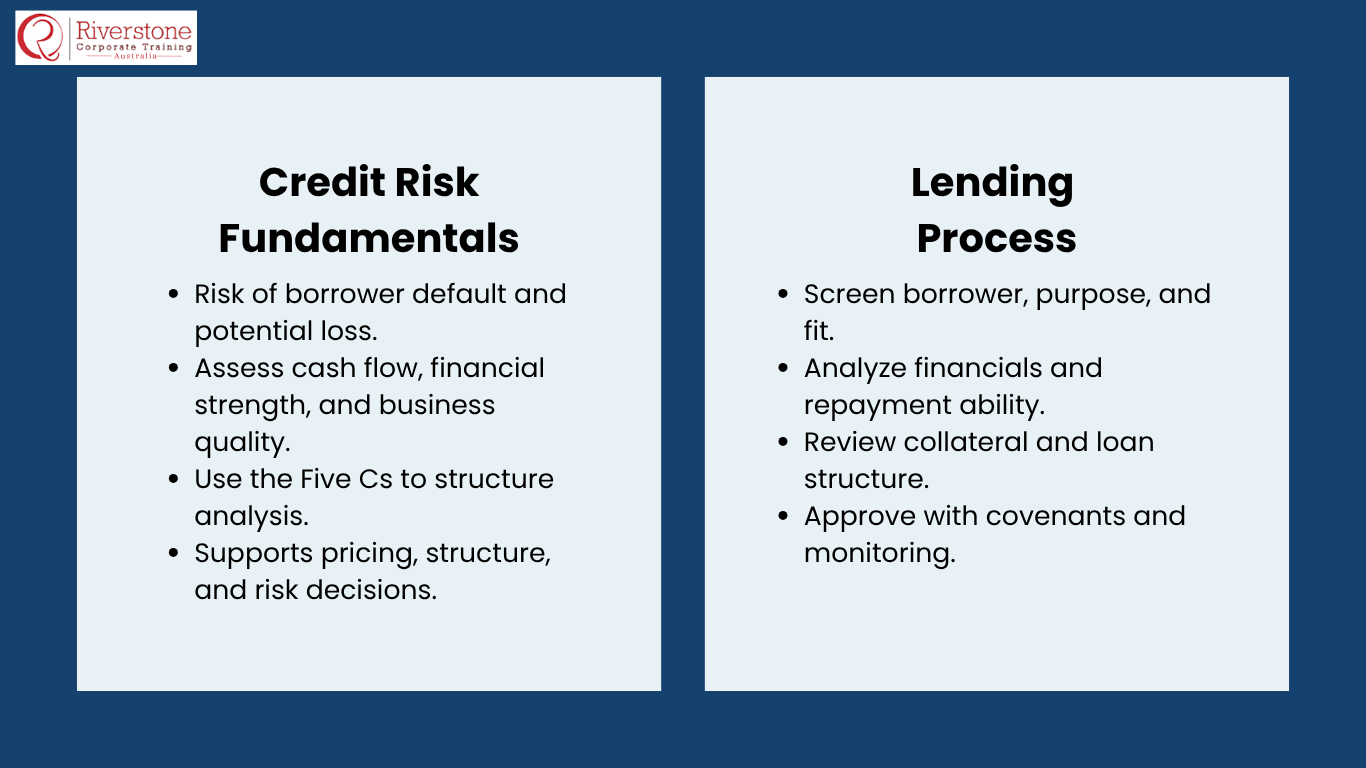
01 Introduction
Credit risk analysis is one of the most important analytical tools in the banking industry. Every commercial loan, every commercial real estate loan, every infrastructure loan, every working capital loan that banks make is based on a credit decision – a formal assessment of the probability that the borrower will not repay, what the bank will lose if that happens and what price and structure should be applied to reflect the risk. Most credit analysis for beginners involves a focus on the framework of this process – the ratios, the covenants, the security packages – rather than the commercial judgement that sets apart those in the credit industry who can apply a formula without understanding it.
- Credit risk analysis, in its simplest form, is the assessment of the probability of a borrower defaulting on its obligations and the loss to the bank if it does. These two elements, Probability of Default (PD) and Loss Given Default (LGD), are the building blocks of every credit rating, every pricing and every portfolio management framework in the banking sector.
- Those who develop the best reputations in credit analysis, corporate banking, and risk management are those who can integrate the analytical rigour of financial statement analysis with the commercial acumen of understanding the borrowers’ business model, the industry in which it operates, and the risks inherent in the lending transaction.
The credit decision-making process banks have adopted has become more formalised and sophisticated over the last 20 years. The Basel regulatory regimes – Basel II, Basel III, and the current Basel IV – have led banks to adopt more complex internal credit risk models, requiring a higher level of analytical sophistication in the origination, monitoring, and management of credit portfolios. Meanwhile, the diversity of borrowers, products and markets that credit risk professionals need to know about has grown exponentially – from traditional corporate term loans and revolving credit lines to leveraged finance, project finance, trade finance, and the sophisticated structured credit products that are at the cutting edge of institutional banking.
- Knowledge of the borrower risk assessment guide is useful not only in banking but also for rating agencies, investment funds, insurance companies, and corporate treasury departments when assessing the credit risks of a counterparty, issuer, or trading partner.
- This article provides a practical overview of the full arc of credit risk analysis: the theory, the five steps in the lending decision-making process, case studies, portfolio risk management, and the pitfalls and lessons that credit practitioners frequently face, providing a basic understanding for practitioners at all levels of their careers.
|
Credit risk analysis is not about managing risk; it is about understanding risk well enough to take the right amount of risk, at the right price, in the right structure, with the right safeguards in place. Those banks with the best lending franchises are those that do this best. |
02 What Is Credit Risk and Why Does It Matter?
The first lesson in credit risk management is that credit risk is the risk that a counterparty (a corporate borrower, a sovereign, a financial institution or a retail customer) will not meet its obligations under a financial contract. It is the most basic risk in banking, and credit risk management is the key driver of whether a bank can deliver acceptable returns to shareholders over an economic cycle.
- The impact of credit risk materialisation on the bank’s financial performance – loan losses, provision charges and capital write-downs – can be significant, particularly when it occurs across the entire portfolio during a recession. Both the global financial crisis of 2008-09 and the recent COVID-19 credit stress cycle showed how rapidly credit quality can deteriorate across the banking system when the economic environment turns.
- From a regulatory point of view, credit risk is the main driver of minimum regulatory capital requirements under the Basel frameworks – banks are required to hold a certain level of Tier 1 and Tier 2 capital against their risk-weighted assets (RWAs) to absorb losses. The risk weights assigned to individual exposures depend on the bank’s own credit risk assessment.
Lending financial risk assessment is more than just assessing a borrower’s ability to repay a loan. It involves managing the bank’s entire portfolio of credit risk exposures – understanding the concentrations of credit risk by industry, geography, product, and size of borrower; defining limits on the amount of each type of credit risk the bank is willing to take; pricing credit risk to ensure that the return from the credit activity is sufficient to cover the cost of capital; and tracking the credit quality of existing exposures to detect deterioration in credit quality before it turns into default.
- The expected credit loss (ECL) accounting framework under IFRS 9 requires banks to recognise loan loss provisions based on forward-looking probability-of-default models rather than incurred-loss models, which has dramatically increased the level of analysis required in credit portfolio management and the need to detect early signs of credit quality deterioration.
- For new entrants to the banking or finance professions, the way banks manage credit risk – from the time a new credit facility is originated through its lifetime until it is repaid or defaults – is the foundational skill that informs almost all other skills needed in commercial banking, corporate lending, credit risk management and financial regulation.
03 The Credit Analysis Framework — The Five Cs
The Five Cs – the five factors of creditworthiness that seasoned credit analysts consider in assessing borrowers – is the best way to teach credit analysis for beginners. The Five Cs offer a comprehensive, conceptually appealing taxonomy of credit risk and are the most common pedagogical approach in credit risk management basics courses at banks worldwide.
- The Five Cs are: Character (the borrower’s willingness to repay), Capacity (the borrower’s ability to generate sufficient cash flow to service the debt), Capital (the borrower’s financial strength and equity buffer), Collateral (the assets available to secure the loan), and Conditions (the external market and economic environment affecting the borrower’s performance).
- The Five Cs framework is a useful way to organise thinking about credit risk. Still, experienced credit professionals know that the dimensions are not independent – a borrower with strong Capital but weak Capacity (a borrower with good financial backing but cash-flow problems) is a very different risk proposition to a borrower with strong Capacity but weak Capital. The credit response should be different in each case.
Character is arguably the most important and intangible of the Five Cs. It relates to the management team’s experience, the transparency of their disclosure of business problems, their history of meeting financial commitments and the corporate governance arrangements that hold them accountable. A management team with good character will disclose issues to their bankers well in advance of them becoming crises, allowing the bank to engage in a constructive dialogue with the borrower to resolve them, rather than finding out about them only when they are material.
- Observable measures of management Character include: a track record of meeting financial forecasts disclosed to the bank, timely and accurate reporting of financial performance, proactive disclosure of business problems, and signs of a prudent financial management approach (not over-leveraging the business to grow faster).
- The Capacity indicator is the most measurable: the bank will determine whether the borrower’s projected cash flows (after operating expenses, taxes, and capital outlays) are adequate to service the proposed debt under various economic conditions. The debt service coverage ratio (DSCR) – operating cash flow divided by annual debt service – is the key measure of Capacity in most corporate lending situations.
Capital provides an equity buffer to cushion losses before the bank suffers losses. A borrower with a high leverage ratio – debt divided by equity and total assets – has less capacity to absorb shocks, as the equity cushion is smaller. Circumstances depend on the external environment: a borrower in a cyclical industry at a low point in the business cycle is not the same as the same borrower at the peak of the cycle, even if the fundamentals of the business are the same.
- Junior credit analysts often misinterpret collateral as being the key line of defence in corporate credit. In reality, lenders should be able to lend in well-structured transactions based on the borrower’s cash flow capacity – collateral is a back-up, not a primary credit risk assessment mechanism.
- Bank loan approval criteria incorporate all Five Cs into a comprehensive credit analysis – a borrower who is strong on four dimensions but weak on one (for example, excellent Character, Capacity and Capital but operating in a severely distressed industry) will likely need to be watched more closely, have a more conservative loan structure or tighter covenants to offset the weakness.
04 Financial Statement Analysis for Credit
Analysing the creditworthiness of borrowers using financial statements is the “nuts and bolts” of credit risk analysis. The income statement, balance sheet and cash flow statement are the main quantitative evidence of a borrower’s financial performance, financial position and cash flows. The skill of reading financial statements through the eyes of a credit analyst is different to that of an investor or an auditor – the credit analyst is particularly interested in cash flow quality, leverage trends, liquidity, and earnings stability under stress.
- Earnings normalisation – the adjustment of reported EBITDA or operating profit to strip out the impact of non-recurring items, accounting policy options and management adjustments that distort the true earnings potential of the company – is the most important analytical exercise in corporate credit analysis. A borrower with reported EBITDA boosted by one-off income, aggressive revenue recognition, or unsustainable cost-cutting is a very different credit risk than the headline numbers suggest.
- In financial risk assessment lending, the analyst must trace the cash conversion cycle, not only considering the income statement margin but also how quickly revenue is converted to cash and whether the working capital cycle is using or producing the cash the income statement forecasts. A very profitable business with a worsening cash conversion cycle may be in liquidity trouble, despite the income statement.
The primary financial ratios used in corporate credit analysis fall into three broad categories: leverage (the amount of debt the business has relative to its earnings and assets), coverage (how well the cash flows cover the interest and principal obligations) and liquidity (how well the business can meet its immediate obligations). Knowing not only how to compute them but what they represent – what affects them, what misrepresents them and how they relate – is the technical skill that distinguishes good credit analysts from those who can build a credit model without really understanding it.
Table 1: Key Credit Ratios — Definition, Typical Thresholds, and Interpretation
| Ratio | Formula | Typical Threshold (Investment Grade) | What It Measures |
|---|---|---|---|
| Debt / EBITDA (Leverage) | Total Debt ÷ EBITDA | < 3.0x for investment grade; < 5.0x for leveraged; >6.5x typically constrains further borrowing | How many years of earnings would it take to repay all debt, the primary leverage metric in corporate lending |
| DSCR (Debt Service Coverage) | Operating Cash Flow ÷ Annual Debt Service (Interest + Scheduled Principal) | Minimum 1.25x (covenant); target 1.50x+ (base case) | Period-by-period ability to service all debt obligations from operating cash flow |
| Interest Coverage (EBIT / Interest) | EBIT ÷ Interest Expense | Minimum 3.0x; stronger credits typically 5.0x+ | Measures earnings buffer above interest obligations — important for assessing vulnerability to earnings decline |
| Current Ratio (Liquidity) | Current Assets ÷ Current Liabilities | Minimum 1.0x; target 1.5x+ for comfort | Short-term liquidity — ability to meet obligations due within 12 months from current assets |
| Debt / Equity (Gearing) | Total Debt ÷ Shareholders’ Equity | < 100% for conservative; 100–200% for moderate; >200% considered highly leveraged | Financial structure — how much of the balance sheet is funded by debt vs equity |
| Free Cash Flow Yield | Free Cash Flow ÷ Total Debt | > 10% indicates strong deleveraging capacity; < 5% indicates tight debt service headroom | Capacity to organically reduce debt from generated cash flows — key indicator of medium-term credit trajectory |
Besides ratio analysis, the basics of credit analysis must extend to an evaluation of accounting quality – how well the financial statements reflect the economic substance of the business. Recognition of revenue, capitalisation of expenses, off-balance-sheet liabilities and intercompany transactions are just some of the accounting decisions that can impact the financial statements’ appearance to lenders. A credit analyst who examines financial statements without considering the accounting policies adopted is not looking at a clear picture of the borrower’s financial affairs.
05 Five Key Steps: The Lending Decision Process
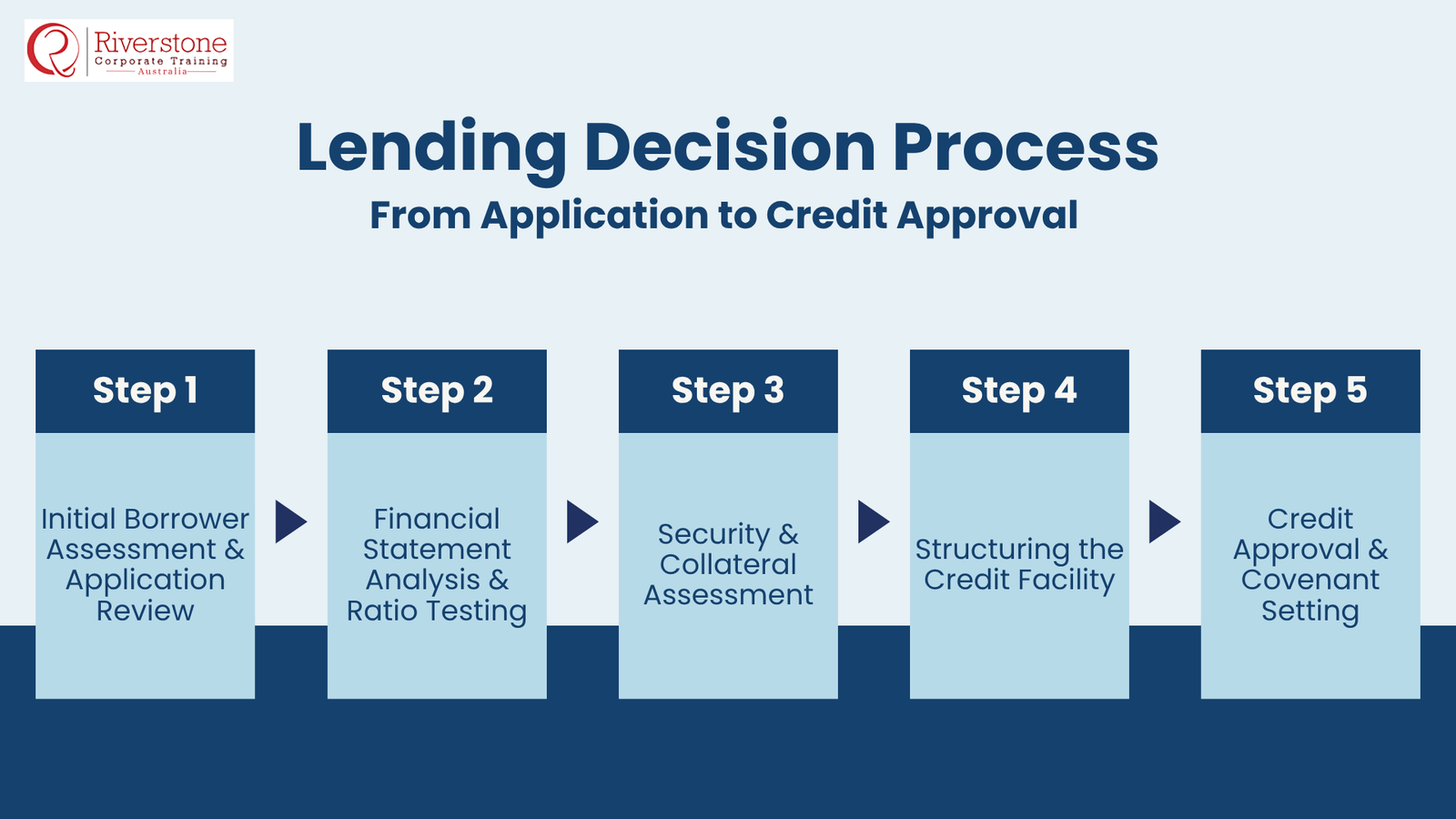
The lending decision process banks undertake takes borrower inquiry and proceeds to credit approval in a five-step process. Knowing this process – and the types of analyses and documentation required at each stage – provides junior professionals with the operational context to support credit origination, approval and monitoring initiatives.
Step 1 — Initial Borrower Assessment and Application Review
The credit process starts with a borrower applying for a loan or being referred to the bank by a relationship manager. Here, the credit analyst must first determine the nature of the borrower’s request – type of facility, size, tenor and purpose – and make an initial assessment as to whether it is in line with the bank’s credit risk appetite and credit policy.
- Evaluation of the bank loan approval criteria at this point is a quick and initial filter: Is the borrower in an industry and country of operation where the bank has credit appetite? Is the requested facility type one that the bank commonly provides? Is there a clear and acceptable purpose for the loan? Are there any obvious problems to be aware of, such as recent profit warnings, covenant breaches with other banks, regulatory problems or major litigation?
- The relationship manager’s knowledge of the borrower’s reputation and track record is crucial here – they may have met the management team, toured the business premises, and formed a commercial judgement of the business’s quality that the credit analyst’s “number crunching” can’t match.
Step 2 — Financial Statement Analysis and Ratio Testing
The heart of the credit assessment is the financial statement analysis – a systematic analysis of three to five years of audited financial statements, backed up by the latest management accounts and the borrower’s forward-looking projections.
- The credit analyst constructs a credit model to normalise historical earnings, compute the credit ratios, test the borrower’s debt service ability against the proposed facility, and stress-test the ratios under the downside scenario (usually a 20-30% decline in the borrower’s EBITDA) to determine if the borrower can service the debt in the event of a business downturn.
- The borrower’s projections are tested for credibility through a budget accuracy analysis that compares last year’s projections to actual results. Managers who consistently deliver realistic forecasts demonstrate the forecasting rigour and commercial integrity that are key elements of the Character analysis.
Step 3 — Security and Collateral Assessment
If the proposed facility is secured – as is common with most commercial property, asset finance and many corporate facilities – the third step is to assess the value, quality and enforceability of the proposed security.
- Loan-to-value ratio (LTV) – the loan amount as a proportion of the security’s independently valued value – is the key measure in secured lending. The target LTV for most commercial property lenders is 60-70% for income-producing property, which provides a substantial equity cushion to absorb value declines before the lender is affected.
- Security is not a primary credit decision criterion – a lender who relies primarily on security to support a decision to lend to a borrower with insufficient cash flow capacity is setting up a relationship that will likely end in enforcement. The optimal credit relationships are those in which security is not required because the borrower’s cash flows comfortably service the debt.
Step 4 — Structuring the Credit Facility
The structuring process converts the credit analysis into the terms and conditions of the credit facility that will be offered – the price, the covenants, the amortisation schedule, the security package, and the reporting requirements that are consistent with the credit risk that has been identified.
- The principal ongoing credit protection is financial covenants – the quantitative tests (usually minimum DSCR, maximum leverage, and minimum liquidity) that the borrower must meet throughout the facility’s life. The covenant package is designed to alert the bank to a deterioration in the borrower’s credit quality, rather than to detect a default only when it is too late.
- Pricing credit risk (the margin above the risk-free rate) accurately reflects the bank’s view of the borrower’s credit quality, the tenor and complexity of the facility, and the market in which it operates. Pricing too low for the risk results in low risk-adjusted returns; pricing too high results in lost business. Understanding the credit risk is critical to getting this right.
Step 5 — Credit Approval and Covenant Setting
The credit approval process requires the credit analysis, facility structure, and the relationship manager’s recommendation to be presented to the credit approval authority, which may be a branch-based delegated authority for smaller facilities or a credit committee of senior credit officers for larger or more complex facilities.
- The credit memo – the document used to convey the credit analysis to the approver – should clearly, accurately and with adequate supporting analysis set out the key credit risks so that the approver can make an informed decision and not simply rubber-stamp the relationship manager’s recommendation.
- Once approved, the credit relationship moves into the monitoring stage, where the bank monitors the borrower’s financial performance against the covenants, reviews the borrower’s financial statements, undertakes periodic credit reviews, and is aware of developments that could impact the credit quality of the exposure.
06 Practical Credit Risk Examples
Examples of credit risk analysis from actual lending situations illustrate the analytical framework and the commercial judgements that set good credit professionals apart from those who simply apply ratios without understanding the underlying business fundamentals. The following three examples are based on typical lending scenarios – fictionalised in detail but real in analysis.
The Growth-Stage Technology Company — Cash Flow vs Balance Sheet Tension
A European SaaS company with impressive ARR growth (120% year-on-year) was looking for a $15 million revolving credit line to support working capital as it ramped up its sales and customer success operations. The company had $12m of ARR, a 90% gross retention rate, and a great management team, but was burning cash (negative free cash flow) and had little collateral to secure the facility.
- The credit problem: leverage and DSCR ratios, which are used to assess creditworthiness for profitable companies, were meaningless or negative for a pre-profitability company. The credit analyst needed to frame the credit assessment in terms of the quality of the ARR, the cash burn rate, the time to profitability, and the ARR’s value as a proxy for enterprise value. A secured lender would need to be satisfied that, in the worst-case scenario, the facility would be drawn and that the ARR could be monetised via a sale of the business at a value sufficient to pay off the facility.
- The lesson: assessing a borrower’s creditworthiness for growth-stage companies means changing the approach – the Five Cs of credit assessment are applied through the lens of the business model, rather than historical financial ratios. Character and Capacity need to be measured by forward-looking indicators (ARR growth, customer economics, management team) rather than past performance, which is absent.
The Cyclical Manufacturer — Stress-Testing Through the Cycle
A medium-sized North American industrial manufacturer was looking for a $50 million, 5-year term loan to expand its capacity. The company had strong historical EBITDA of $18 million per year over the last three years, resulting in a healthy leverage ratio of 2.3x and a DSCR of 2.1x. The company’s management team had a long history and was well regarded by the relationship team.
- The credit risk was cyclic: historically, the industry in which the business operated had an EBITDA swing of ±40% over the cycle. The company’s EBITDA had dropped to $9 million at the trough of the global financial crisis, which was still serviceable, but would have little room for covenant compliance at the proposed level of debt. The key question was whether the five-year life of the credit would be sufficient to cover a full cycle, and what the DSCR would be at the cycle trough.
- The loan was granted with a more stringent DSCR covenant (min 1.30x vs the original 1.10x proposal) and cash sweeps that forced a percentage of cash flow to be used for voluntary prepayment in years when cash flow was above a certain threshold – effectively creating a de-levering buffer in the good years before the cycle turned. The lesson: financial risk assessment for lending to cyclical businesses should be done over the full cycle, not just the good times. So the question is not ‘can they service the debt now?’ but ‘can they service the debt at the bottom?’
The Commercial Property Loan — When Valuation Assumptions Prove Optimistic
A European real estate developer was granted a $30 million construction loan to develop a mixed-use, commercial and residential development, secured against the development land and completed development. The independent valuation of the completed property assumed a gross realisation value of $48 million, equating to an LTV of 63% (below the bank’s approved LTV of 65%).
- The credit risk arose when, after 18 months of construction, a change in the commercial leasing market led to a 30% decline in the demand for the commercial space in the property. The new estimate of the completed development value was $39 million, with an LTV of 77% – well in excess of the approved limit, and a covenant breach. The bank had to negotiate a restructuring with the borrower, which involved additional equity injections and a revised repayment schedule.
- The take-out: borrower risk assessment guide for property-secured lending should carefully scrutinise the assumptions underlying the collateral valuation – especially the rental yield, vacancy rate and capitalisation rate assumptions that determine the completed property value where engaging independent valuation advisory at the outset can provide a more conservative and defensible basis for LTV calculations. A valuation that reflects the top of the property cycle or assumes 100% occupancy with no leasing-up period results in an LTV cushion that can disappear when the bank needs it.
07 Credit Risk Management in Portfolio Context
Individual credit risk management fundamentals are just one facet of credit risk. At the portfolio level – where a bank manages hundreds or thousands of credit exposures – the emphasis shifts from individual credit evaluation to concentration risk, expected and unexpected losses, capital allocation, and early warning systems that detect credit quality deterioration before credit defaults.
- Concentration risk occurs when a bank’s credit risk is concentrated in a particular industry, geographic region, borrower or asset class. A bank with 40% of its commercial property loan portfolio in a single city, or 30% of its corporate loan portfolio in a single cyclical industry, is exposed to a correlation risk – that a deterioration in the concentration area will impact many exposures at once rather than in isolation.
- Credit risk appetite frameworks operationalise the board’s risk tolerance for credit risk into quantitative limits: maximum exposure to individual names, maximum concentrations in industry sectors, maximum average portfolio leverage, and target distributions of portfolio-level DSCRs. These limits reflect the bank’s credit strategy, and the credit risk management function monitors compliance with them.
Early warning indicators – the ongoing monitoring of portfolio-level signals that are precursors to credit quality deterioration – are a powerful tool for credit risk management. These include: rates of covenant breach, the number of requests for amendments and waivers (borrowers unable to comply with their covenants as written), arrears rates on principal and interest payments, credit rating migration (exposures moving from investment-grade to non-investment-grade), and sector-specific stress indicators derived from macroeconomic data.
- The IFRS 9 staging model requires banks to categorise exposures into three stages based on their credit quality since initial recognition: Stage 1 (performing, 12-month ECL provision), Stage 2 (significant increase in credit risk, lifetime ECL provision) and Stage 3 (credit-impaired, lifetime ECL provision with interest recognised on net carrying amount). The Stage 1 to Stage 2 migration trigger – determining when credit risk has ‘significantly increased’ – is one of the most complex and important judgements in credit risk management.
- Stress testing – modelling the effect of specified adverse macroeconomic scenarios on the expected losses, regulatory ratios and profits of the credit portfolio – is now a regulatory requirement for systemically important banks as part of APRA’s prudential practices guide and a best practice for all credit institutions. Knowing how to structure, run and interpret a credit portfolio stress test is an emerging advanced credit risk skill.
08 Common Challenges and Lessons Learned
The types of problems that credit analysts and loan officers face most frequently in practice are well-understood from the history of banking credit cycles. Knowing what they are before they are encountered – and learning the professional skills that preclude the most common failure modes – are among the most important lessons that junior credit professionals can learn.
Table 2: Credit Risk Lending Process — Phases, Activities and Common Failure Points
| Process Phase | Key Activities | Common Failure Mode | Best Practice Response |
|---|---|---|---|
| Initial Origination | Relationship manager brings opportunity; initial credit assessment and appetite check | Origination pressure causing ‘relationship banking’ to override credit quality standards; the credit team approving deals they should not because of commercial relationship importance | Maintain credit culture independence from origination; ensure credit approval is genuinely independent of the relationship function |
| Financial Analysis | Three-to-five year financial statement analysis; normalisation; ratio calculation; projections review | Over-reliance on management-adjusted EBITDA metrics; accepting normalisation adjustments without critical evaluation; not tracing cash conversion from earnings to cash flow | Always build the analysis from audited financials; question every normalisation adjustment; reconcile EBITDA to operating cash flow |
| Structuring | Covenant design; pricing; security assessment; tenor and amortisation profile | Covenants set too loosely relative to the borrower’s actual financial position, providing no early warning, and pricing that does not reflect the true risk | Calibrate covenants to current financial metrics with meaningful but not punitive headroom; ensure pricing reflects the risk-adjusted return requirement |
| Approval Process | Credit memo preparation; credit committee or delegated authority review | Credit memos that present the case selectively, downplaying risks and emphasising positives; approvers who rely too heavily on relationship manager advocacy | Present credit memos with balanced risk identification; the approval authority should be able to assess the risk independently from the credit memo alone |
| Monitoring | Covenant compliance tracking; annual review; covenant breach management; credit rating review | Annual reviews that are perfunctory; covenant breaches that are waived without genuine remediation; monitoring that detects deterioration after it has become severe | Meaningful annual reviews that reassess the credit from first principles; covenant breaches treated seriously and remediated genuinely, not waived indefinitely |
| Stress and Exit | Workout management, enforcement, and portfolio stress testing | Extending credit to stressed borrowers for too long without genuine rehabilitation (extend-and-pretend); enforcement that is delayed past the optimal recovery point | Set clear triggers for escalation to the workout team; engage restructuring specialists early; act decisively when genuine rehabilitation is not achievable |
The overarching challenge that underpins all the specific failure modes listed above is culture and incentives. The way banks “think” about assessing credit risk and the way they “do” it can be quite different when the culture of the bank is to reward origination volume, when the relationship managers have an outsized influence on the credit decision-making process, or when the time frame used to assess credit performance is too short to capture the full credit cycle consequences of poor origination decisions. The banks that have the best long-term credit performance are those that have a credit culture – a culture where credit quality is valued as highly as commercial relationship management, where credit officers have the power to reject transactions, and where credit losses are attributable to bad credit decisions.
- The single most pervasive lesson we have learned from credit practitioners who have lived through credit cycles in various economic environments is that problems with credit quality are almost always evident in the data if you know where to look – and that the banks that suffer the most severe losses are always those that allowed their origination standards to erode during periods of strong economic growth, when the temptation to deploy capital was the strongest.
- For young professionals, the ability to develop the courage to speak out about credit quality – to question the assumptions about a borrower’s cash flows, to question a security value that appears to be high, to recommend a decline where the risk-adjusted return is not attractive – is one of the most important skills that can be used to build a strong career as a credit practitioner.
09 Building a Career in Credit and Risk
The discipline of credit risk analysis encompasses a broad spectrum of jobs in the financial services sector – from credit analysts in commercial banks, to structured credit specialists in investment banks, to portfolio risk managers in major financial institutions, to credit rating analysts in ratings agencies, and to credit research analysts in asset managers. What is common to all of these roles is the financial analysis, commercial judgement and risk management that this article has attempted to explain.
Table 3: Career Pathways in Credit Risk and Lending
| Role Type | Typical Employers | Core Competencies Required | Development Priorities |
|---|---|---|---|
| Credit Analyst — Commercial Banking | Major banks, regional banks, credit unions, challenger banks | Financial statement analysis; credit ratio calculation; credit memo writing; industry analysis | Build depth in 2–3 industry sectors; develop credit memo writing skill; seek live portfolio monitoring experience |
| Leveraged Finance Analyst | Investment banks; leveraged finance funds; credit-focused PE funds | LBO financial modelling; debt capital markets knowledge; covenant analysis; sector research | Master LBO modelling; develop deep knowledge of loan documentation and covenant mechanics |
| Credit Risk Manager — Portfolio | Major banks, APRA-regulated ADIs, insurance companies, and diversified financial institutions | IFRS 9 ECL modelling; stress testing; credit policy development; regulatory capital frameworks | Develop quantitative credit modelling skills; understand the Basel framework; build regulatory engagement capability |
| Credit Research Analyst | Rating agencies (S&P, Moody’s, Fitch); buy-side credit research (asset managers, insurance) | Sector analysis, public company financial analysis, rating methodology application, and report writing | Develop sector specialisation; build rating methodology expertise; focus on written communication quality |
| Structured Credit / Securitisation | Investment banks, structured credit funds, RMBS/ABS originators | Structured finance mechanics; cash flow modelling; tranche analysis; legal documentation | Build understanding of securitisation mechanics; develop cash flow modelling for structured products; study CDO/CLO structures |
The best way for those seeking to develop a career in credit risk is to learn credit risk analysis through live transaction experience. The analysis frameworks outlined in this article are best understood not as taught in the classroom but as practised in the process of credit analysis, where the management accounts are not always clear-cut, where the security is more complicated than first thought, and where the credit decision is not simply an application of technical credit analysis but requires commercial judgement regarding risk and return.
- The most accessible and most neglected form of self-directed credit risk development is the analysis of public financial information – the publicly available annual reports, credit rating agency research reports, and bond offering documents contain detailed financial analysis, industry commentary and credit assessments that offer a free, real-world course in the basics of credit risk management for any practitioner who takes the time to engage with the content actively.
- The most effective technical training discipline to develop the skill of assessing borrower creditworthiness that employers consistently cite as the most important skill for early career credit practitioners is the development of a library of credit memos – written analyses of public companies or hypothetical lending scenarios, organised along the Five Cs and the key financial ratios.
10 Conclusion and Actionable Insights
Banks’ approach to credit risk analysis is a discipline that values intellectual rigour, commercial integrity, and the professional courage to make and defend an independent assessment of a borrower’s credit risk, even when commercial pressures are in the opposite direction. First principles of credit risk analysis show that the credit analysis process is not a black box. Still, a structured combination of financial statement analysis, business quality analysis, and scenario stress testing, applied to the Five Cs framework used by generations of credit analysts to make lending decisions.
For entry-level and mid-career professionals, the lending decision process banks use to assess, analyse, structure, approve, and monitor credit risk provides the operational roadmap that credit and risk professionals follow. Real-world credit risk examples from actual borrower cases repeatedly teach the same lesson: good credit decisions are driven by good analysis and sound analytical processes, not by complex credit models. A simple model properly applied provides better credit decisions than a sophisticated model poorly applied.
- Understand the Five Cs – not as a list to be ticked off but as an analytical framework that informs your thinking about all borrowers and all deals. Character is the foundation; Capacity is the primary line of defence; Capital, Collateral, and Conditions are the supporting themes.
- Master financial statement analysis – how to read a balance sheet, a cash flow statement and a set of financial projections with the eyes of a credit practitioner: assessing the quality of cash conversion, the normalisation of results, the accounting policies adopted and the potential signs of financial distress.
- Always stress-test a credit assessment: it is not enough to know whether the borrower can pay back the debt in the most likely scenario; it must also withstand the worst-case scenario. Lending without a realistic downside test is not risk assessment lending.
- Focus on industry knowledge as well as technical skills. The quality of the borrower risk assessment guide depends on the analyst’s evaluation of the borrower’s business commercial viability, which in turn depends on their understanding of the sector, the competitive environment, and the cyclicality that affects the borrower’s revenue and earnings streams.
- Hone your communication skills as well as your analysis skills. The credit memo – the document that communicates the credit analysis to the approver – needs to clearly and accurately explain the risk, and provide enough information for the approver to make an independent assessment. The skill of preparing a clear and well-organised assessment of bank loan approval criteria is among the most easily measured and widely valued among credit professionals.
| Credit risk management is ultimately about ensuring the safety of the bank’s capital by making good lending decisions – and good lending decisions are made by good analysis, good judgement and a culture that recognises that credit quality is as important as commercial success. Those who develop true expertise in credit risk analysis are some of the most valuable professionals in the financial services sector. |