

- 01 Introduction
- 02 WACC Explained — The Core Concept
- 03The Components of WACC — Cost of Equity and Cost of Debt
- 04 How to Calculate WACC — The Formula and Its Inputs
- 05 Five Key Steps: Deriving WACC for a Real Company
- 06How to Use WACC in Valuation and Decision-Making
- 07 Practical WACC Examples from Real Transactions
- 08Common Mistakes and Lessons Learned
- 09Building Corporate Finance Competency Around WACC
- 10Conclusion and Actionable Insights
Cost of Capital (WACC):
Practical Applications in Corporate Finance Decision-Making
Table of Contents
01 Introduction
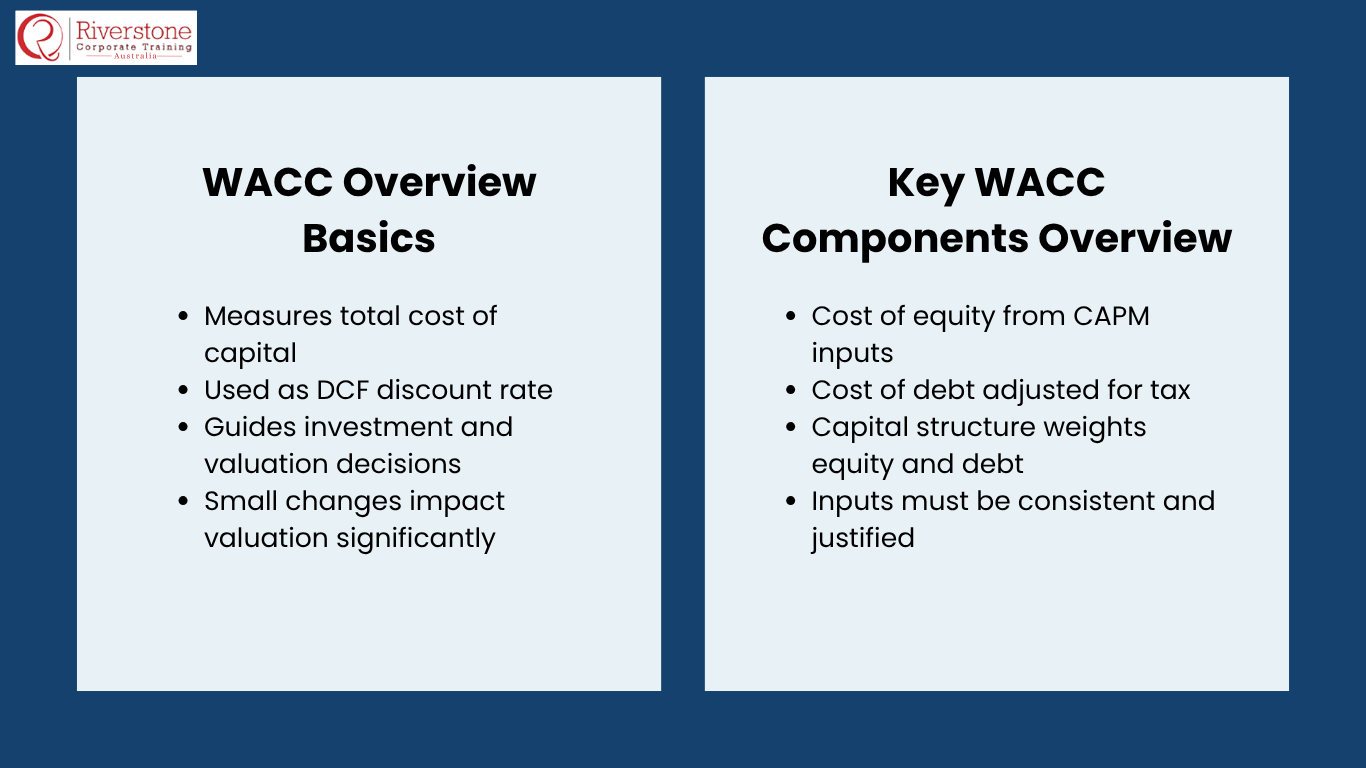
WACC, explained simply, starts with the premise that capital costs money. Capital is expensive for a business, whether it is obtained from shareholders who expect to earn a return on their investment or from creditors who expect to receive interest on their loans. The weighted average cost of capital (WACC) is the composite rate that represents what the business needs to earn on its capital to meet the expectations of all its capital providers. It is also the hurdle rate the business must earn on any investment it makes, the discount rate it uses to value future cash flows in a DCF analysis, and the rate against which it measures its performance.
- Finance cost of capital knowledge is fundamental to almost all corporate finance decisions: valuations for acquiring businesses, capital investment decisions, measuring the performance of business units, setting the optimal capital structure for a business, and setting performance targets against investor expectations.
- Those who develop the best reputations in corporate finance, investment banking and advisory services – those who can explain not only what the valuation says but why the discount rate was set at a particular level and how sensitive the valuation is to changes in the discount rate – have all invested in understanding how to calculate and apply WACC and its parts.
An understanding of the cost of capital calculation guide is not theoretical. In all DCF valuations, the WACC is the assumption that most affects the valuation: a 1% higher discount rate for a firm valued at 10x EBITDA will reduce the implied equity value by 15-20% or more. This means that any WACC mistakes – whether they are a miscalibration of betas, incorrect capital structure, or inconsistent tax rate treatment – result in valuations that over- or under-value by commercially meaningful amounts.
- Corporate finance decision-making tools that rely on WACC are not limited to valuation – they also include capital allocation models, hurdle rate systems for project evaluation and the economic profit metrics that tie financial returns to the cost of the capital used to produce them.
- This article provides a comprehensive overview of the practical use of WACC from its foundations to its application in transactions: the formula and its components, the five-step process for deriving WACC, its use in valuation and capital allocation, practical examples, pitfalls, and a development roadmap for professionals seeking to build their skills in this foundational discipline.
|
WACC is not a product of a financial model. It is the rate that answers the most central question in corporate finance: what return must this business earn to justify the capital it employs? That rate should judge all decisions about how to use that capital. |
02 WACC Explained — The Core Concept
WACC, simply put, is the weighted average cost of the components of the capital used to finance the business, with the weights being the relative proportions of each component of the capital structure. A business funded solely by equity has a cost of capital equal to the cost of equity. A business funded entirely by debt has a cost of capital equal to its after-tax cost of debt (the pre-tax interest rate multiplied by 1 minus the corporate tax rate, reflecting the tax deductibility of interest). The majority of businesses are funded by a mix of the two, and the WACC is a weighted average of the two costs.
- The most common form of the weighted average cost of capital formula is: WACC = (E/V × Ke) + (D/V × Kd × (1 – T)), where E is the market value of equity, D is the market value of debt, V is the total value of the business (E + D), Ke is the cost of equity, Kd is the pre-tax cost of debt, and T is the corporate tax rate. Each of these elements has its own methodology for derivation, and the WACC result is only as good as the detail used to calculate each element.
- The logic underlying the formula is that a business that is financed with a mixture of equity and debt must earn a return that meets the expectations of both classes of capital providers – the equity investors who expect a return in line with the risk they have borne, and the debt investors who expect their interest to be paid. If the business’s return is less than its WACC, it is consuming capital rather than generating returns – it is destroying value.
To understand capital costs in finance, it is important to understand why the cost of equity is greater than the cost of debt for a business. Debt investors receive guaranteed interest and principal payments and are paid before equity in the event of bankruptcy; they are therefore less risky and demand a lower return. Equity investors receive a residual return after debt is paid off – they are riskier, so they expect a higher return. The cost of equity minus the after-tax cost of debt reflects the capital structure’s risk hierarchy.
- The tax shield is a key concept in capital structure theory: the tax deduction of interest expense for the corporate borrower reduces the cost of debt by the tax benefit of the deduction. A business that pays 6% interest on debt with a 30% corporate tax rate has an effective after-tax cost of debt of 4.2% (6% × (1 – 30%)), making debt a cheaper source of funds than equity on an after-tax basis.
- Why companies do not issue more debt to take advantage of the tax shield is because increasing leverage increases the financial risk of the business, which in turn increases the cost of equity (equity investors in a more leveraged business face greater risk of loss if the business underperforms) and ultimately the cost of debt (lenders charge a higher rate of interest for credit risk as leverage increases). The target capital structure is the one that minimises WACC.
03 The Components of WACC — Cost of Equity and Cost of Debt
The approaches to calculating the discount rate for the two main components of WACC, the cost of equity and cost of debt, are different in terms of their analytical frameworks, data sources and sources of uncertainty in their calculations. Knowing how each component is derived and what assumptions are made in each derivation is critical for anyone who develops, reviews, or uses DCF models in practice.
- The cost of equity is the return expected by equity investors to compensate them for the systematic risk of investing in the business. The cost of equity is not observable and must be estimated using a model (usually the Capital Asset Pricing Model, or CAPM), which links the expected return on the company’s equity to three variables: the risk-free rate, the equity risk premium, and the company’s beta.
- The cost of debt is more observable: it reflects the rate at which the company can borrow (usually based on its existing debt securities, credit rating, or recent debt financing). The key difference is that this rate must be adjusted to an after-tax rate before being used in the WACC formula (since interest is tax-deductible).
The cost of equity can be derived using the Capital Asset Pricing Model (CAPM): Ke = Rf + β × ERP, where Rf is the risk-free rate (usually the yield on a government bond with a maturity that matches the time horizon of the valuation), β (beta) is the volatility of the company’s equity returns relative to the market (a beta of 1.0 means the company’s returns move in line with the market; a beta greater than 1.0 means the company is more volatile than the market; a beta less than 1.0 means the company is less volatile than the market), and ERP is the equity risk premium (the expected return of the equity market minus the risk-free rate).
- Beta is probably the most contentious input to the WACC. For public companies, it can be derived from historical returns of the share price relative to the market index. For unlisted companies, it has to be estimated from listed peers: an asset (unlevered) beta from the peer group is re-levered to reflect the company being valued’s capital structure, using the Hamada equation to account for differences in financial leverage.
- The equity risk premium (ERP) is the most important single input into the cost of equity for most companies – and also the one about which there is the most controversy. The long-run ERP for developed markets is typically estimated at 4% to 7%, depending on the approach used (realised premium, implied forward premium, or survey-based). A 1% increase in the assumed ERP corresponds to a 1% increase in the cost of equity, and a 0.5-0.8% increase in the WACC for a typical levered company.
04 How to Calculate WACC — The Formula and Its Inputs
The key to cost of capital calculation guide practice is not only knowing how to calculate WACC but also where the inputs come from, how they are calibrated, and how they are checked for reasonableness. A WACC that is mechanically correct but based on poorly specified inputs will result in an unreliable discount rate that will lead to inaccurate valuations.
- The capital structure weights – the E/V and D/V in the formula – should be based on the target capital structure of the business rather than its historical balance sheet structure. This is because the WACC is a long-term rate, and a business that is currently temporarily under- or over-levered relative to its target should be weighted at its target. For publicly listed businesses, the market capitalisation of equity should be used as the weight rather than book value, as it reflects the current economic value of the equity claim.
- The risk-free rate is typically taken as the yield on a long-dated government bond with a maturity matching the cash flow projection period (typically 10 years for most corporate valuations) in most markets. Using the yield on a short-dated government bond (which is much more responsive to central bank policy and thus more volatile) would result in a WACC influenced by short-term monetary policy rather than a long-term cost of capital.
The tax rate for the after-tax cost of debt should be the corporation’s expected effective tax rate over the cash flow projection horizon, not the statutory rate. For companies with substantial tax loss carry-forwards, the effective tax rate in the near term may be much lower than the statutory rate, resulting in a lower tax shield and higher WACC. For foreign businesses, the tax rate used should be the rate in the countries where interest expense is deductible.
Table 1: WACC Components — Inputs, Sources and Common Calibration Issues
| WACC Component | Input Required | Recommended Source | Common Calibration Mistake |
|---|---|---|---|
| Risk-Free Rate (Rf) | Yield on long-dated government bond | 10-year government bond yield in the relevant currency (e.g., RBA 10-year, US Treasury 10-year) | Using a short-term bill rate, which is volatile and policy-driven, failing to match the currency of the cash flows |
| Equity Risk Premium (ERP) | Expected excess return of equities over the risk-free rate | Damodaran database (country-specific); Duff & Phelps survey; long-run historical equity premium studies | Using a historical average without considering current market conditions, applying a single global ERP without country risk adjustment for emerging markets |
| Beta (β) | Sensitivity of equity returns to market — levered for listed companies; re-levered from peers for private companies | Bloomberg or Refinitiv (2-year weekly returns vs relevant market index); peer group unlevered beta re-levered using the Hamada equation | Using raw beta without adjustment for mean reversion (Blume adjustment), the peer group selection does not reflect a true comparable risk profile |
| Cost of Debt (Kd) | Current borrowing rate for the company — yield to maturity on existing debt or indicative market rate | Company’s existing debt schedules; recent financing activity; credit spread based on rating vs risk-free rate | Using the historical coupon rate on legacy debt rather than the current marginal cost of new borrowing, not adjusting for applicable tax shield |
| Tax Rate (T) | Effective corporate tax rate applicable to interest expense | Company’s effective tax rate from income tax note; jurisdiction-specific statutory rate where different | Using the statutory rate when the effective rate differs materially, not accounting for tax losses that reduce the near-term tax shield |
| Capital Structure Weights | Market-value weights of debt and equity in total capital | Listed companies: market capitalisation (equity), book value of financial debt; Private companies: industry target leverage benchmarks | Using book value equity rather than market value, using current leverage rather than target leverage for temporarily over/under-levered companies |
One additional consideration in calibrating WACC for practice is that the WACC should be expressed in the same currency as the cash flows being discounted. WACC is based on a UK risk-free rate, and UK market ERP should be used to discount cash flows in pounds sterling; using it to discount cash flows in euros without adjusting for the interest rate difference between the two currencies will result in a biased valuation. This currency consistency rule is one of the most frequent sources of significant error in cross-border transactions.
05 Five Key Steps: Deriving WACC for a Real Company
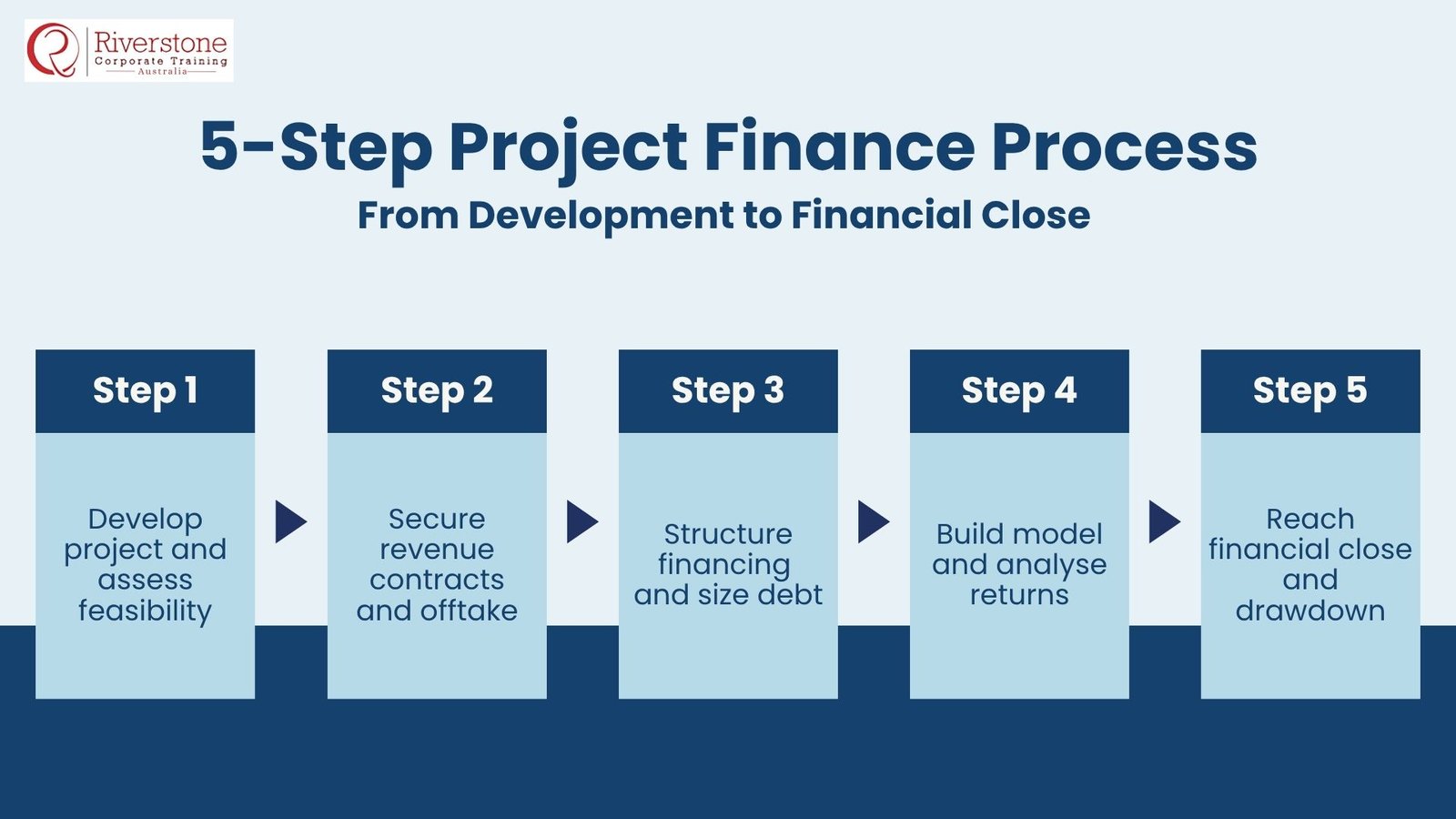
The following five steps are used to derive WACCs in real-life examples. By understanding this process – and the analytical decisions made at each step – practitioners can derive a defensible WACC for any business and assess the WACC assumptions in models developed by others.
Step 1 — Determine the Target Capital Structure
The first step in deriving a WACC is to determine the capital structure weights – the relative amounts of equity and debt financing used by the business. For public companies, equity is valued at market capitalisation. For unlisted companies (or acquisition targets), the target capital structure is usually determined by reference to the capital structures of listed peers in the industry.
- The target capital structure should be based on the business’s long-run financial structure (not the current financial structure imposed by a recent acquisition or the de-leveraging process of a post-LBO business). A 70% debt-funded business that a PE firm has just acquired has a long-run target capital structure more in line with the sector’s average leverage (say, 30-40%), and the WACC should be calculated based on that target, not the current leverage.
- The capital structures of comparable listed companies (typically drawn from databases such as Damodaran’s annual sector statistics or practitioners’ own peer-group analyses) serve as benchmarks for setting capital structures for private companies.
Step 2 — Calculate the Cost of Debt
The cost of debt is the marginal cost of borrowing for the company – the interest rate at which it could issue new debt today, based on its current credit rating and market conditions.
- For public companies with traded debt, the cost of debt is the yield to maturity on the firm’s existing debt. For unlisted companies without publicly traded debt, the cost of debt is calculated by adding a credit spread (corresponding to the company’s estimated credit rating) to the risk-free rate, using published credit spreads by rating from sources such as Bloomberg or Damodaran.
- The cost of debt must then be adjusted by (1 – T) to reflect the tax deductibility of interest expense, to determine the after-tax cost of debt used in the WACC formula. For instance, the cost of debt for a company with a 5.5% pre-tax cost of debt and a 30% tax rate is 3.85% (5.5% x (1-30%)).
Step 3 — Derive the Cost of Equity Using CAPM
CAPM is commonly used to calculate the cost of equity. Still, variants – such as the Fama-French three-factor model and various adjustments for the size premium of small companies – are occasionally used for specific applications, such as valuing small-capitalisation companies or highly illiquid private companies.
- For a listed company, beta is calculated by regressing the company’s historical share price returns (usually 2 years of weekly returns) on the market index. The raw beta is sometimes adjusted towards 1.0 using the Blume adjustment (Adjusted Beta = 0.67 x Raw Beta + 0.33 x 1.0) to reflect the observed tendency of betas to revert to the market beta.
- For a private company, it is necessary to identify a peer group of listed comparable companies, calculate the unlevered (asset) beta for each peer (using the Hamada equation: βu = βL / (1 + (D/E × (1 – T))), compute the median unlevered beta of the peer group, and re-lever this to the target company’s own capital structure to estimate the levered (equity) beta.
Step 4 — Apply the Tax Shield Adjustment
The tax shield adjustment – converting the pre-tax cost of debt to an after-tax cost – is the area where most mistakes are made by practitioners who do not grasp the commercial rationale.
- The adjustment is based on the fact that interest expense is deducted from income, thereby reducing the company’s tax liability. For the company, the cost of debt is adjusted down by the tax savings on the interest expense. If a business pays $100 of interest and faces a 30% tax rate, it receives a tax saving of $30, reducing the cost of the debt financing to $70 – a 30% reduction in the pre-tax cost of borrowing.
- This tax adjustment is only relevant when the company is profitable – if the company is unprofitable, the tax shield is deferred and not realised and using the full tax shield in the WACC calculation overstates the short-term tax benefit.
Step 5 — Compute and Interpret the Blended WACC
Now that all the pieces are in place, the blended WACC can be calculated using the formula, and sanity checks can be performed to ensure the result is reasonable before it is used in a valuation or capital budgeting exercise.
- The key sanity check is against WACC averages for similar companies and industries. Damodaran’s industry WACC statistics, investment bank equity research reports and expert reports are all good sources of comparison. If the WACC is significantly higher or lower than the sector average, it should be explained: either the business is actually more or less risky, or the WACC input assumption should be checked.
- The second step is the sensitivity analysis: computing the WACC under various beta, ERP, and debt/equity ratio assumptions to derive a range of WACC (as opposed to a single number, which reflects the uncertainty in WACC estimation and is the proper way to report the discount rate assumption in a valuation report.
06 How to Use WACC in Valuation and Decision-Making
Using WACC in valuation is not just limited to the DCF model. WACC is the analytical bridge between capital structure theory and investment and corporate decision-making, and knowing all of its applications elevates a practitioner from knowing how to calculate WACC to using it as a corporate finance decision-making tool in the marketplace.
- In the discounted cash flow model, WACC is used to discount the free cash flows to the firm (FCFF – the operating cash flows available to all capital providers, after tax and capital expenditure) to arrive at the enterprise value of the business. Enterprise value – net debt = equity value. For a growing business, a 1% increase in the WACC assumption will lead to a 10-20% decrease in the implied enterprise value. Hence, WACC sensitivity is the key technical test in a DCF analysis.
- WACC is used in investment decisions in capital budgeting as the discount rate for evaluating new projects. A project with an expected return (internal rate of return, or IRR) greater than the firm’s WACC adds value – it delivers a return that is greater than the cost of the capital used to fund the project. A project whose IRR is less than the WACC destroys value – even if it makes a positive return.
Economic Value Added (EVA), one of the most important approaches to corporate financial decision-making over the last 30 years, is based on WACC. EVA is defined as NOPAT (net operating profit after tax) less the product of capital employed and WACC. Positive EVA indicates the company is creating value (earning more than its cost of capital); negative EVA indicates value destruction. EVA-based incentives guide divisional performance towards value creation, and connect WACC theory with practice.
- Adjusted Present Value (APV) – an alternative to the WACC-based DCF – values the unlevered business (discounting the cash flows at the unlevered cost of equity) and then adds the value of the tax shield from debt (discounting at the cost of debt or the risk-free rate). APV is a valuable approach in highly levered transactions (such as levered buy-outs) where the capital structure is likely to change over time (so a constant WACC assumption is not appropriate).
- In practice, cross-business-unit capital allocation means that different business units or projects should be discounted using their own divisional WACCs (reflecting the risk of their cash flows), rather than the corporate WACC. A multi-industry conglomerate with an industrial utility division and a consumer products division should discount the utility’s cash flows (which are more certain due to contracts) at a lower rate and the consumer products division’s cash flows (which are more variable) at a higher rate.
07 Practical WACC Examples from Real Transactions
Real corporate finance WACC examples show how the theory applies to the practical decisions that are made in real projects. The three examples below are based on typical valuation and corporate finance scenarios – fictional but representative.
Example 1 — The Mid-Market M&A Acquisition: WACC for a Private Target
An industrial equipment manufacturer in the UK was being bought by a strategic acquirer for an enterprise value of about £180 million. The valuations team had to calculate a WACC for the target, a private company with no listed equity or debt. Beta was derived using a peer group of seven listed industrial equipment manufacturers.
- The beta of the peer group was unlevered (0.62-0.95, median 0.76). This was levered to the target leverage (30% debt, 70% equity, in line with the sector’s median leverage) to yield a levered beta of 0.95. Together with a risk-free rate of 4.1% (10-year UK gilt) and an ERP of 5.0% (reflecting both the UK market premium and a small-size premium for a mid-market firm), the CAPM yielded a cost of equity of 8.9%. The after-tax cost of debt was 3.9% (5.5% pre-tax × (1 – 30%)). The WACC was 7.4%.
- The lesson: the most critical methodological decision in calculating WACC for private companies valuations is the selection of the peer group – an unlevered beta calculated from a peer group that includes large-cap industrial conglomerates and small mid-market manufacturers will not reflect the systematic risk of the target. The peer group should be as targeted to the market, product and customer segments as possible.
Example 2 — The Infrastructure Project: Why WACC Must Reflect Cash Flow Risk
A European company owning a concession for a toll road was developing a DCF valuation for a refinancing. The road had been operating for eight years under a government concession, with a regulated return on assets, producing very secure, inflation-linked cash flows. The analyst first discounted the cash flows at the group’s WACC of 8.2%.
- The independent financial adviser disagreed: the toll road’s cash flows were less risky than the group’s corporate average, as they were contracted, inflation-indexed, and government-guaranteed, with no significant volume or competition risk over the remaining term of the concession. A more appropriate WACC for the road, based on other regulated infrastructure assets, was 5.8-6.2%. Discounting the cash flows using the corporate WWACC resulted in the asset being undervalued.
- The lesson: investment decision using WACC means that the discount rate should reflect the risk of the cash flows being discounted, not a corporate rate that may be much higher or lower than the risk of the specific asset. The application of a corporate WACC to assets with different risks is one of the most frequent and significant valuation mistakes.
Example 3 — The Capital Budgeting Decision: Divisional Hurdle Rates
A North American diversified energy firm with three divisions – a regulated gas distribution utility, a renewable energy development business, and an oil field services business – was considering its capital allocation process. The firm had historically applied a corporate WACC of 9.0% as the hurdle rate for all new investments across the divisions.
- The corporate strategic finance team engaged a review which established divisional WACCs: the regulated gas utility warranted 6.5% (reflecting its contracted cash flows and low leverage); the renewable energy development business warranted 8.5% (reflecting the uncertainty of the construction and technology, partially mitigated by contracted PPA revenues); and the oil field services business warranted 11.5% (reflecting the high cyclicality and commodity price sensitivity of its revenues).
- •The result was dramatic: the single corporate WACC of 9.0% had been approving investments in the oil field services business (where 9.0% was too low and overvalued the investments) while rejecting investments in the utility business (where 9.0% was too high and undervalued the investments). The divisional WACC framework fixed this capital allocation problem – the most important practical example of why, in real life, WACC should be applied to specific assets or businesses, not the corporate average.
08 Common Mistakes and Lessons Learned
The most common mistakes in deriving and using WACC are well documented in the valuation literature and in the review reports of independent experts and audit engagements. Knowing these mistakes before they are made – and learning to avoid them by adopting professional practice habits – is one of the best lessons that aspiring corporate finance practitioners can learn.
Table 2: WACC Derivation Process — Steps, Key Decisions and Common Errors
| Step | Key Decision | Common Error | Best Practice Response |
|---|---|---|---|
| Capital structure determination | Should the WACC use current or target leverage? | Using the company’s current (often temporarily elevated post-acquisition) leverage rather than target sector leverage | Benchmark to sector-median leverage; use target structure for long-run WACC; document the rationale explicitly |
| Risk-free rate selection | Which tenor and which government bond market? | Using short-term bill rates (sensitive to central bank policy) rather than long-term bond yields, and mismatching currency between the risk-free rate and the cash flow currency | Use the 10-year government bond yield in the same currency as the cash flows; lock in the rate at a defined date and document it |
| Equity risk premium calibration | Which ERP estimate to use and whether to add country risk? | Using a single global ERP without adjusting for country-specific risk in emerging markets, using a narrow historical window that includes atypical market conditions | Reference multiple sources (Damodaran, Duff & Phelps, historical); add country risk premium for non-investment-grade markets; document the selection rationale |
| Beta estimation | Which peer group and what estimation period? | Using a peer group with materially different scale, leverage, or business model; applying raw beta without Blume adjustment; failing to re-leverage private company beta to target capital structure | Select peers by business model, not just SIC code; apply Blume adjustment; use the Hamada equation for private company beta re-levering |
| Tax rate selection | Should the statutory or effective tax rate be used? | Applying the statutory rate when the effective rate differs materially, applying the tax shield at the full rate when the company is loss-making and cannot currently benefit | Use the effective rate from the tax note; for loss-making companies, consider a phased tax shield reflecting the timing of the benefit |
| Sensitivity analysis | What range of WACC should be presented? | Presenting a single-point WACC without any range — creating false precision in a metric with inherent estimation uncertainty | Always present a WACC range (typically ±0.5–1.0%) in valuation outputs; show DCF sensitivity to the WACC range in a two-variable data table. |
Beyond the technical errors listed above, there is a professional integrity issue: using WACC to support a preconceived valuation outcome rather than to reflect the risk of the cash flows accurately. WACC calculation methods that are manipulated – by aggressive ERP assumptions, peer group betas cherry-picked to suit the purpose, or leverage weights selected to achieve a desired WACC – violate the integrity of the valuation and place the practitioner and firm at risk of reputational and legal damage. The practice of WACC calculation must be based on intellectual rigour and documented in a way that allows the methodology and assumptions to be scrutinised.
- The litmus test for a properly derived WACC is whether the practitioner can justify every assumption to a sceptical and informed reviewer, be it an investment committee, an auditor, an expert witness in a court of law, and defend the choice based on the merits of the choice itself, not the impact on the valuation outcome.
- Valuation and corporate finance decision-making tools based on WACC are only as good as the analytical rigour of the WACC. A valuation that boasts impressive detail in its cash flow estimates but then uses a WACC built on unreliable assumptions (or assumptions that are not documented) is an unreliable valuation – and this will not escape the scrutiny of an experienced reviewer.
09 Building Corporate Finance Competency Around WACC
The WACC framework for understanding capital costs in finance forms the conceptual underpinning for a broad array of more complex corporate finance topics – capital structure, dividend policy, M&A transaction structure, advanced valuation techniques, to name a few. The roadmap below represents the learning journey that leads to the best corporate finance practitioners.
Table 3: WACC Competency Development — A Structured Learning Progression
| Stage | Focus Areas | Practice Activities | Target Outcome |
|---|---|---|---|
| Foundation (0–3 months) | WACC formula mechanics; CAPM theory; debt vs equity distinction; tax shield concept | Manually derive WACC from first principles for 3–5 listed companies using public data; practice unlevering and re-levering beta; compare your WACC to sell-side research | Comfortable deriving WACC from scratch; understand every input and its source |
| Development (3–9 months) | WACC for private companies; peer group selection; sensitivity analysis; EVA applications | Build WACC derivations for private company targets using peer group methodology; construct a WACC sensitivity table in Excel; compute EVA for a business using WACC | Derive a defensible WACC for unlisted companies; present WACC as a range with supporting rationale |
| Proficiency (9–18 months) | Divisional WACC; APV methodology; international WACC (country risk, currency); real options | Build a divisional WACC framework for a diversified company; compare WACC-based DCF and APV for a leveraged transaction; derive WACC for an emerging market business with country risk premium | Apply divisional WACCs in capital allocation analysis; use APV for complex capital structures; handle cross-border WACC adjustments |
| Advanced (18+ months) | WACC in IC presentations; WACC as a negotiation tool in M&A; regulatory WACC for infrastructure assets; stressed WACC for credit analysis | Lead WACC assumptions in investment committee memos; present WACC derivation and rationale to senior investment committees; review WACC assumptions in expert reports | Trusted senior practitioner able to defend WACC assumptions under expert scrutiny; mentor junior team members. |
The question of how to use WACC in valuation in a professional context requires practitioners to grapple with its limitations and merits. The main limitation is that WACC assumes the capital structure is fixed over the valuation period; this assumption is not true for highly leveraged transactions, where the capital structure changes as debt is paid down. For leveraged buy-outs and integration periods following an acquisition, the APV method is generally preferred, and the ability to discern when to use each method is a professional skill.
- Independent expert reports (available from ASX corporate announcements and other exchanges) are one of the best free sources of real-world practice for developing WACC practitioner skills – these reports contain a fully documented WACC derivation, including peer group, beta, ERP and sensitivity analysis, and provide the practitioner with a real-life example of how to derive a WACC at a high level of competence.
- Maintaining a WACC database – recording the WACC assumptions in public reports, valuations and equity research for different sectors and market conditions over time – provides the market intelligence that helps determine whether a particular WACC derivation is reasonable in current market conditions, and is the best way to obtain the ongoing market awareness required for professional WACC practice.
10 Conclusion and Actionable Insights
The cost of capital definition is that it is the minimum return that a business must make to keep all of the capital providers happy – but in reality, the calculation and use of WACC is a complex discipline, involving the simultaneous calibration of risk-free rates, equity risk premiums, betas, credit spreads, tax rates, and capital structure weights to produce a consistent and justified rate that is an accurate reflection of the risk of the business and its cash flows. The way to master the cost of capital calculation guide is not to memorise the formula but to practise deriving WACCs from data, benchmarking them against market data, and understanding the commercial consequences of the decisions made in deriving the WACCs.
For entry- and mid-level professionals, knowing how to use WACC in valuation and commercial decision-making is one of the most valuable skills in the toolkit. Corporate finance decision-making tools that use WACCs – discounted cash flow (DCF) valuation, capital budgeting with hurdle rates, economic value added (EVA) performance management, and divisional capital allocation – are the day-to-day language of corporate finance, and proficiency in this language is a passport to careers in investment banking, private equity, corporate finance advisory, and in-house CFO roles. The weighted average cost of capital formula is the handshake between finance theory and the world of commercial practice, and the practitioners who can do so with conviction and rigour are the most valuable in their field.
- Be proficient with the CAPM cost of equity formula – know the sources, calibrations and sensitivities of the risk-free rate, equity risk premium and beta. Derive the cost of equity from scratch for listed companies and for unlisted companies using the peer group re-levering approach.
- Develop a collection of WACC derivations for companies from different industries, sizes and geographies. The only way to gain the feel of WACC – to know when the WACC ‘feels right’ for a given business – is to see a lot of WACCs in a lot of different situations.
- Always report WACC as a range estimate. The uncertainty in estimating the ERP, beta, and capital structure weights makes the precision of a point estimate of WACC intellectually dishonest. WACC should be presented with a base case, a sensitivity analysis, and a description of the most significant assumptions.
- Know when not to use WACC: for highly levered transactions with varying capital structures (use APV), and for businesses where the assumption of a representative, constant capital structure over time is invalid.
- Ground WACC in the real world: whenever you discount cash flows in a model, ask yourself whether the discount rate is appropriate for the risk of the cash flows. A technically accurate WACC applied to the wrong cash flows or not adjusted for differences in risk across a company’s divisions will still lead to an inaccurate valuation.
| Our corporate finance advisory work assists clients with all aspects of WACC – from valuing acquisitions using DCF models to allocating capital, to expert WACC reviews and cost-of-capital submissions to regulators. We start with the particular business and its risk characteristics, and finish with a discount rate you can stand behind under the most intense cross-examination. |