

- 01 Introduction
- 02 Why Finance Teams Need Structured Training
- 03The Business Case for In-House Finance Training
- 04 Designing Effective Finance Training Programmes
- 05 Five Key Steps: Building a Finance Team Training Programme
- 06Real-World Training Programme Examples
- 07 Common Challenges and Lessons Learned
- 08Making Training Stick — Embedding Learning in Daily Practice
- 09The CFO’s Role in Finance Capability Development
- 10Conclusion and Actionable Insights
Building Strong Finance Teams:
The Role of Effective In-House Training Programmes
Table of Contents
01 Introduction
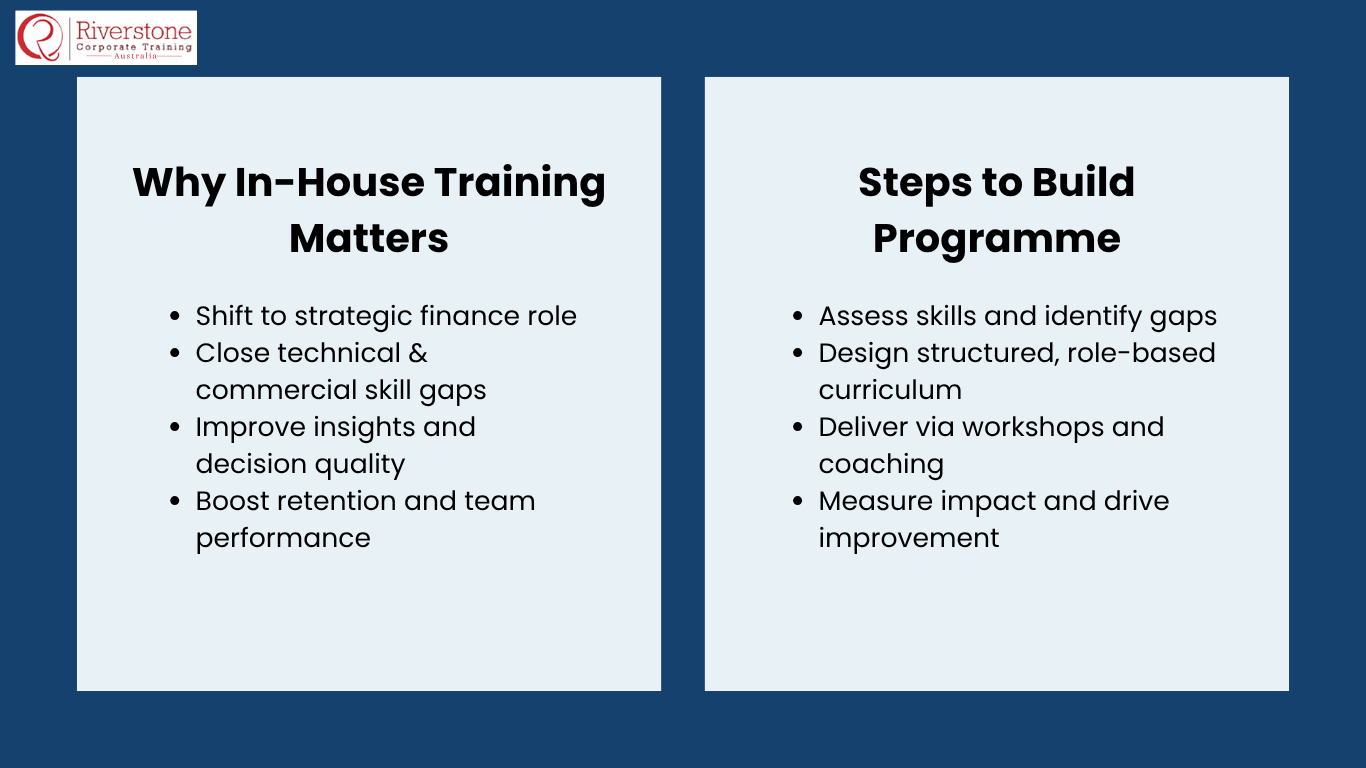
Developing world-class finance teams is one of the most important – and most chronically neglected – roles of the contemporary CFO. Over the last ten years, the role of the finance function in most organisations has shifted from being primarily a transactional recording and reporting function to being a strategic business partner, required to provide forward-looking commercial insights, challenge management’s thinking, contribute to capital allocation decisions, and serve as an enterprise-wide risk management resource. This shift demands not only different systems and processes, but a different level of capability in the finance team, which can seldom be sourced entirely through external recruitment, and which needs to be nurtured through ongoing investment in structured finance team training.
- The benefits of in-house finance training go well beyond the direct improvement in skills of the individuals who attend the training: they transform the analytical culture of the whole finance function, establishing a common language, a set of quality standards and a community of practice that lifts the performance of the whole team, not just the individuals who attend the training.
- The companies that consistently excel in terms of finance capability – whose finance teams are trusted by the business as strategic partners, whose financial reporting is accurate and insightful, and whose financial analysis is used to inform and guide commercial activities – are invariably those that have made the capability development of their finance teams a structured, ongoing organisational priority rather than an ad hoc response to perceived capability gaps.
In-house corporate finance team development is not the same as external training. External training – open enrolment courses, university short courses, professional qualifications – delivers a standardised curriculum to a diverse audience. Internal training is tailored to the organisation’s context, its processes and strategies, and the specific analytical challenges the team faces in practice. This is why the benefits of in-house finance training are so huge compared to the cost.
- For finance professionals at junior and middle levels, internal training programmes are one of the key indicators of whether an organisation values its finance team as a strategic resource or merely as a transactional cost centre – and are increasingly a key consideration in attracting, retaining and developing the next generation of senior finance leaders.
- This article addresses the entire cycle of in-house finance training programme development, including the business case, needs assessment, design, delivery, evaluation and the leadership behaviours that shape whether the investment in training makes a lasting difference in finance skills.
|
Finance team training is not an HR function. It’s an investment in the organisation’s capacity to make better decisions with better information. The CFO who understands the importance of capability building invariably delivers a more capable, influential, and trusted finance team. |
02 Why Finance Teams Need Structured Training
There’s a greater need for finance capability-building strategies now than at any other time in business history. The speed of regulatory evolution – new accounting standards, tax regimes, growing ESG disclosure standards – means the technical skill base of the finance function needs to keep pace to achieve compliance. The rapid pace of digital transformation – new enterprise resource planning (ERP) systems, data analytics software, and artificial intelligence (AI) enhanced forecasting tools – means that the technology capability of the finance team must keep pace with the technology they use. And the rising demand for finance to be a strategic business partner means that finance professionals need not only technical skills but also the business acumen, communication skills and leadership influence to impact strategy at the highest levels of the organisation.
- Upskilling finance teams through training addresses an important gap between the skills finance professionals develop through formal education and qualification programs and the skills they need to perform effectively in their business’s specific environment. Accounting degrees build technical skills; internal training builds the skills to apply that technical competency within the specific analytical, process, and quality frameworks that determine its value in the business context.
- The tight labour market for finance professionals means that, where organisations fail to invest in development, they face a retention issue: talented finance professionals who feel they are not developing will leave for a better opportunity. The cost of replacing a middle-level finance professional who leaves due to a lack of development opportunities is well in excess of the annual development investment needed to keep them.
Training finance employees in finance departments creates a compound return because finance skills are linked: improved understanding of accounting leads to better financial modelling, which leads to better analysis, which leads to better commercial insights, which leads to better decision support. Training in any one of these areas will improve performance across all downstream areas. This means that the return on training investment is not realised solely in the improvement of the skill being trained, but in the improvement of the team’s overall capability, realised over time.
- The finance teams that are best at analytics – whose models are trusted, whose forecasts are accurate, whose insights are valued by the business – are those where senior professionals invest time in training their juniors, maintain high standards for work quality, and share knowledge rather than hoard it.
- Team performance improvement through finance training also helps avoid the hidden costs of low capability: the time wasted fixing mistakes in financial models, the damage to reputation when forecasts are inaccurate, and the opportunity costs of analytical work not done to the standard needed to inform decision-making. These costs are real, but often not explicitly quantified – hence the underestimate of the return on training investment in those organisations where it has not been made a priority.
03 The Business Case for In-House Finance Training
Best practices for in-house finance training are based on a business case that makes the case for investing in finance capability building as a priority rather than a cost. Developing this case – and communicating it effectively to a CFO, CEO or board – demands the same level of analysis that finance teams use to justify capital investments: what are we investing in, what are we expecting to return, and how certain are we about the expected returns?
- The direct return on investment in training includes: lower costs of external recruitment (as in-house development reduces the need to hire experienced professionals at high salaries), lower costs of error correction (as better quality analysis work requires less rework), and lower costs of consultancies (as in-house capability eliminates the need for external specialists to support recurrent analytical work).
- Indirect returns – more difficult to measure but no less real – include: better commercial decision-making (as better information leads to better capital allocation), better positioning of the finance team as a business partner (with flow-on effects on the quality of the information provided to the finance team by the business), and better retention (as people who see a future in the organisation are less likely to leave and more likely to cost less to replace).
In-house finance training benefits are also a competitive advantage. Companies whose finance teams can model scenarios, interpret financial data, and communicate financial information to non-financial stakeholders make faster, better capital allocation decisions than companies whose finance teams are a reporting and compliance machine. In a competitive environment, the quality of financial decision-making is a source of competitive advantage – and the quality of financial decision-making is a function of the quality of the finance team.
- A powerful argument for a sceptical board or executive is the cost of failure: the acquisition that failed due diligence because the internal team could not identify critical risks, the budget that was 30% off because the forecasting process was too simplistic, the compliance failure that occurred because the team did not understand the new reporting standard. Each of these has a cost, and this cost is generally far in excess of the cost of training that could have avoided it.
- The market for talent delivers a second part of the business case: the scarcity of experienced finance professionals in most markets means organisations need to build capability internally or pay ever-greater premiums for external talent. Finance capability building is thus not only a performance investment – it’s also a talent strategy that reduces reliance on a costly and tight market.
04 Designing Effective Finance Training Programmes
Training finance professionals through effective training programs involves a learning architecture that matches the way that adults learn – through a mix of conceptual instruction, application, feedback and practice. The traditional 70:20:10 model of learning – 70% of learning comes from on-the-job experience, 20% from social learning, and 10% from formal instruction – suggests a design principle: finance team training programs that are based primarily on classroom instruction will have less long-term impact than those that combine formal instruction with practice and application.
- Finance training programmes that are designed backwards from the output (what the trained person should be able to do differently as a result of the training) to the input (what the person needs to know, skill and practice to get there) are more effective than those that are designed forwards from the input to the output. Backwards-designed training is more targeted, relevant and measurable than forwards-designed training.
- Localisation is the key design principle for in-house finance training: training using the organisation’s own financial data, business model, financial analysis problems, and cases. Finance practitioners learn financial modelling fastest by modelling their organisation’s business; they learn credit analysis fastest by analysing borrowers in their loan portfolio; they learn FP&A fastest by working through the organisation’s budget process. The more relevant the training to the job, the quicker and more effective the learning.
Finance capability-building programs for different target audiences require different designs. Entry-level analysts need technical skills development in financial statement analysis, Excel modelling, accounting, and basic valuation techniques. Analysts and senior associates need commercial skills-building: business partnering, executive communication, strategic analysis, and translating financial insights into business recommendations. Managers and senior managers need leadership and influence-building: how to lead and manage a team of analytical professionals, how to influence senior decision-makers, and how to coach and develop junior analysts and associates within the team.
Table 1: Finance Training Curriculum Framework — By Level and Capability Area
| Audience | Technical Skills | Commercial Skills | Leadership / Communication |
|---|---|---|---|
| Graduate / Analyst (0–2 years) | Financial statement analysis; Excel modelling (DCF, 3-statement); accounting standards literacy; basic credit analysis | Business model understanding; industry research; cost-benefit analysis basics | Written communication, presentation of findings to the manager, and working in analytical teams |
| Senior Analyst / Associate (2–4 years) | Advanced modelling (LBO, scenario analysis); valuation methodology; financial forecasting; IFRS updates | Commercial acumen; value driver analysis; performance metric interpretation; business case construction | Executive summary writing, presenting to senior stakeholders, and managing analyst work quality |
| Manager / Senior Associate (4–7 years) | M&A analytical skills; complex deal modelling; strategic financial planning; risk quantification | Business partnering; finance as strategic adviser; challenging commercial assumptions; competitive analysis | Leading team training sessions; stakeholder influence; coaching and developing analysts; upward management |
| Senior Manager / Director (7+ years) | CFO-level financial reporting; board-ready analytical outputs; capital structure strategy; investor relations analytics | Sector strategy and market positioning analysis; capital allocation advisory; enterprise risk oversight | Board presentation; external stakeholder communication; building a high-performance finance team culture |
05 Five Key Steps: Deriving WACC for a Real Company
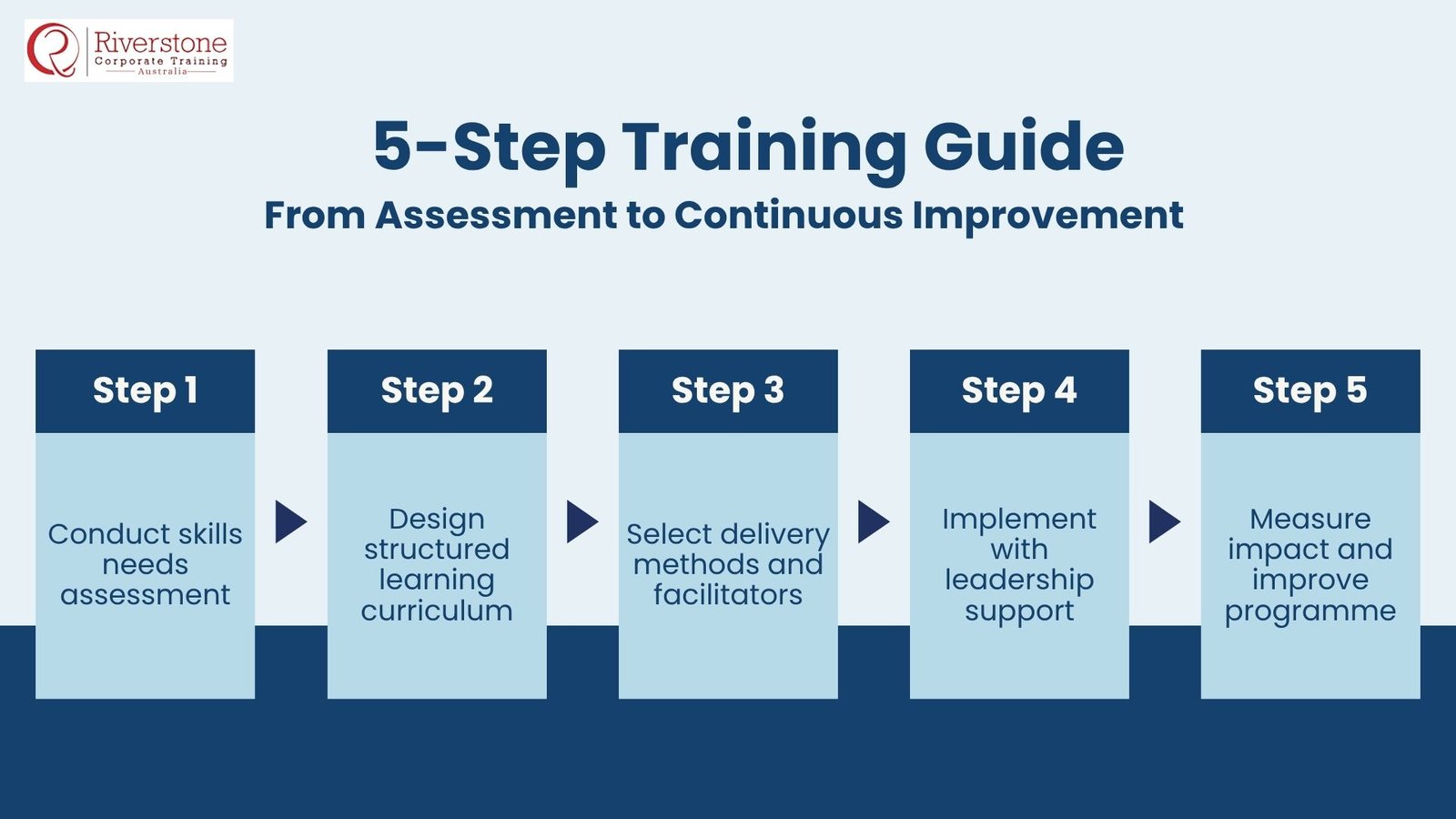
Finance team training programs that improve team performance over time have a five-step development and delivery process. Knowing this process – and the particular design and governance choices at each step – provides finance leaders and HR business partners with the operational blueprint to develop programmes that have the desired impact on team performance rather than just meeting a compliance obligation for team training.
Step 1 — Conduct a Skills Needs Assessment
The foundation of all successful training programmes is a rigorous understanding of the team’s current capabilities and identifying skill gap in teams between those capabilities and the level needed to support the team’s functions’ strategic goals. A rigorous skills needs assessment, using a blend of performance data analysis, manager feedback, peer observation, and technical skills assessment, provides a stronger, more specific rationale for training investment than assumptions and generic standards.
- The needs assessment should assess three aspects of capabilities: technical skills (quality of financial modelling, accounting, regulatory knowledge), commercial skills (understanding of business model, communication of insights, judgement) and professional skills (attention to detail, clarity of communication, teamwork). The assessment approach differs across dimensions: technical skills can be directly assessed; commercial and professional skills require structured observation and 360-degree feedback.
- The needs assessment produces a capability heat map – a visual depiction of the skill set that highlights what capabilities are strong (and therefore need to be sustained rather than built), what capabilities are adequate but in need of improvement, and what capabilities are significantly below the standard expected for the function to achieve its strategic goals. This heat map informs the curriculum design and investment decision-making.
Step 2 — Design the Curriculum and Learning Architecture
The curriculum design step takes the capability gap analysis. It turns it into a learning programme, defining what will be learned, in what order, how it will be learned, and which application exercises will supplement the formal learning.
- Curricula should be modular – designed as a sequence of connected but stand-alone learning modules that enable participants to absorb the content in bite-sized chunks, and build more complex capability over time. The modular approach also enables the curriculum to be progressively updated as standards evolve and new capability requirements arise, rather than requiring a complete overhaul.
- Application activities (exercises, case studies and work assignments that require participants to apply new knowledge to actual analytical problems) should be built into the curriculum, not tacked on at the end. It’s here that learning is embedded; without it, the formal instruction results in knowledge that doesn’t translate into behaviour.
Step 3 — Select Delivery Methods and Facilitators
Internal training best practices show that the delivery method and the quality of the facilitator are as critical as the quality of the content, because the same content delivered by an engaged facilitator with relevant commercial experience in a workshop will result in much better learning outcomes than the same content delivered by a disengaged facilitator in a passive e-learning format.
- The most effective delivery mix for finance training generally includes a combination of workshops (for conceptual teaching and group case study work), mentoring and coaching (for individual support and feedback in applying the skills learned), peer learning groups (for sharing knowledge and solving problems collaboratively), and self-paced learning resources (for reference and just-in-time skill development). Each of these delivery methods plays a different role in the learning system, and the best training uses a combination of them.
- When choosing facilitators, favour those with a strong commercial background in the topic being taught – people who have built the financial models they are instructing on, managed the credit risks they are describing, or worked with the regulatory frameworks they are discussing. Finance professionals respect commercial credibility, and the training’s stories and case studies are more relevant and less abstract.
Step 4 — Implement with Senior Sponsorship and Accountability
Training for finance employees is often less effective when viewed as an HR function rather than a business imperative owned by the CFO and the finance leadership team. Senior sponsorship – the active, public endorsement of the program by senior finance leaders – is the critical factor in determining its success in achieving its capability development goals.
- Senior sponsorship is more than signing up to the budget: it is the CFO’s attendance at the launch event, line managers attending training with their teams, senior professionals facilitating training sessions and providing case study material, and the clear message that capability development is part of the leadership agenda, not something that is optional.
- Accountability mechanisms – attendance, completion and most importantly the application of the training content to work – ensure that the training investment is transformed into performance improvements rather than being enjoyed as a “feel good” learning experience with no behavioural consequences. The best accountability tool is the professional’s quarterly development discussion with the direct manager, where the transfer of training to the workplace is assessed and reinforced.
Step 5 — Measure, Evaluate and Continuously Improve
Training for team performance improvement in finance requires measurement that goes beyond the typical ‘happy sheet’ to determine if the training has actually improved the job. The Kirkpatrick model, which measures training effectiveness at four levels (reaction, learning, behaviour, and results), is a framework that can be used to assess training effectiveness in most finance training situations.
- The third level – measurement of behavioural change – is the most important and the most difficult: it involves structured observation of quality of work before and after training, feedback from managers and colleagues about whether the professional is using skills learned, and measurement of relevant performance metrics (model error rates, forecast accuracy, time taken to produce analytical reports) over a period of 3-6 months following training.
- The feedback loop – using the measurement results to improve the curriculum, training delivery and practice activities – is what turns a training event into an ongoing capability building process. Programmes that are assessed and refined each year, based on evidence of what is and is not working, have a greater positive impact over time than one-off designs that are run without change.
06 Real-World Training Programme Examples
In-house training of finance professionals is best illustrated by examples of how companies have designed, delivered and evaluated the success of their training programs. The following three examples are based on actual programme designs – anonymised in their organisational details but real in their design and results.
A Global Manufacturing Group — Building Financial Modelling Capability
A European-based, 12-country manufacturing group recognised a significant capability gap in financial modelling within its finance team: models developed by regional finance teams were structurally inconsistent, prone to formula errors, and used assumptions that were neither documented nor tested for historical accuracy. This added considerable work to the group consolidation process and affected confidence in the strategic planning analysis.
- The training was delivered in three modules: a basic module (four half days, covering Excel disciplines, three-statement model building, and the group’s standard model template), an intermediate module (three half days, covering scenario analysis, WACC calculation and DCF valuation) and an advanced module (two full days, covering M&A financial modelling and complex scenario modelling). All modules involved a modelling exercise based on the group’s divisional financials.
- 18 months later, the group reported a 40% improvement in group-level model review time (fewer errors to correct), a 25% improvement in time to produce the annual strategic planning financials, and greatly increased participation by the business unit leaders who reported that the finance team’s modelling and analytical output was more credible and more valuable to their own decision-making. Finance capability building approaches that target the tools of the trade – as opposed to abstract theories – have the most readily visible impact.
A Financial Services Group — FP&A Business Partnering Programme
A regional financial services group with a 35-person finance team was facing significant tension between the CFO and the business: the finance team was delivering accurate financial reports that met compliance requirements, but business leaders felt the financial insights they were receiving were retrospective, too technical, and not relevant to their decision-making. The CFO engaged in a business partnering capability-building programme.
- This involved a two-day workshop on turning financial information into commercial insights, as well as a six-month mentoring programme, in which finance team members were paired with senior business leaders for monthly discussions on how finance could provide more useful information in the context of their decision-making. The mentoring was the most popular part – it provided finance professionals with an opportunity to hear directly from the business stakeholders they were meant to serve.
- The results were assessed by an annual survey of business unit leaders on their assessment of “finance as a business partner”. It scored an average of 5.8 out of 10 at the beginning of the programme and 7.9 out of 10 a year later – and the open-ended responses identified “more insight and less data” and “better understanding of our business challenges” as the main benefits. This example shows that skills development for finance teams must focus on commercial and communication skills, as well as technical skills.
A Technology Company — Building a Finance Graduate Programme
A fast-growing technology firm was facing a typical early-stage growth issue: it had grown quickly. It hired a large cohort of graduate finance professionals who were extremely well qualified academically, but were not keeping up with the pace and complexity of the company’s financial operations. The CFO developed a 12-month graduate development programme that included technical skills and company-specific commercial training.
- The training program comprised monthly technical workshops (modelling, accounting, analysis skills), quarterly company strategy sessions (presentations by senior leaders on the business model, competition and strategy), and a capstone project in month 12 (where each graduate undertook an independent financial analysis of a strategic issue within the company, and presented it to the CFO and senior leadership team).
- The capstone project was the most valuable component: it forced graduates to apply all the skills they had learnt over the year to a real commercial analysis, and it provided a direct view into each graduate’s analysis skills. Two years after the programme started, graduate retention rates rose from 58% to 84% – a direct payback on the investment in training that more than offset the programme’s cost. To build high-performing finance teams, it all starts with graduates and continues through the rest of the career journey.
07 Common Challenges and Lessons Learned
The most common challenges organisations face when delivering finance team training initiatives are structural, cultural and operational – and the best way to ensure that these challenges do not derail training initiatives is to anticipate them before they occur and build solutions into the training initiative to overcome them.
Table 2: In-House Finance Training Process — Phases, Activities and Common Failure Points
| Phase | Key Activities | Common Failure Mode | Best Practice Response |
|---|---|---|---|
| Needs Assessment | Skills gap analysis, performance data review, stakeholder interviews | Assessment based on assumptions rather than evidence; focus on desired training rather than identified capability gaps | Use direct capability testing alongside manager input; be honest about gaps even when the findings are uncomfortable |
| Programme Design | Curriculum development; facilitator selection; case study design | Designing training around available content rather than identified needs; using generic external materials rather than context-specific cases | Invest time in developing organisation-specific cases and examples; select facilitators for commercial credibility, not academic credentials |
| Launch and Communication | Stakeholder communication; CFO sponsorship; participant briefing | Positioning training as an HR compliance activity rather than a strategic development investment; insufficient clarity about what participants will gain | CFO to personally launch the programme and explain why it matters; frame training as investment in the team’s career development and strategic impact |
| Delivery | Workshop facilitation, coaching sessions, and application exercises | Workshops disconnected from real work; facilitators who have no commercial credibility with the finance audience; insufficient practice time vs instruction time | Balance instruction and application at 40:60 or even 30:70; ensure all facilitators have genuine practitioner backgrounds; use the organisation’s real data |
| Application | On-the-job skill application; manager coaching; peer learning | Trained skills are not applied because work processes do not create opportunities to use them; managers who do not reinforce training in daily work supervision | Redesign work processes where necessary to create application opportunities; make manager reinforcement an explicit part of the programme design |
| Measurement | Pre/post skills assessment; behavioural observation; business impact metrics | Measuring satisfaction rather than capability change; no follow-up beyond the immediate post-training survey | Measure at all four Kirkpatrick levels; track performance metrics 6–12 months post-programme; close the feedback loop by sharing outcomes with participants |
The overarching problem that most commonly derails finance team training is a lack of leadership commitment. Training programmes that start with the strong support of the CFO but then fall down the priority list as the finance leader’s focus shifts to other issues will not deliver on their capability-building goals. The companies that have high-capability finance teams are those that make capability development a standing agenda item, not a “one-off” project to be finished and then shelved.
- The most common insight from organisations that have successfully developed high-capability finance teams through internal training is the need for patience: the benefits of a well-designed training initiative will take 12-24 months to fully emerge because skills take time to develop, and the most valuable outcomes (better quality analysis, better commercial insights, better relationships with business partners) are not measured in the short term.
- The second most consistent lesson is the importance of peer learning: the informal knowledge transfer that occurs between colleagues – when a senior analyst shares a modelling trick with a junior, when a manager shares a case study from a previous project, when a team reviews what worked and what didn’t after a project – provides more cumulative learning than any formal training. The best internal training practices provide opportunities for this peer learning to occur regularly.
08 Making Training Stick — Embedding Learning in Daily Practice
Training finance professionals is not about delivering training sessions, it’s about embedding new knowledge and skills into the everyday practices, processes and relationships of the finance team. Adult learning research shows that without reinforcement, knowledge acquired in formal training is quickly forgotten – the “forgetting curve” indicates that if there is no structured practice and review, most of the content of a training event is forgotten within a few weeks. A learning system, therefore, is the goal of a good finance team training programme, because it provides ongoing reinforcement of the learning.
- Output quality standards – clear statements of what constitutes a “good” financial model, a “good” memo or a “good” management presentation in the context of the organisation – reinforce the technical standards taught in training. When a manager checks a piece of work and provides feedback against these standards, they are continuing the training programme in the workplace without further training.
- Monthly team learning meetings – brief (30-60 minute) structured learning opportunities where team members share some work they have done, discuss lessons from recent projects, or introduce a new accounting standard or market development – provide a regular rhythm of collective learning that reinforces training content and keeps the team up to date without taking up too much time.
The importance of the manager in training effectiveness. Managers who view training as an event that happens to their team, rather than something they reinforce, model, and integrate into the team’s work, will find that their training investment leads to short-term performance improvement rather than long-term capability development. The best way to do this is to embed development conversations in the normal manager-report dynamic: asking the professional how they’ve applied the training to their work, giving feedback when the skills being learned are being applied well or not, and giving stretch assignments that require the application of new skills.
- Knowledge management – capturing the analytical approaches, model templates, research findings and case study lessons from the work of the team in a searchable, accessible library – is one of the most important and most under-invested aspects of finance capability development. A knowledge management database that enables any team member to rapidly access a previous model, a similar analysis, or a summary of how a particular problem was addressed is a permanent organisational learning resource that supports all future analytical efforts.
- Recognition of learning – when team members are explicitly rewarded for their ability to learn quickly, for their efforts to apply their learning to produce valuable analytical outputs, or for their efforts to help others learn – sends a message that learning is important, and just as important as delivery. In finance functions where recognition is largely tied to transaction execution or reporting accuracy, explicitly recognising learning and development behaviours helps establish a culture of continuous improvement that underpins ongoing capability development.
09 The CFO’s Role in Finance Capability Development
Creating high-performing finance teams is a leadership challenge, not a training challenge. The CFO who takes a personal interest in the development of their team – who is involved in the training program, who coaches their direct reports, who sets the standard for the quality of analytical work they expect from the finance team and who makes the development of team capability a regular topic of discussion at the board table – always delivers a more capable finance team than the CFO who leaves the development agenda to HR or an external training provider.
- The most direct impact of a CFO on team capability development is the quality of their analytical work. When a CFO returns a financial model with specific, targeted feedback on the modelling methodology, the assumption documentation and the communication of key findings, they are providing the most effective training – real-time, personalised feedback on actual work from the most senior and respected voice in the finance team. This feedback is more important to the quality of analysis than training.
- The CFO’s second most important contribution is to make development possible – to carve out time for training from the operational pressures of the job, to ensure that development is a permanent part of the annual talent review, and to present the business case for training investment to the board and secure its approval as a recurring budget line, rather than an ad hoc expense to be challenged each year.
Investment in corporate finance team development as a priority must be reflected in the CFO’s performance metrics – the way they are measured and rewarded by the CEO and board. CFOs who are measured purely on the accuracy of their financial reports, cost control, and compliance have an implicit incentive structure that de-emphasises investment in development. CFOs who are measured on the capability of their finance team, the strength of their talent pipeline and the quality of financial advice they give to the business have an incentive to invest in their team’s development.
- The development discussion that the CFO has with each of their direct reports – not just about performance, but development, not just delivery but capability – establishes the culture of development throughout the finance function. When senior finance professionals see the CFO taking an interest in their development, they are more likely to do the same with their own teams, and the snowball effect of development investment spreads throughout the finance function.
- External leadership development – exposing senior finance professionals to best-practice finance functions at peer organisations, to industry forums and conferences, to cross-functional rotations within the broader business – gives finance leaders the benchmarking perspective they need to assess their team’s capabilities against the market benchmark, and to identify the development initiatives that will most effectively improve their team’s competitiveness. Finance team training programs that are benchmarked against the market are more focused than those that are not.
10 Conclusion and Actionable Insights
Investing in high-performing finance teams through internal training is one of the most valuable things a CFO can do – and one of the most under-invested in with respect to commercial value. Finance team training initiatives that are well designed, well supported, and well measured deliver improvements in analysis quality, business partnering, talent retention, and decision-making, resulting in a return on investment that far outweighs the cost. Organisations that prioritise the development of their corporate finance teams as a strategic initiative deliver more effective finance functions than those that treat training as an intermittent response to identified capability deficiencies.
The biggest mindset shift for finance leaders is from training as an event to training as a system – from thinking about capability development as a series of courses to be attended and completed, to thinking about it as a continuous, embedded practice that is integral to everyday team operations. To develop the level of finance team skills needed to support the strategic goals of the modern finance function, it is not enough to have well-designed training courses – it requires a culture of learning that values development, incentivises improvement and provides the daily opportunity for new knowledge and skills to be practised, reinforced and refined.
- Do a proper skills audit – before developing training, do the work to understand the current skills profile of the team, specifically and accurately. Combine direct skill testing with managers’ and peers’ observations to create a heat map of capabilities that informs investment decisions rather than guesswork.
- Design training from the output backwards – identify exactly what team members will be able to do better after the training, then build the training content, training delivery and application exercises to support that. Content-forward training is less focused and effective than capability outcome-forward training.
- Get CFO sponsorship and involvement – the single most important factor in training programme success is the active, ongoing involvement of the CFO. The CFO’s personal commitment to the launch of the program, to facilitate some sessions, and to explicitly link development to performance communicates to the team that capability development is important.
- Focus on behaviour, not just satisfaction – measure the impact of training on the way people work (better models, more accurate forecasts, more effective business partner conversations) over the 6-12 month period after the training, not just the fact that people liked it. Apply these measures to inform the programme design.
- Institutionalise learning – build the output quality standards, monthly learning sessions, manager coaching cadence and knowledge management systems that embed training content in the day-to-day practices of the finance function. Best practices for in-house training are not enough; it’s the practices surrounding training that make the difference between capability improvement and knowledge acquisition.
| Our in-house finance training and capability development services help CFOs and finance leaders design, implement, and evaluate the effectiveness of structured development initiatives that address top business challenges for Australian Companies and specific capability needs of their finance team, the organisation’s commercial environment, and the finance function’s strategic goals. It starts with a realistic view of the team’s capabilities and ends with a development approach that delivers the team you want. |