

- 01 Introduction
- 02 The Australian Finance Industry — A Landscape Overview
- 03Finance Industry Roles Explained
- 04 Core Skills Needed for Finance Careers
- 05 Five Key Steps: How to Start a Finance Career
- 06Breaking Into Investment Banking and Competitive Roles
- 07 Real-World Career Journeys
- 08Challenges and Lessons Learned
- 09Accelerating Your Career Progression
- 10Conclusion and Actionable Insights
Starting a Finance Career in Australia:
Skills, Roles, and Industry Expectations
Table of Contents
01 Introduction
A career in finance in Australia is more pertinent and challenging than ever. The Australian finance sector offers a remarkable breadth of career opportunities – from graduate analysts in the Big Four accounting firms and transaction services teams, to investment bankers, private equity associates, credit risk managers, financial advisors and corporate treasurers. Each role offers a fulfilling career, but each has its own entry criteria, skill sets and career development path that aspiring finance professionals must understand well if they are to plan a successful career entry strategy.
- How to get a job in finance in Australia requires a blend of academic qualifications, technical and commercial skills, and the work experience and professional connections that prove a genuine interest in the profession – not just its academic study.
- Those who build the most rewarding and fastest-moving careers in finance approach their career development with the same structured rigour they bring to their analytical practices – setting career goals, developing the skills to achieve them, and identifying opportunities that offer the most intensive learning.
Australia offers significant graduate finance opportunities across the breadth of the industry – from the graduate programs offered by major banks and the Big Four accounting firms through to smaller advisory firms, infrastructure funds, and corporate finance teams within listed and unlisted companies and groups. The sheer diversity of pathways is actually one of the most frequent sources of confusion for early-career finance professionals: with so many potential pathways, it is important to have a structured approach to deciding which pathway to pursue and how best to pursue it.
- A finance career Australia guide is most useful when it goes beyond the generic ‘study hard, network widely, be professional’ to offer practical insights into what is required for each pathway, what makes successful candidates different from unsuccessful candidates, and what the likely career progression will be once the first role is obtained.
- This article provides the full spectrum: an overview of the Australian finance industry, a breakdown of the major role types, skills required across the various pathways, a five-step process to kick-start a career, examples of successful career journeys, challenges and lessons, and a framework for accelerating career progression once the journey has begun.
|
Finance is not a single role – it is a portfolio of experiences, skills and relationships that build over time. Those who develop the most successful careers treat each role as a learning opportunity and each relationship as an investment. |
02 The Australian Finance Industry — A Landscape Overview
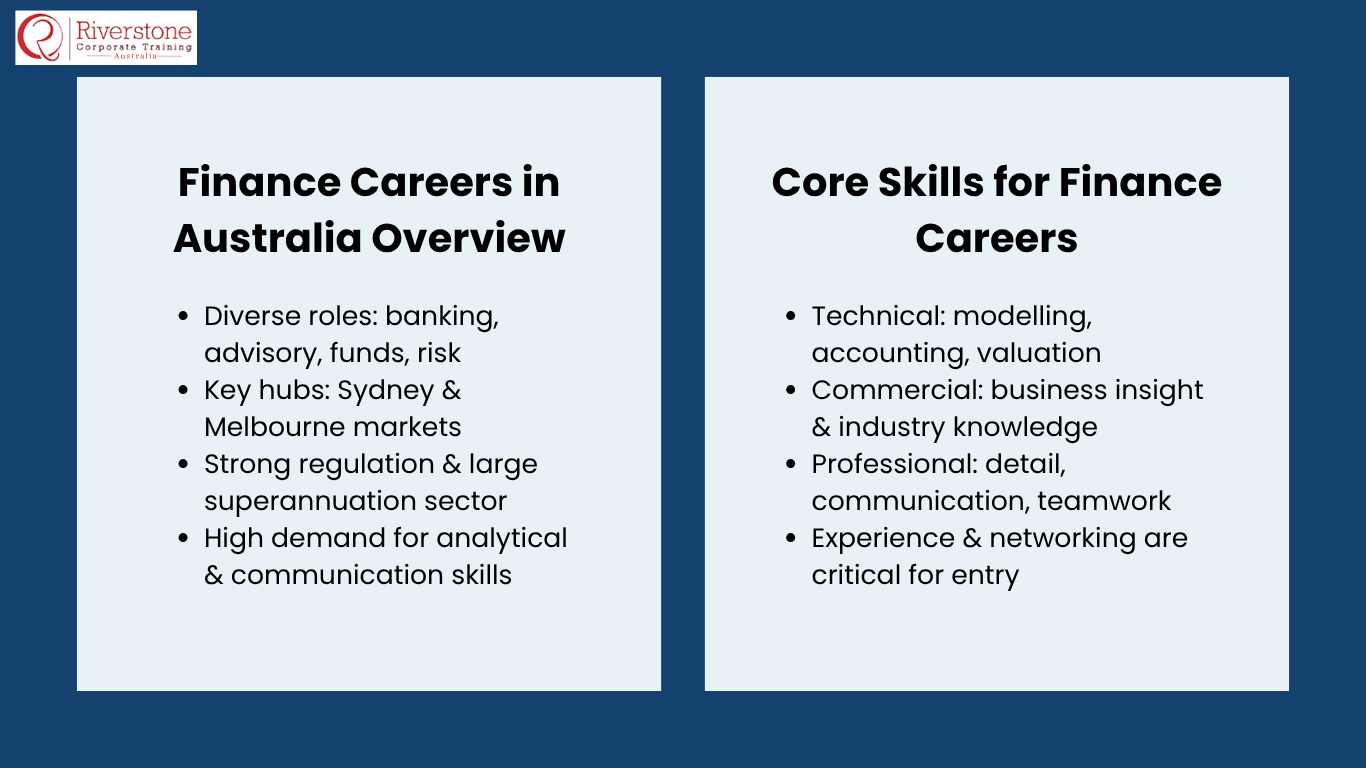
An Australian finance career guide starts with an overview of the industry. The Australian financial services industry is one of the most advanced in the Asia-Pacific – featuring four major banks (each one of the largest banks in the Southern Hemisphere), a highly developed superannuation industry with more than $3.5 trillion in assets under management, a very active M&A and private equity market, and a network of professional services (accounting, advisory, law and management consulting) firms that support capital allocation and financial decision making in every corner of the economy.
- Financial services is the largest sector of the Australian economy in terms of gross value added, and employs hundreds of thousands of people in banking, insurance, superannuation, funds management, financial advice, and corporate advisory. This ensures the industry provides a wide range of careers – from highly analytical risk modelling jobs to client-focused investment banking and relationship-focused private banking.
- Sydney and Melbourne are the two major financial centres, with Sydney home to most investment banking and equity capital markets activity. At the same time, Melbourne is a major hub for funds management, private equity and infrastructure finance. The other capital cities are home to significant regional banking, mining, finance and advisory markets.
The nature of the industry is important for those considering a career in finance in Australia. The superannuation system (in which employers are required to make contributions to retirement savings for all workers) has led to one of the largest pools of managed assets per capita in the world, creating significant demand for funds management, asset consultancy and infrastructure investment specialists. Historically, the mining and resources sector has been a major source of corporate finance and advisory business, including project finance, M&A and equity capital markets. And the technology and healthcare sectors have been the main source of M&A activity in recent years, driving the need for specialist advisers and corporate finance professionals in these sectors.
- Highly regulated environments are a feature of the Australian finance industry: APRA’s regulation of banks, insurers and superannuation funds, ASIC’s regulation of financial markets and advice, and the ATO’s administration of complex tax and superannuation regulations combine to create a regulatory framework that places a premium on specialist compliance, risk and governance skills in the industry.
- The finance jobs in Australia requirements differ by sector and role type, but what is common across the industry is the need for analytical rigour, attention to detail, integrity, and the capacity to communicate complex information to a variety of audiences.
03 Finance Industry Roles Explained
Finance industry roles explained in detail involve delineating the industry’s key practice areas and the types of roles within. The most obvious distinction is between front office (roles that interact directly with customers or markets – investment banking, asset management, financial advisory) and middle and back office (roles that support the front office with risk management, compliance, technology and operations). This is important for career development because the required technical and interpersonal skills, as well as the career path, differ significantly.
Table 1: Finance Industry Role Map — Pathways, Employers and Key Skills
| Practice Area | Typical Roles | Key Employers | Primary Skills Required |
|---|---|---|---|
| Investment Banking | Analyst, Associate, Vice President, Director, Managing Director | Bulge bracket banks, mid-market boutiques, and local banks’ institutional divisions | Financial modelling (LBO, DCF); deal structuring; client communication; transaction execution |
| Corporate Finance / M&A Advisory | Analyst, Associate, Senior Associate, Manager | Big Four transaction services; boutique advisory firms; in-house corporate development teams | Valuation; due diligence; business analysis; financial modelling; deal project management |
| Private Equity / Infrastructure | Analyst, Associate, Investment Manager, Partner | Infrastructure funds; buyout PE firms; growth equity funds; sovereign wealth funds | LBO modelling; investment thesis formation; portfolio company management; deal sourcing |
| Asset and Funds Management | Research Analyst, Portfolio Analyst, Fund Manager | Superannuation funds, listed investment trusts, boutique fund managers, and investment consultants | Financial analysis; equity research; portfolio construction; quantitative analysis |
| Commercial / Corporate Banking | Credit Analyst, Relationship Manager, Structured Finance Analyst | Major banks, regional banks, and international banks with Australian operations | Credit analysis, financial statement analysis, relationship management, and product knowledge |
| Accounting / Audit / Assurance | Graduate, Senior, Manager, Senior Manager, Partner | Big Four accounting firm, mid-market accounting firms, and in-house internal audit | Accounting standards; audit methodology; financial reporting; internal controls |
| Risk and Compliance | Risk Analyst, Compliance Officer, Quantitative Risk Manager | APRA-regulated institutions; banks; insurance; superannuation; ASIC-regulated firms | Regulatory knowledge; risk modelling; governance frameworks; analytical rigour |
| Financial Planning / Advice | Paraplanner, Financial Adviser, Senior Adviser | Financial planning groups, private banks, and insurance company advice arms | Financial planning methodology; FASEA compliance; client communication; technical product knowledge |
Corporate finance careers start with an analyst role – either as part of a transaction services team at a Big Four firm, as part of the M&A advisory team of an investment bank, or in the corporate development team of a large listed company. The analyst position involves heavy financial modelling, due diligence and report writing – as well as increasing client contact and independent analysis over time as the professional advances in their career. The progression from analyst to associate (two to three years in the job) is characterised by the shift from analysing to owning parts of a deal or engagement.
- The transition from associate to manager (three to six years) focuses on project management skills – the ability to manage a work stream, junior analysts, clients and counterparties, and to be accountable for the quality of the team’s analytical work.
- Senior levels (director, partner, managing director) require not only analytical and project management skills but also a commercial franchise: the ability to develop relationships, win new business, and nurture client relationships that are the source of the revenue that drives the firm’s economics
04 Core Skills Needed for Finance Careers
The skills required for finance careers in Australia fall into three broad buckets: technical skills (the quantitative and analytical skills that provide the analytical foundation for financial work), commercial skills (the business judgement, industry knowledge, and client communication skills that apply analytical skills to commercial problems), and professional skills (the work ethic, attention to detail, teamwork and communication disciplines that determine how well technical and commercial skills are applied in a team and client environment).
- Technical skills are the easiest for financial employers to teach and test: financial modelling in Excel, accounting, valuation, credit analysis, and quantitative data analysis are the technical skills most financial employers focus on in their recruitment. Developing these skills to a professional level before starting a career is the best way for a candidate to improve their chances of success.
- Commercial skills are largely learned on the job. Through working on real deals, with real clients and real business problems that require the application of technical skills to situations where the information is not complete, the constraints are binding, and the outcomes are of commercial significance. The key to rapid development of commercial skills is to proactively seek out these experiences rather than wait for them to happen.
Three professional skills are consistently identified in finance job requirements Australia hiring processes as the most important at the junior level: attention to detail (the ability to produce work that is not only accurate but error-free, even when under pressure to complete it within a tight timeframe), communication clarity (the ability to communicate complex analytical insights in clear, concise terms to a non-specialist audience), and intellectual curiosity (the engagement with the world of financial markets, business and commercial strategy that signals that the candidate will continue to learn beyond the formal curriculum).
- Excel skills – financial modelling, pivot tables, VLOOKUP/INDEX MATCH, and the ability to structure and present information in models – are the most universally needed technical skills for almost every finance role, and the one most frequently underestimated by candidates as being important to develop before entering the market.
- Accounting knowledge – how the three financial statements are prepared, how they interact, and what they tell us about the financial position of a business – is the analytical language of finance. Those who can’t interpret a set of financial statements are not able to make a meaningful contribution to any financial analysis, no matter how skilled they are in other areas.
05 Five Key Steps: How to Start a Finance Career
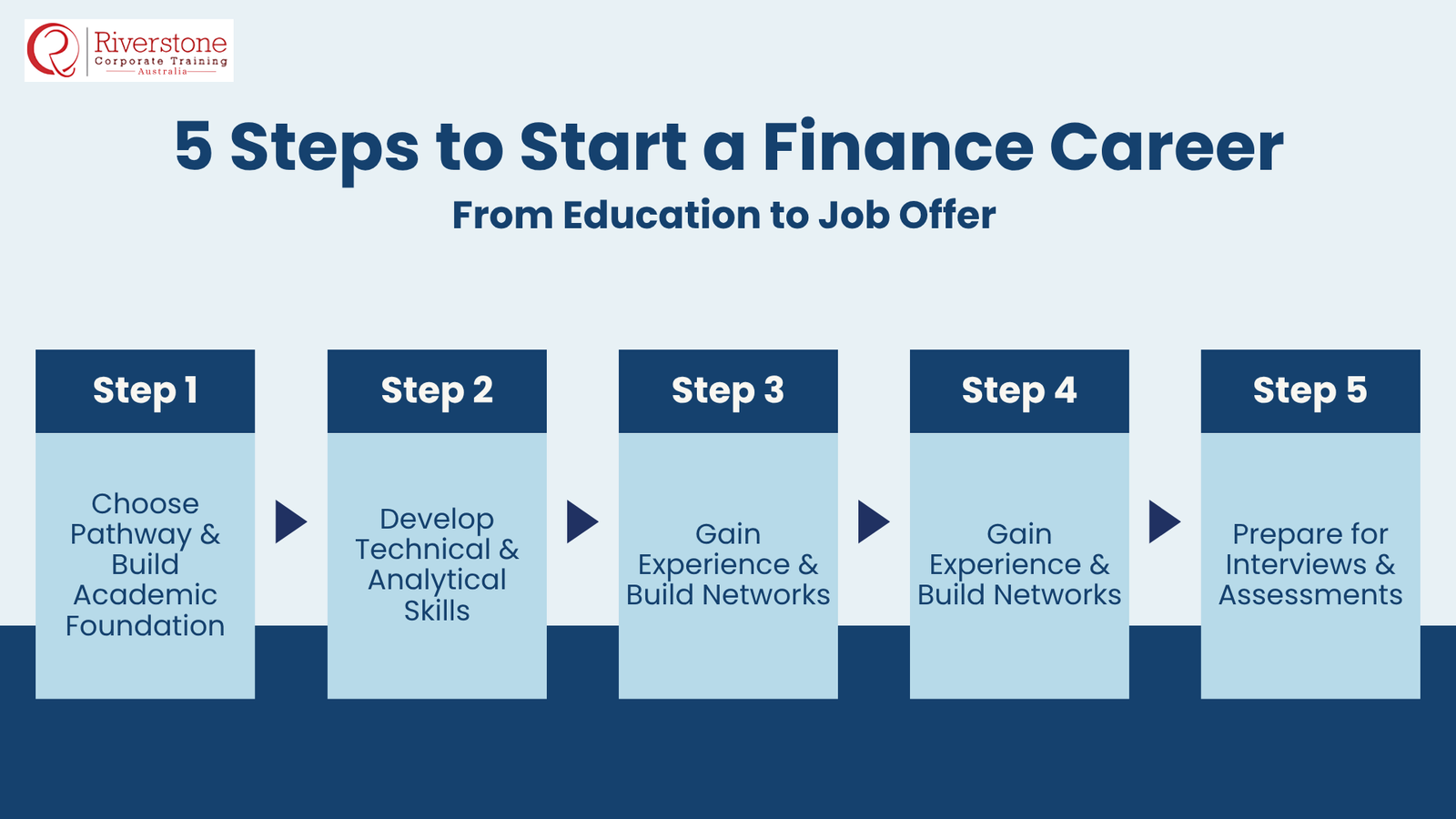
The process of starting a finance career in Australia is a five-step journey that takes us from the initial decision-making about career and education to the interview performance that translates the application into a job. Knowing this process – and the investments that yield the best return at each step – helps candidates prepare for the next step by focusing their time and effort on the activities that will make the biggest difference.
Step 1 — Choose Your Pathway and Build Your Academic Foundation
The most important step in building a career in finance is to select the pathway best suited to your interests and abilities – because the education, the employers, and the activities that build the skills needed to be successful vary widely for investment banking, accounting, risk management, funds management and financial planning.
- Relevant degrees (Commerce, Finance, Economics, Accounting, Law (double degrees) or Actuarial Studies) are the most common pathways to graduate finance jobs in most financial services. For quantitative roles (risk management, derivatives, systematic funds management), degrees in Engineering and Mathematics are now favoured in addition to Finance.
- Grades are important in highly competitive recruitment environments – especially for investment banking and the Big Four, where GPAs are used as a screening mechanism. But academic performance is a screening, not a distinguishing attribute: you have to have a high GPA to get past the initial screen, but what makes successful hires different from others with the same academic credentials is what happens next.
Step 2 — Develop Technical and Analytical Skills
Finance skills need to be acquired – not learned. There is a significant gap between the skills taught in undergraduate finance degrees and the skills required for entry-level finance jobs, and the latter can only be acquired through self-driven skills development.
- Excel financial modelling (building DCF models, three-statement integrated models, basic LBO models from scratch using data from real companies) is the best investment a finance job candidate can make in preparation for the job market. There is no shortage of free material (corporate reports, published reports by independent experts, and free modelling courses) to practice with.
- Accounting skills must be taken beyond the basics: IFRS financial statements, the notes, not just the main statements, and how the items in the income statement feed through to the balance sheet, and the cash flow statement is the minimum analytical skill required of all entry-level analysts in most finance roles.
Step 3 — Build Practical Experience and Networks
Employers in entry-level finance jobs in Australia consistently rank experience (internships, vacation work, cadets, significant student finance roles) as the most important non-academic factor in graduate recruitment. Experience shows the applicant has moved from the academic to the practical world, and has tested their skills in analysing problems that are not theoretical.
- The application period for the most sought-after roles (investment banks, Big Four transaction services, top-tier private equity funds) for the following year’s internships typically begins 12-18 months before the internship start date – students should be preparing for the application process in their second or penultimate year of study, not their last.
- Networking – through university finance societies, alumni, industry events, and LinkedIn – is not a nicety, but rather a part of the process of identifying and securing roles in the Australian finance industry, where referrals and relationships play an important role in hiring at all levels above entry.
Step 4 — Target the Right Roles and Craft Your Application
Finance job requirements in Australia differ by firm type, role, and level of seniority, and successful applications demonstrate an appreciation of the specific role being applied for rather than a generic interest in finance. A cover letter that explains why the applicant is applying to this firm, for this role, with this background – rather than a generic cover letter copied from a job website – is a strong signal of interest and engagement with the hiring process.
- Resume building for finance positions should emphasise analytical accomplishments – specific examples of financial analysis, modelling, or quantitative problem solving – rather than general professional skills. A one-page resume that showcases academic achievements, relevant work experience, technical skills and two or three examples of analytical impact is much better than a two-page resume with generic work experience.
- Strategic application – making a shortlist of target employers and jobs where the fit is right and focusing applications on these, rather than applying to every job – leads to a much higher success rate than a “spray and pray” application strategy that suggests a lack of focus.
Step 5 — Succeed in Interviews and Assessments
To succeed in investment banking in Australia and the most sought-after finance jobs, candidates must prepare for a multi-faceted selection process that may involve: an online application, a numerical and verbal reasoning test, a video interview, a technical assessment or case study, and a panel interview with senior professionals.
- Finance interview technical preparation should include the ‘fit’ questions (Why finance? Why this firm? What is your favourite business analysis?) and the technical questions (How would you value a business? How would you value a business? How do you calculate WACC?). Both of these types of questions demand preparation – crammed responses are easily spotted by the interviewer.
- The best and most reliable way to prepare for an interview is to explain financial concepts clearly, concisely and in plain English – to a friend, to an immediate family member, or to yourself in the mirror. The capacity to explain what a DCF is to a non-finance person in 60 seconds is a better measure of understanding than simply memorising the formula.
06 Breaking Into Investment Banking and Competitive Roles
Many finance students aspire to work in investment banking in Australia, and knowledge of the process, including what the job entails, what is required to get a job, and what the career is like once you are through the door, is the baseline that separates the informed from the uninformed.
- There are relatively few investment banking analyst positions in Australia – perhaps only 100-200 analysts hired per year across all the major banks and boutiques, and all product and coverage areas. As a result, the selection process is extremely competitive, and those who succeed have typically shown an interest in the commercial world, analytical and relevant experience, and demonstrated this through their academic record, internships, and industry involvement.
- The actual work of an investment banking analyst – long hours, intense analysis, lots of Excel and PowerPoint, exposure to real deals, and rapid development of technical skills – is more challenging and more educational than most applicants’ initial perceptions. Those who succeed in these roles are those who are drawn by the analytical challenge and the opportunity to work on real transactions, rather than just the brand name.
A corporate finance career path starting with investment banking is excellent technical training – the vast majority of analysts who spend two to three years in investment banking have financial modelling, valuation, deal structuring and client presentation skills that are hard to learn in other early career roles. This is why investment banking experience is so highly regarded throughout corporate finance – it is a credentialing process for analytical ability and hard work, recognised by employers in PE, hedge funds, corporate development, and consulting.
- For applicants who are not successful in obtaining investment banking jobs straight out of university, the Big Four transaction services route is a great alternative: the work is similar (financial modelling, valuation, due diligence), the training is tough, and the breadth of transactions is wide. Many successful investment bankers and PE professionals have started their careers in Big Four transaction services before moving to the banking and investing world.
- Boutique advisory firms – smaller M&A advisory practices specialising in particular industries (technology, health care, resources, financial services) – are becoming increasingly significant sources of graduate employment for those who prefer smaller team sizes, earlier contact with clients, and the chance to build up sector expertise early in their careers.
07 Real-World Career Journeys
There are many different ways to pursue graduate finance opportunities, and learning about the career journeys of those who have successfully embarked on finance careers is one of the most useful pieces of information for junior professionals. The three career journey profiles below are based on typical career paths – fictionalised in their personal details but real in their career paths.
The Investment Banking Pathway — From Graduate Analyst to PE
A Finance and Law combined degree holder from a commerce degree started out in the equity capital markets division of a large investment bank, where he or she worked for 2.5 years as an analyst on IPOs, rights issues, and block trades. The job was highly technical – financial modelling, prospectus preparation, investor roadshows – and long days were common, but the learning opportunities from working on real deals and the rapid skill acquisition were unmatched.
- The graduate was then hired as an associate by a mid-market private equity firm following the investment banking experience, where the investment banking background was prized for its signalling of the graduate’s analytical ability and work ethic. The new role involved new skills – investment thesis development, portfolio company monitoring and board interaction – that build on the investment banking background.
- The takeaway: the investment banking career path is best used as a two- or three-year boot camp rather than a long-term career. The transaction and analytical skills it provides are transferable to other corporate finance jobs – but the credential deteriorates if people remain in junior analyst roles beyond their natural timeframe, without moving into associate-level roles.
The Accounting Foundation — Building Credentials and Pivoting
A commerce graduate with a major in Accounting was drawn to the audit practice of a Big Four firm by the training and development opportunities, the support to complete the CA qualification, and the opportunity to gain exposure to a wide range of industries. Having gained the CA qualification and progressed to senior associate level, they moved internally to the Transaction Services practice – using the financial accounting expertise and client management skills gained in audit as a springboard to a career in M&A advisory.
- The move required technical training (in financial modelling and valuation techniques), which the candidate undertook through self-study (constructing DCF models from annual reports) and the Big Four technical training program. Sixteen months later, they were independently leading due diligence workstreams for M&A deals.
- The lesson: the accounting and audit pathway offers credentialing (CA qualification), training in analytical skills (attention to detail, financial statement analysis), and broad exposure to the industry, which is a useful stepping-stone to more “business-focused” finance roles. The move demands technical investment, but the accounting background is an opportunity rather than a handicap for those who are proactive about the career move.
The Non-Traditional Entry — Leveraging a Different Degree
A quantitative engineer with a strong interest in energy markets transitioned into finance via a graduate program at a major bank’s project finance team, where their technical knowledge of infrastructure assets was quickly put to use on a team that assesses the technical and financial feasibility of large energy projects.
- The move from engineering to finance required the graduate to develop specific financial skills – in accounting, financial modelling and credit analysis – which they did through qualification study (the graduate completed the CFA Level 1 in their first year) as well as the project finance team’s training.
- The take-out for non-finance candidates: skills required for finance careers can be learned through a combination of formal qualifications and self-directed study and practice, and a non-finance background can be an asset in specialist roles where the technical knowledge of a particular industry (such as energy, health, technology) is as important as the financial knowledge. The trick is to find roles where their non-finance background is a strength.
08 Challenges and Lessons Learned
The most common challenges faced by early-career finance professionals are structural (the difficulty of entry, the rate of change in the technical skill sets required) and psychological (the adjustment to the difference between the expectations of a finance career and the reality of early-career finance, the development of resilience in the face of inevitable rejections and setbacks). Knowing them in advance – and the mindset and behaviours that are most effective in dealing with them – is one of the most valuable contributions that a guide to a finance career in Australia can offer.
Table 2: Common Finance Career Challenges — Causes and Practical Responses
| Challenge | Why It Arises | How Effective Professionals Navigate It |
|---|---|---|
| Competitive entry — rejection in graduate hiring | Top-tier finance roles have more qualified applicants than places; first application cycles are learning experiences as much as genuine opportunities | Treat each rejection as diagnostic information; debrief on what to strengthen; apply to a wider range of employers, including boutiques and regional firms; use the application process itself as networking |
| Technical skill gap between university and employer expectations | University finance curricula rarely teach applied financial modelling to a professional standard | Build financial models independently using published company data; complete a recognised modelling course (BIWS, Breaking into Wall Street, CFI); practice Excel daily |
| Unclear pathway choice between multiple attractive options | The breadth of finance career options creates genuine decision difficulty; different pathways have different early-career experiences and long-term trajectories | Talk to 10+ professionals in roles you are genuinely considering; understand the day-to-day reality, not just the brand; make a committed decision and pursue it with full energy |
| Managing long hours and intensity in early-career roles | Investment banking, transaction services, and similar high-intensity roles require significant time commitment that can be unsustainable if not managed proactively | Develop sustainable work practices early; seek roles in teams with healthy cultures; be honest with yourself about your tolerance for intensity vs learning tradeoff |
| Building networks as a student or recent graduate | Finance networks are relationship-intensive and established over years; breaking in requires sustained effort and genuine relationship investment | Join campus finance societies; attend industry events; engage meaningfully on LinkedIn; follow up every conversation with a genuine thank-you and a specific next step |
| Imposter syndrome in early technical roles | Early-career professionals frequently feel underprepared relative to more experienced colleagues — which is both normal and temporary. | Recognise that everyone feels this initially; focus on what you are learning, not what you do not yet know; ask good questions; document your own learning progress to see how far you have come. |
The overarching challenge that underpins all of the specific issues above is that of managing the gap between expectations and reality – between the idealised image of a finance career (intellectually challenging, well-paid, prestigious, important) and the reality of the early years (hard work, sometimes repetitive, technically challenging, with a long lead time to the more senior and fulfilling roles). This gap is managed effectively by a clear understanding of what drives you, a realistic understanding of the nature of the work at each stage of the career, and the persistence to get through the difficult early career years that lead to more senior and meaningful roles.
- The most consistently satisfied professionals in finance careers are almost always those who found intrinsic reward in the intellectual work of financial analysis and commercial problem-solving – who enjoy the challenge of understanding complex businesses as well as the more instrumental benefits of financial analysis. This foundation for a career in finance is the source of engagement and persistence that is hard to find among professionals driven by external motivation.
- The most common career advice that experienced finance professionals give is that they wish they had started the active skill development and networking activities sooner – that they had started their modelling practice earlier, that they had started attending the industry events earlier, that they had started networking with their alumni earlier. The time value of these activities begins now and compounds; delay is a cost.
09 Accelerating Your Career Progression
To progress a career in finance beyond entry level, different tactics are required than those used to get the job. Career advancement in the profession is less about the academic and technical test scores and more about the work done, the relationships forged, the industry knowledge gained, and the reputation earned through every assignment, every client meeting and every piece of work that bears the practitioner’s stamp.
Table 3: Finance Career Progression — Key Transitions and Accelerators
| Career Stage | Typical Timeframe | Primary Focus | Key Accelerators |
|---|---|---|---|
| Analyst / Graduate (Entry) | 0–2 years | Technical skill development; learning the firm’s processes and culture; demonstrating reliability and attention to detail | Excel and modelling mastery; accounting literacy; asking good questions; completing CA, CFA, or CFA Level 1 |
| Senior Analyst / Associate | 2–4 years | Taking ownership of analysis workstreams, client meeting participation, mentoring juniors, and beginning to develop sector depth | Seeking stretch assignments; managing analysts effectively; building sector expertise in 1–2 industries; developing direct client communication skills |
| Manager / Senior Associate | 4–7 years | Leading engagements; client relationship development; business development contribution; team leadership | Winning responsibility for client relationships; contributing to pitch processes; developing an identifiable area of specialist expertise; and actively developing an industry network development |
| Senior Manager / Director / VP | 7–12 years | Business development; senior client relationships; team leadership; P&L contribution; market positioning | Building a client franchise, developing a recognisable market reputation in a sector or product area, and sponsoring junior talent |
| Partner / Managing Director | 12+ years | Strategic leadership; firm development; major client relationships; market presence | Consistent client franchise; sustained revenue contribution; leadership of a practice area or team; external market profile |
Qualifications play a critical role in accelerating a career in corporate finance and finance. The CA (Chartered Accountant) designation, administered by Chartered Accountants ANZ, is the most common credential required for accounting and audit-based careers and is increasingly sought after for transaction advisory careers. The CFA (Chartered Financial Analyst) qualification – administered by CFA Institute – is the most highly regarded global qualification for investment analysts and portfolio managers, and increasingly for corporate finance and M&A advisers.
- The CFA Level 1 exam covers equity valuation, financial statement analysis, fixed income, derivatives, portfolio management and ethics – and is the most comprehensive single technical development program for finance practitioners, as well as being a signal to potential employers of analytical rigour.
- Specialisation in one or two industries (technology, healthcare, resources, financial services, infrastructure), in conjunction with a wide range of finance technical skills, is the attribute that most consistently distinguishes the most successful and highest-paid senior finance practitioners from those with generic skills. The finance practitioner who can bring both technical and commercial expertise to a given industry is a precious commodity across the entire industry.
10 Conclusion and Actionable Insights
Finance career Australia guide for professionals at the beginning of their journey boils down to a combination of pathway (knowing what pathway you are targeting and why), skill (building the analytical skills required for the pathway to a professional standard, and doing so proactively and in advance of the job), and networking (building the relationships that translate aspiration into opportunity). Many qualified candidates are competing for entry-level finance jobs in Australia – and the ones who stand out are those who have taken the time to prepare for the specific jobs they want, rather than any job.
A career in finance is a long-term project that adds value to the practitioner’s skill set with every experience, every relationship, and every technical skill acquired. Entry-level finance jobs are the beginning of that journey, not the end – and the most important attitude to bring to those opportunities is one of genuine interest in the work, genuine attention to the quality of the analysis, and genuine focus on the professional relationships that will shape the career over the next 20 years, not just the next 2 years.
- Decide on a path with a clear intention – research the specific role type, talk to people who are already in the roles you are targeting and decide, rather than delaying. Those who get ahead the fastest are those who know where they want to go.
- Invest in technical skills in advance – financial modelling in Excel, financial statement analysis, and the valuation technique that is relevant to your desired role should be mastered to a professional level before you begin applying, not afterwards. Finance skills are teachable and learnable; the time and effort invested before applying is rewarded at each step along the way.
- Prepare for the industry before you join it: attend on-campus finance events, join finance societies, read industry news and market developments, and connect with LinkedIn contacts you admire. The people who will help you land jobs in finance take months and years to get to know.
- Treat every job as a learning opportunity – the best early-career investments are not the size of the pay packet or the status of the organisation, but the learning opportunities they provide. Look for jobs where you will learn, where the work is meaningful, and where you will have opportunities to interact with senior practitioners.
- Build technical qualifications alongside work experience – CA, CFA, and other professional qualifications demonstrate an interest in analysis, provide systematic technical training, and increasingly distinguish between professionals with comparable experience. The finance career Australia guide that best serves professionals over the long term provides practical short-term advice, along with longer-term credentials and expertise development that compound into a uniquely distinctive personal profile.
| Our consulting and training services help finance professionals at every point in their finance career – including graduate job seekers preparing for their first interviews, mid-career professionals looking to build new technical skills, or to move into new specialisations. Our work starts with understanding your particular needs and opportunities, and concludes with a meaningful development plan that fits your circumstances and ambitions. |