

- 01 Introduction
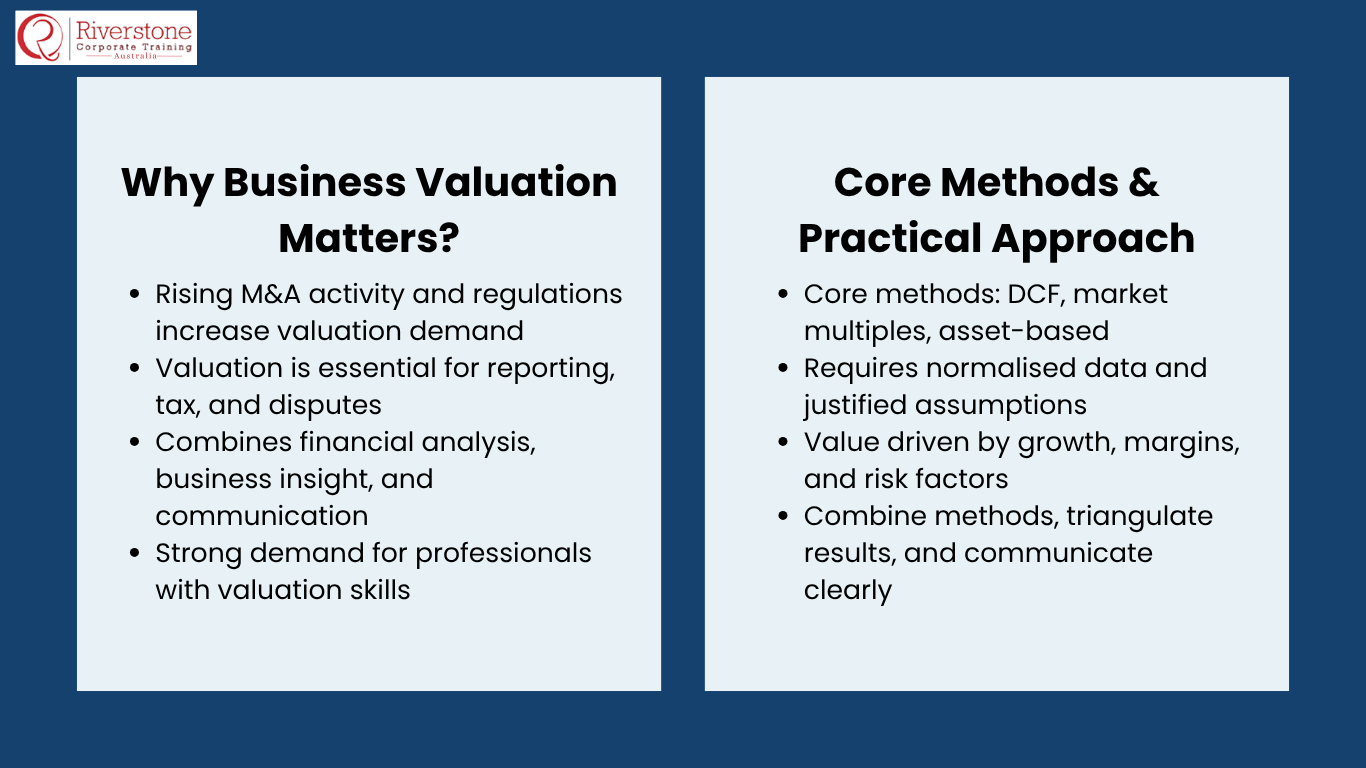
- 02 Why Business Valuation Matters More Than Ever
- 03Core Valuation Methodologies Explained
- 04 Five Key Steps: How to Value a Company in Practice
- 05 Examples: Learning from Real Business ScenariosStrategy
- 06Common Challenges and How to Navigate Them
- 07 Building Your Valuation Skillset: A Practical Roadmap
- 08Conclusion and Actionable Insights
Business Valuation in Australia:
Practical Skills for Real-World Company Analysis
Table of Contents
01 Introduction
The business valuation Australia guide is a topic that is more important and in greater demand than ever before across the practice. Whether you are a new graduate joining a corporate finance team, an accountant advising the owners of a privately held business on a succession plan, or a lawyer representing a party in a shareholder dispute, your ability to understand, explain and critically assess what a business is worth is a skill that defines the quality of your professional services.
- Practising business valuation is not simply about learning formulas – it is about mastering the art of blending financial analysis, commercial acumen, industry understanding and regulatory awareness into a persuasive and defensible conclusion about value.
- It is the professionals who understand the art of translating between the numbers and the narrative – explaining not only what they have concluded about a business’s value, but why – who gain valuable skills in real-world company valuations.
Business valuation is a skill set that cuts across corporate transactions, financial reporting, taxation, and litigation. It encompasses all phases of the corporate life cycle – from an emerging company raising its first round of venture capital, to an established company in the midst of an acquisition or restructuring, or a shareholder contemplating retirement. The scope of this landscape is why valuation training for professionals is such a valuable investment: it is a competency that compounds, becoming more valuable with each new engagement, industry sector, and market cycle that each practitioner experiences.
- Practitioners who invest early and build on their financial valuation skills for beginners to develop a more advanced skill set go on to outperform their counterparts who view valuation as a “niche” technical skill.
- This article outlines the practical spectrum: the valuation landscape, key methods, the five-step approach, practical examples, and a learning framework to build the skill set the market seeks.
|
Valuation is not a hunch, but a professional argument based on evidence, back-tested against market information, and expressed with the Financial Accounting Standards Board (FASB) level of precision required. Good argument, good advice. |
02 Why Business Valuation Matters More Than Ever
The market and regulatory environment for Australian businesses has grown the need for practical company valuation examples and valuation services more than at any other time in recent history. Merger and acquisition transactions have increased in all industries. And financial reporting standards – AASB 3 for business combinations, AASB 136 for impairment testing, AASB 13 for fair value – have institutionalised recurring valuation requirements in the financial reports of all entities that have made an acquisition or hold substantial balances of intangibles. And the emergence of private equity and venture capital as a source of funding for businesses has created a large market for the analysis techniques Australian valuation practitioners use to set the cost of capital.
- Regulatory requirements mean valuation is no longer simply a transaction tool – it is a regular financial reporting practice with legal ramifications if it is done incorrectly.
- The growth of private equity, strategic M&A, and international investment means that valuation professionals are in demand at both the junior analyst and senior advisor stages across all sectors.
This is a great opportunity for junior to mid-level professionals. The mix of financial analysis, business, and communication skills that a top-quality business valuation Australia guide provides is in limited supply but in high demand across corporate finance, audit, legal, management consulting, and in-house CFO functions. Developing this skill set early in a career – and doing so in a way that includes real-world, practical involvement in analytical challenges, not just theorising – is one of the best career moves one can make.
- Valuation skill is highly interdisciplinary – once learnt, it can be applied across deal teams, audit, tax, management consulting, and the CFO office.
- When employers are asked, they report that understanding and presenting a valuation argument is among the most valuable skills they look for in junior- to mid-level hires.
03 Core Valuation Methodologies Explained
The three main families of valuation methodologies used in practice for company valuation examples in Australia are the income approach, the market approach and the asset-based approach. All three represent different notions of what constitutes a business’s value and have different data needs, assumptions, and applicability. Financial valuation skills for beginners must extend beyond the ability to simply run a numerical model in a spreadsheet, to a true understanding of the underpinnings of each of the three approaches – not only what makes them best suited to particular situations, but also what their limitations are.
- The income approach (typically modelled as a discounted cash flow (DCF) analysis) values the business by discounting its expected future cash flows. It is the most theoretically sound and most commonly used approach for valuing ongoing businesses with a long-term earnings outlook.
- The market approach relies on observable market information – trading multiples of comparable listed companies, or transaction multiples from recent M&A transactions – to compare the subject business to market multiples.
The asset-based approach is the value of the business, measured as its net assets at fair value. It is typically used for holding companies, real estate businesses, and asset-intensive entities, where the value of the assets, rather than earnings, is the key driver of value. The asset-based approach is generally used as a floor value (and a sanity check) for operating businesses with demonstrated earnings. Each approach has both quantitative and qualitative aspects: the quantitative (building the model, choosing multiples, discount rate) is the technical skill, and the qualitative (having an understanding of which approach is most suitable, calibrating assumptions to the specific business and market circumstances, identifying the sources of value and risk) is the art of the professional valuator, who is better than a modeller.
- A good valuation generally involves two or more approaches and triangulation between methods – a one-method approach is more likely to be challenged by investors, auditors or courts.
- The WACC, the terminal growth rate, and the choice of comparable companies or transactions are usually the most critical and most scrutinised assumptions in the valuation process – mastering the skill of calibrating and justifying these is a key technical skill.
Table 1: Valuation Methodologies — When to Use Each
| Methodology | Best Used For | Key Inputs | Primary Limitation |
|---|---|---|---|
| Income Approach (DCF) | Growing/profitable operating businesses; AASB 136 impairment testing; businesses with clear earnings forecasts | Revenue/margin forecasts, WACC, terminal growth rate, capex and working capital | Highly sensitive to discount rate and terminal value assumptions |
| Market Approach (Multiples) | Mature businesses with comparable peers; transaction benchmarking; sense-check of DCF outcomes | Comparable company EV/EBITDA, EV/Revenue, P/E multiples; precedent transaction data | Comparability is difficult; private companies differ from listed peers on size, liquidity, and control |
| Asset-Based Approach (NAV) | Holding companies, real estate entities, liquidation scenarios, and asset-intensive businesses | Fair value of all assets and liabilities; independent asset appraisals | Does not capture earnings power or going-concern premium for operating businesses |
| Hybrid / Combination | M&A transactions; PPA under AASB 3; litigation; any high-stakes context | All of the above; cross-check consistency between approaches | Requires more time and data; conclusions must be reconciled between approaches |
04 Five Key Steps: How to Value a Company in Practice
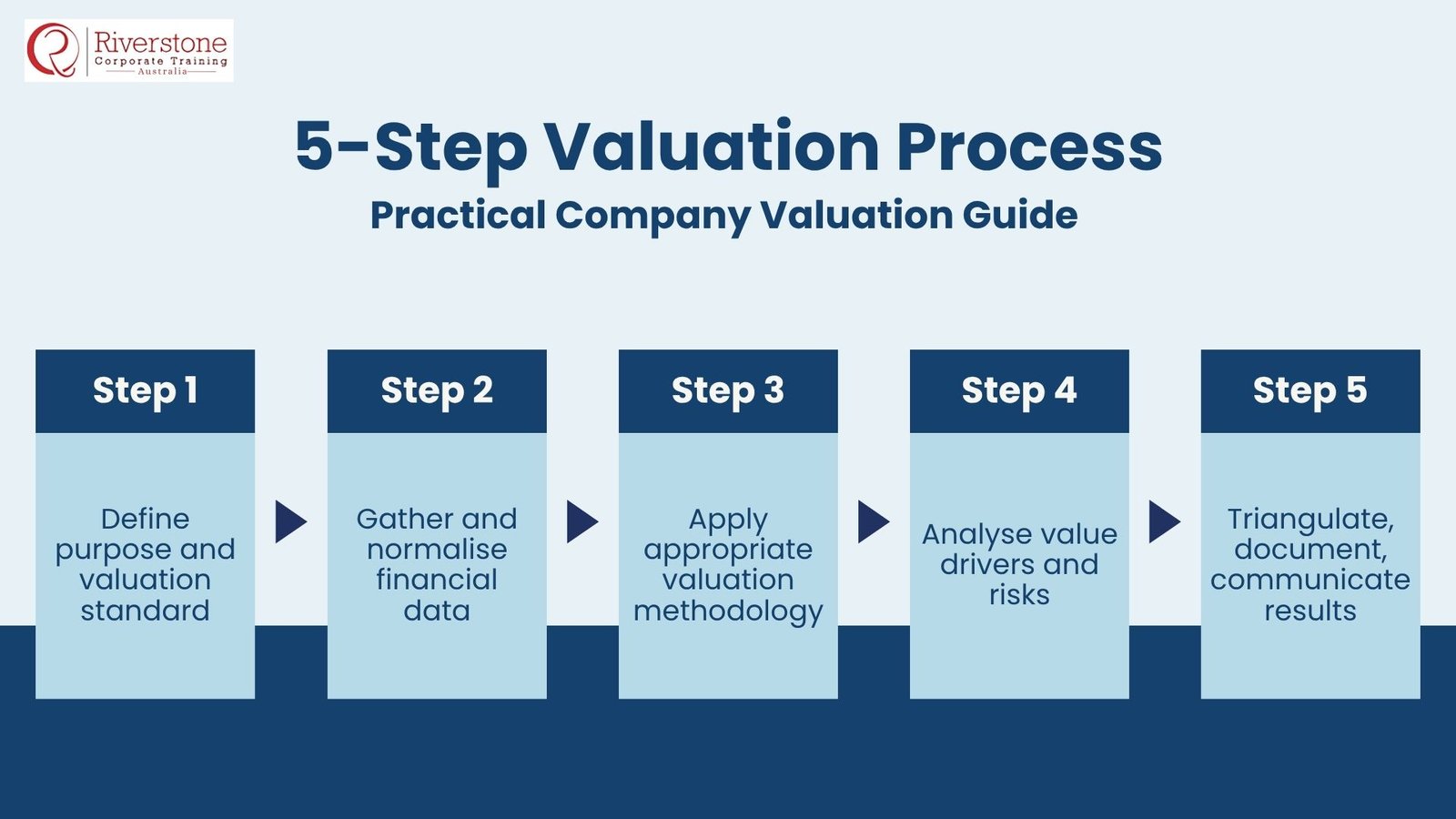
How to value a company step by step is the fundamental question that this section addresses with a practical approach. This five-step process mirrors the workflow of a professional valuation assignment, modified for the learning context of practitioners gaining their first hands-on experience valuing a company.
Step 1 — Define the Purpose and Standard of Value
All valuations start with an understanding of the purpose and standard of value. And the purpose determines what information will be required, what approach will be taken, and how the conclusion will be presented.
- Typical purposes include: M&A transactions, purchase price allocation under AASB 3, impairment testing under AASB 136, ESOP / share-based payment valuation under AASB 2, valuation for tax purposes at the request of the Australian Tax Office, shareholder dispute resolution, and valuation for strategic planning.
- The standard of value (usually fair market value, defined as what a willing and informed buyer would pay a willing and informed seller, or fair value under AASB 13, from a market participant perspective, or investment value, value to a particular buyer with particular synergies) impacts the assumptions that are made for the analysis.
Step 2 — Gather and Normalise Financial Information
The valuation’s accuracy depends on the accuracy of the financial information. In valuations of private companies, which account for the majority of practical business valuation methods (PBVM) in Australia, the information is often incomplete, inconsistently prepared, or distorted by owner-managers.
- Normalisation adjustments eliminate the distortions introduced by owner management: excessive owner remuneration, personal expenses charged to the business, non-arm’s-length related-party transactions, and non-recurring revenue or cost items that do not reflect the business’s earnings potential.
- The normalised earnings before interest, tax, depreciation and amortisation (EBITDA) is the most widely used earnings measure in valuations of Australian private companies because it allows comparison to market multiples of comparable listed companies.
Step 3 — Apply the Appropriate Methodology
With normalised financial data and an understanding of the purpose, the third step is to build the valuation model. The primary methodology (and the cross-check) should be clearly justified in the valuation, depending on the nature of the business and the valuation’s purpose.
- In the case of a profitable and established business being valued for an M&A transaction, the primary methodology will likely be a combination of DCF and EBITDA market multiples that offer an intrinsic value (from the DCF) and a market-related value (from the multiples) that form the upper and lower bounds on the likely sales price.
- For an impairment test under Australian accounting standard AASB 136, the value in use (VIU) is subject to certain constraints (no uncommitted restructurings and a terminal growth rate not above the long-run average market growth rate, and a pre-tax discount rate) that differentiate it from a DCF used in commercial valuation.
- Step 1 — Define the Purpose and Standard of Value
All valuations start with an understanding of the purpose and standard of value. And the purpose determines what information will be required, what approach will be taken, and how the conclusion will be presented.
- Typical purposes include: M&A transactions, purchase price allocation under AASB 3, impairment testing under AASB 136, ESOP / share-based payment valuation under AASB 2, valuation for tax purposes at the request of the Australian Tax Office, shareholder dispute resolution, and valuation for strategic planning.
- The standard of value (usually fair market value, defined as what a willing and informed buyer would pay a willing and informed seller, or fair value under AASB 13, from a market participant perspective, or investment value, value to a particular buyer with particular synergies) impacts the assumptions that are made for the analysis.
Step 4 — Analyse Value Drivers and Risk Factors
The most valuable element of the how-to-value-a-company step-by-step process for commercial purposes is the value driver and risk analysis, which specifies which specific features of the business should be rewarded with a premium and which should be discounted relative to the market average. This is the area of business valuation where the practice of valuation differs most from its theory.
- Premium value drivers include: recurring and contracted revenue, a diversified customer base, an experienced, deep management team independent of the founder, strong and growing EBITDA margins, proprietary IP or technology, and high-quality ESG and governance practices.
- Discount factors include: customer concentration risk (where one or two customers account for a large percentage of revenue), founder risk, potential for litigation or regulatory violations, poor internal controls and inadequate historical earnings to make reliable forecasts.
Step 5 — Triangulate, Document and Communicate
- This stage integrates the results of the different methodologies, resolves differences between them, concludes a value (or a range), and documents and communicates the value (or range) in the required format for the specific purpose.
- Triangulation demands a close engagement with the reasons for the different results obtained from different methodologies – and a rational determination of which result, or which range, is the most reliable conclusion about the value of the subject business in the circumstances of the particular purpose.
- Documentation is not a minor consideration: in financial reporting (auditors), tax (ATO) and litigation (courts) contexts, the quality and content of the evidence supporting the valuation is as important as the valuation itself – and in adversarial situations, it is the documentation that will be examined.
05 Applied Examples: Learning from Real Business Scenarios
The ultimate form of valuation education for the professional practitioner is the application of company valuation examples, as they involve translating generalised methodologies into valuation judgment and analysis. The three company scenarios outlined below are the most common business scenarios encountered by Australian valuation professionals – with company names changed but the challenges real.
The Technology Startup — Valuing Growth Without Profit
An EU-based SaaS company with a nascent Australian user base was raising funds for a Series A round from a local VC. The company was growing its ARR at a strong rate (180% year-on-year) but had yet to be profitable; the founders’ forecasts anticipated a loss for three more years before hitting positive EBITDA.
- The main valuation approach was an ARR multiple methodology, based on comparable VC-funded SaaS valuations using multiples of 6-14x ARR, depending on growth rate, net revenue retention and gross margins. The business had 95% net revenue retention and 78% gross margins – so it ranked in the top half of comparable deals.
- The takeout: for unprofitable growth businesses, the DCF is highly sensitive to the chosen discount rate, and market evidence from comparable VC transactions is often a more reliable basis for valuation. The key is to know when to use the market and not an intrinsic value model.
The Mature Private Business — Managing the Expectations Gap
A privately-owned manufacturing company in the industrial equipment industry – trading for 22 years with a steady EBITDA of around $3.8 million a year – was looking for a valuation in a sale to a private equity group. The business owners believed they would receive an 8-10x EBITDA multiple for their business, based on publicly available sector multiples. The business was valued at 5.5-6.5x EBITDA.
- The discrepancy was explained by three specific business-specific discounts: customer concentration risk (top three customers accounted for 68% of revenue), business founder dependency (both founders were the main contacts for all major accounts), and below-market management structure (no CFO, no succession plan, no documented processes for any function).
- The learning point: to understand a business’s value in Australia, it is important to candidly assess the gap between its headline financials and its capacity to sustain performance under new owners. Value driver analysis is not an academic pursuit but a commercially significant practice with substantial advice and pricing implications.
The Financial Reporting PPA — Precision Under Audit Pressure
A middle-market health services company was preparing its first financial report under AASB 3 following an acquisition 12 months ago of a regional network of allied health services. The business combination entailed identifying and measuring the fair value of all acquired intangible assets – customer relationships, brand, clinical software system and workforce.
- The customer relationship asset, valued using the multi-period excess earnings method (MPEEM), required attrition studies, contributory charges for the other assets, and a useful-life review. The auditors scrutinised both the attrition rate and discount rate assumptions, and the model had to be run twice to obtain clearance.
- The lesson: valuations for financial reporting are held to a higher evidentiary standard than commercial valuations – all assumptions must be recorded, benchmarked, and justified. Company analysis skills for financial reporting purposes need to be audited, as well as the financials.
06 Common Challenges and How to Navigate Them
The most common challenges practitioners face in developing the skills required for company valuations in practice are technical, analytical and interpersonal. Knowing about them in advance is a great advantage – it is the difference between being unprepared for a challenge and having a strategy for addressing it.
Table 2: Common Valuation Challenges and How to Address Them
| Challenge | Why It Occurs | How to Navigate It |
|---|---|---|
| Unrealistic management projections | Business owners are optimistic; projections often reflect aspiration rather than operational reality | Apply a budget accuracy test (prior year forecast vs actual); build a bottom-up revenue model from identified customer opportunities; use industry growth benchmarks as a ceiling test |
| Discount rate uncertainty | WACC involves subjective inputs — equity risk premium, beta selection, size premium — that can vary materially across practitioners | Use multiple sources for each input; document selection rationale; run sensitivity analysis showing the valuation range across a reasonable WACC range |
| Insufficient comparable data | Private company transactions are often confidential; listed company peers may differ materially in size, margins, or business model | Expand the comparable set with care; document comparability adjustments; use multiple metrics (EV/EBITDA and EV/Revenue) to triangulate |
| Auditor challenge in the financial reporting context | AASB 136 and AASB 3 valuations are scrutinised for assumption reasonableness, discount rate calibration, and useful life assessments | Engage auditors early; share draft methodology before final modelling; document each assumption with an external benchmark or management rationale |
| Client expectation management | Business owners often have an emotional attachment to a specific value expectation that the analysis may not support | Present the analysis transparently; explain the specific factors causing any gap; frame the conversation around value improvement levers rather than dwelling on the discount |
| Keeping current with market data | Multiples, royalty rates, and interest rates change continuously; stale benchmarks produce unreliable conclusions. | Maintain active subscriptions to comparable-company and transaction databases; update your WACC quarterly; and track sector-specific M&A activity regularly. |
What they all share is a common core – the production of good analysis is intertwined with good communication and good relationships. The art of learning business valuation is to develop the analytical ability to deliver a high-quality analysis and the interpersonal skills to communicate it, justify it, and assist the client in applying it to inform a decision.
- The most consistent message from senior practitioners is that the valuation engagement is rarely where the most important work is done – it is in the quality of the discussion of the analysis that the client is better informed and better off at the end of the engagement than at the beginning.
- For entry-level practitioners, those who learn to communicate as well as analyse – to make a case for a valuation, not just a valuation model – always move up the career ladder more rapidly than those who invest solely in the technical skill set.
07 Building Your Valuation Skillset: A Practical Roadmap
Professional valuation training that delivers valuable, marketable skills must be structured — it must integrate technical, practical, and commercial knowledge within a career progression that adds dimension to skills. The roadmap below represents the learning architecture that leads to the most functional practitioners.
Table 3: Valuation Skill Development — A Structured Progression
| Stage | Focus | Key Activities | Target Outcome |
|---|---|---|---|
| Foundation (0–12 months) | Technical methodology and financial analysis fundamentals | DCF construction and sensitivity analysis; EBITDA normalisation; WACC derivation; comparable company analysis; accounting standards literacy (AASB 3, 136, 13, 2) | Ability to build a competent valuation model and explain the key assumptions |
| Development (1–2 years) | Real engagement experience and sector knowledge | Participate in live M&A and financial reporting engagements; develop sector expertise in 1–2 industries; engage with auditors in financial reporting valuation reviews | Ability to manage the information-gathering process and contribute substantively to conclusions |
| Proficiency (2–4 years) | Complex situations and independent analysis | Lead PPA exercises; manage independent valuations for shareholder disputes; conduct impairment testing under auditor scrutiny; build and maintain comparable databases | Ability to produce an independent, defensible valuation for complex situations |
| Advanced (4+ years) | Strategic advisory and business development | Client relationship management; expert witness engagements; mentoring junior practitioners; sector-specific advisory leadership | Trusted adviser status; specialist reputation; leadership in engagement teams |
Alongside the structured path shown above, the business valuation Australia guide most beneficial to a career is the one that gives practical, actionable advice on the accelerators, the things, actions and habits that lead to the fastest skill development. Three accelerators are common to the experience of those who have developed expertise.
The first is working on real deals and reporting cases. Theory and training of business valuation courses provide concepts, but the judgment that is so valuable to a practitioner can only be learned by working with real data and transactions, where the numbers are not always so neat, where management’s assumptions need to be challenged and where the consequences are sufficiently serious for quality to be important. Look for opportunities to get involved in real valuation work as early as possible in your career.
- Self-selecting into cross-functional project teams, M&A due diligence exercises and financial reporting close processes provides the kind of practical experience that will allow your company’s valuation capabilities to develop far more rapidly than through study alone.
- Analysing publicly accessible prospectuses for business sales, scheme booklets, and expert reports for transactions listed on the Australian Securities Exchange offers an open course in practical examples of company valuations for those prepared to make the time.
The second accelerator is sector specialisation. The most successful valuation practitioners (in terms of fees and market position) are those who have developed expertise in a particular industry (technology, healthcare, resources, financial services, consumer) in addition to their technical valuation competency. The sector specialists are better able to identify relevant comparables, calibrate assumptions about future growth, and engage with the client in a strategic discussion of the valuation task. It is the skill set and sector knowledge that generate the most valuable insights.
- Monitoring sector-based M&A, reviewing sector research, and attending sector-specific practitioner events are all low-cost, high-return investments in sector knowledge that set the best of the best apart.
- Focus your continuing education on the two or three sectors most active in your professional market and reap the compound interest of a career’s worth of sector-specific knowledge.
08 Conclusion and Actionable Insights
This business valuation Australia article has mapped the entire practical journey in professional valuation competency, from the regulatory context and the three major families of valuation methodology, to the five-step practical process and the case studies that flesh it out, to the problems that commonly confront practitioners and the roadmap to producing real, marketable skills. Knowing the value of a business in Australia is not a niche skill; it is an analytical competency at the heart of the practice, one that grows in value with each engagement, each industry, and each market cycle, expanding the practitioner’s experience.
The key takeaway for new professionals early in this learning curve is: be deliberate. Those who develop the best financial valuation skills for beginners are those who view every encounter with a valuation – every model they see, every report by an independent valuation expert that they read, every conversation with a more senior practitioner – as an opportunity for learning rather than a test to be passed. The analysis of companies in Australia outlined in this article is not taught; it is practised: by failing sometimes in low-pressure situations, by having those failures identified and explained, and by gradually building up the layers of judgement and intuition that only come from experience.
- Be comfortable with all three main approaches (DCF, market multiples, and asset-based) in terms of their underlying principles, not just their Excel formulas. Know when to use which, and why.
- Focus on understanding the regulatory drivers of the most common valuation requirements in Australia: AASB 3, AASB 136, AASB 2, AASB 13, and the Australian Taxation Office’s valuation requirements for tax and transfer pricing.
- Look for opportunities to engage with real valuations as early in your learning journey as possible – the skill that makes the practitioner valuable is the ability to develop a good judgement of the situation, not just the textbook skills.
- Develop your understanding of one or two industries in parallel to developing your technical skills – the most valuable analysis is the combination of sector knowledge and technical skills.
- Hone your communication skills as well as your technical skills – the learning in business valuation practice requires not only the ability to build a model, but also to explain a model to a non-technical audience.
| The business valuation techniques explained in this article are the core of a professional skill set that is among the most widely applicable and enduringly valuable in the whole financial, accounting,g and advisory value chain. Use it well, use it rigorously and use it to communicate with the clarity of the most important decisions. |