

Evaluating Investment Deals:
How Private Equity Professionals Approach Real Transactions
Table of Contents
01 Introduction
Understanding how private equity evaluates deals is one of the most useful things a finance professional can learn – not because all careers in finance end up in private equity, but because the analytical rigour of private equity investment decision framework thinking is applicable in corporate finance, mergers and acquisitions (M&A) advisory, lending, management consulting and, indeed, every area where financial capital is deployed in return for a promised return. The capacity to evaluate a business with the discipline, commercial focus, and systematic scepticism of the best private equity analysts is a skill that adds value in any career.
- Investment deal analysis, explained at its best, is not a list of items to be ticked off – it is a process of developing and testing a hypothesis about why a particular business, purchased at a particular price, with a particular structure, will deliver a return that compensates for the risk and cost of capital.
- Knowledge of this process – how deals are identified, screened, evaluated, structured and decided – is the basic skill set that distinguishes those who work around deals from those who lead them.
The M&A deal evaluation process is more systematic than most of the analytical skills students and junior professionals learn in the early years of their careers. It requires financial modelling skills, commercial understanding, legal skills, management evaluation and market knowledge all at once – and in the context of a time-limited, competitive process where the cost of an analytical misstep is measured in the millions of dollars. The most useful M&A deal knowledge for early-career professionals is that which helps them bridge the gap between theory and practice – between how deals work and how they are executed.
- This article provides a comprehensive overview of the private equity deal evaluation process – from sourcing and screening through to the investment committee – with case study analysis and a roadmap to developing the skills that the most successful firms in the industry are seeking.
- This guide will provide the language, the tools and the insight to help you increase your impact from the first day in the job, whether you are a recent graduate looking to break into a private equity or M&A role, an accountant or lawyer looking to understand better transactions, or an analyst looking to take on more responsibility in a deal team.
|
Private equity is not just about acquiring businesses. It is a systematic approach to identifying and buying great businesses, at prices that enable the return to be earned by improving the business and expanding the multiple, and to build the case that the investment is a good one. The best are part analyst, part strategist and part business operator. |
02 How Private Equity Thinks About Deals
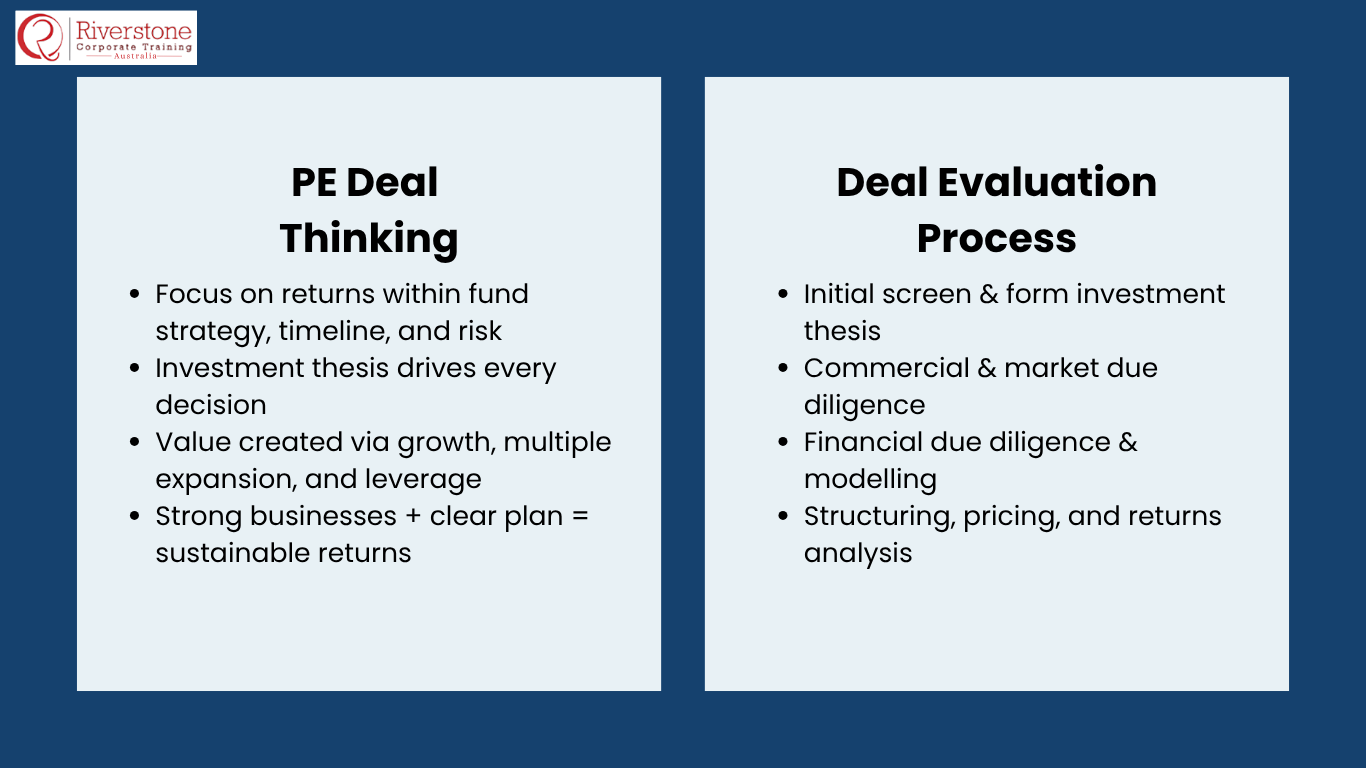
The way investors think about business opportunities in private equity differs from that of a strategic buyer, a passive investor, or a lender. A private equity fund is an entity with a defined investment strategy, a defined time frame (typically 3-7 years), a defined return expectation (usually expressed as an internal rate of return or a money-on-invested-capital multiple), and a defined amount of capital that needs to be invested and returned within that structure. Investment choices must be assessed not only on their own merits, but also within a framework for deploying capital to achieve the fund’s mission, timeframe, and return hurdles.
- The GP (General Partner) – the PE firm that runs the fund – is responsible to its LPs (Limited Partners – the institutional investors, pension funds, sovereign wealth funds, and family offices that supply the capital) for delivering a return that compensates for the illiquidity risk of private-market investments.
- This accountability informs how PE professionals think about every deal: every model, every negotiation stance, every structure is assessed for its impact on the likelihood of achieving the fund’s return targets.
Private equity deal strategy is based on the investment thesis – the particular case that a given business, bought at a particular price, will deliver the target return with a particular combination of value creation levers. The investment thesis is the intellectual heart of the PE investment, and the quality of the thesis – how specific, testable and competitive it is – is the best predictor of investment success.
- The three major levers of value creation in a PE investment are: multiple expansion (acquiring at a lower multiple and selling at a higher multiple), earnings growth (either organically or through add-on acquisitions) and financial engineering (levering the balance sheet to increase returns on equity).
- The most sustainable returns are generated by earnings growth backed by actual improvements in the business – and the best long-term performers among PE firms are invariably those whose investment theses include a specific, credible plan for improving the business, rather than relying on the market or leverage to generate returns.
03 Deal Screening and Initial Assessment
The basics of deal screening and due diligence come in two speeds. The screen – which, in a competitive auction process, may be required to be completed within 24 to 72 hours of receipt of an information memorandum – is a high-speed analysis to determine whether the deal is worth the additional time and effort. The due diligence, which occurs after the submission and acceptance of a non-binding offer, is a lengthy process of intensive investigation into all material aspects of the business. They are both disciplined, but in different ways.
- The first screen usually addresses five questions: Is this business in an industry and geographic location where we have expertise and an advantage? Is the target’s financial profile in line with? In particular, is EBITDA quality high and is growth sustainable? Is the management team competent to implement the value creation strategy? Is the implied valuation range likely to enable the target returns to be delivered? And are there any obvious reasons why the deal cannot be invested in without further investigation?
- The purpose of a good initial screen is not to make a recommendation to go ahead or not – it is to outline the questions that need to be answered by due diligence, the conditions under which the deal might be interesting and the risks that need to be understood before an offer is made.
Analysing acquisition targets at the screening stage requires substantial work with limited information. The information memorandum (IM) prepared by the sell-side adviser is crafted to present the business in the best possible light, emphasising growth, minimising risks, and highlighting adjusted financial measures that may or may not reflect the true quality of earnings. The analyst scrutinises an IM in the same way an auditor would scrutinise a set of management accounts: reading between the lines to understand what the document stresses, downplays and omits.
- The first and most important analysis is the EBITDA quality check: what adjustments have been made to the reported EBITDA, are they valid, and what is the business’s normalised earnings?
- Concentration of customers, quality of revenues (recurring or one-off), tenure of management, competitive position and the quality of the growth projections are the five most important screening variables for most buyout opportunities – and a first pass on each of these should be made within 48 hours of an IM being received.
Table 1: Initial Deal Screen — Key Assessment Variables
| Assessment Area | Key Questions to Answer | Green Flags | Red Flags |
|---|---|---|---|
| Revenue quality | How recurring is the revenue? What is the contract structure? How concentrated is the customer base? | Long-term contracts; subscription/retainer model; diversified customer base | Revenue concentrated in 1–2 customers; no contracts; project-based revenue with no visibility |
| EBITDA quality | What adjustments have been made? Are they legitimate? What is the normalised earnings run-rate? | Clean, audited financials; conservative adjustments with clear rationale | Aggressive add-backs; EBITDA that substantially exceeds reported profit; unexplained normalisation |
| Growth trajectory | What is driving the historical growth? Is it sustainable? What assumptions underpin the forecast? | Organic market share gains; new product/service adoption; management-driven improvement | Growth driven by macro tailwinds; large customer wins unlikely to repeat; forecast assumes step-change without a specific basis |
| Management team | Is the team capable of executing the value creation plan? What is the plan post-acquisition? | Experienced team with relevant track record; staying post-acquisition; aligned incentives | Founder-dependent; key people leaving at close; no succession plan; no buy-in to the PE model |
| Entry valuation | Can returns be achieved at the indicated price? What does the multiple represent? | Multiple at or below sector median; acquisition multiples that allow a plausible path to target returns | Premium-to-sector multiple with no clear rationale; valuation already pricing in the full upside |
04 Five Key Steps: The PE Deal Evaluation Process
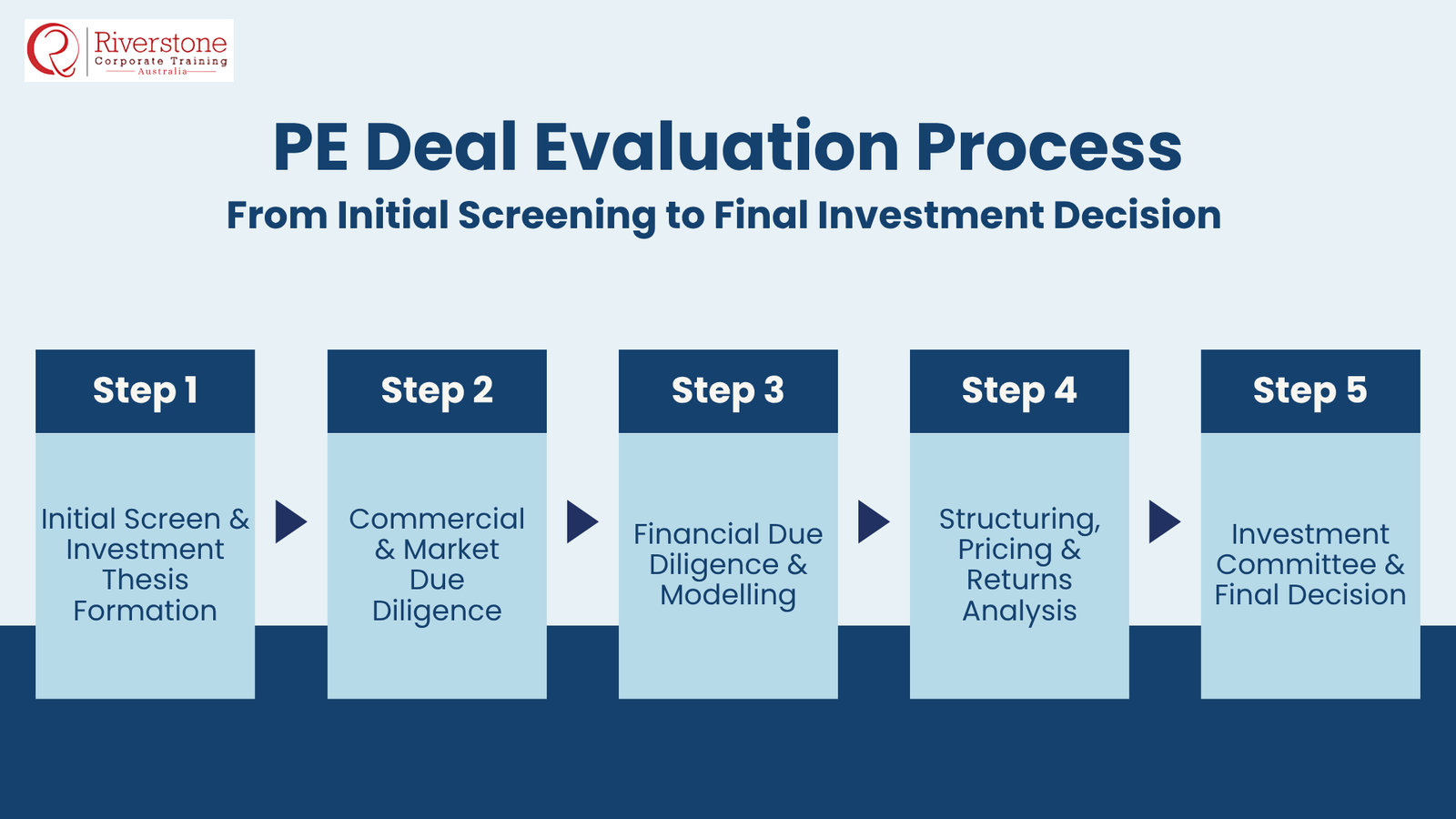
Private equity deal evaluation is a five-step process that runs from the initial commercial assessment through to the investment committee approval. Knowing this process – and the type of analysis required at each step – is the practical knowledge that allows junior analysts to participate in deal teams.
Step 1 — Initial Screen and Investment Thesis Formation
The initial screen, as outlined in the previous section, determines whether the deal warrants further investment of time. If it does, the analyst must then form an initial investment thesis – the specific case for why the business, as purchased at roughly this price, is expected to deliver the desired return. This thesis will be refined as the analysis proceeds, but establishing it early sets the intellectual context for the analysis.
- A good preliminary thesis includes: an opinion on the size of the market and the business’s competitive position in the market, the key value driver (multiple expansion, earnings growth or financial engineering) and a specific hypothesis about what the PE firm will bring – beyond money – to the business to help it grow faster.
- The thesis should be falsifiable from the beginning: the analyst should be able to identify the two or three things that have to be true for the investment to go through, and the two or three things that would make it fail. These two sets of questions inform the due diligence plan.
Step 2 — Commercial and Market Due Diligence
Commercial due diligence is the analysis of the business’s market share, market structure, customer base and growth potential. This generally includes primary research (interviews with management, reference customers, and sometimes external experts) and secondary research (market reports, regulatory filings, competitive analysis). The objective is to provide an independent confirmation or refutation of the commercial assumptions behind the business plan and the investment thesis.
- The key outcome of commercial due diligence is a well-informed opinion of the sustainability of the business’s competitive advantage: is the revenue base secure or vulnerable, is the management team’s growth strategy viable, and are there any market tailwinds or headwinds that will impact the investment horizon?
- Customer calls – structured interviews with the business’s key customers – are one of the most important due diligence activities that a PE firm can undertake to provide direct evidence of the customer’s commitment to the relationship and their perspective on the vendor’s competitive position.
Step 3 — Financial Due Diligence and Modelling
Financial due diligence (FDD) is an in-depth analysis of a business’s past financial results, usually conducted by an accounting firm for the purchaser. It assesses the quality of financial earnings, the working capital position, debt and liabilities, and financial controls and reporting systems. The FDD report is the key input to the financial model used by the PE team to model returns.
- The leveraged buyout (LBO) model is the main financial tool used to evaluate the PE deal, modelling the purchase, debt financing, operational enhancements, exit, and equity return (IRR and MOIC) for the fund across various scenarios.
- Our analysis of investment case studies shows that the biggest modelling errors are optimistic revenue growth, underestimated capex and working capital, and inadequate debt service coverage under adverse scenarios.
Step 4 — Structuring, Pricing and Returns Analysis
The last step in M&A deal analysis is structuring: determining the price to pay, funding the deal, and structuring it to safeguard investors’ returns and interests. The purchase price decision (typically expressed as a multiple of EBITDA) is the most important in the deal process because the entry multiple is one of the best predictors of returns in the private equity industry.
- The deal structure typically combines equity (paid by the PE fund) and debt (loans from banks or credit funds). The leverage ratio (debt/EBITDA) magnifies returns on equity when the business’s performance is good, but magnifies losses when it is bad. The key to the right level of leverage is to be realistic about the business’s cash flow stability and debt service ability in the downside case.
- Private equity investment decision analysis of returns typically includes at least three scenarios: a base case (representing the investment thesis as presented), an upside case (if the key drivers of growth perform better than expected) and a downside case (if revenues are lower or costs higher than planned). The downside case should still yield an acceptable return.
Step 5 — Investment Committee and Final Decision
The investment committee (IC) presentation is the final stage of the deal evaluation process – and the stage in which the quality of the analysis is most directly tested. The IC comprises the most senior partners of the PE firm, the most experienced and sceptical investors.
- The IC presentation is not a summary of all of the information gleaned during due diligence – it is a compelling argument that this investment is in line with the fund’s investment strategy, that the price is right, that the management team can execute the plan and that the risks identified are manageable within the proposed structure.
- The key skill of deal team members presenting to the IC is to respond to the tough questions (all of which test the most optimistic scenarios in the model) with facts, not assumptions. The IC will test the investment thesis where it is weakest, and the team’s readiness to answer those questions is the best measure of the quality of the analysis that underpins the investment case.
05 Real Investment Case Studies
Investment case study analysis is the best way for professionals to learn about the process by which investors evaluate business opportunities. The three case studies below are composites of typical deals in the private equity industry – fictionalised in detail but real in terms of the analysis required.
The B2B Software Platform — Classic PE Thesis in Practice
A European mid-market PE firm bought a vertical software company in the logistics industry – a company with $18 million of ARR, 92% gross retention, and EBITDA margins of around 28%. The PE firm paid 12x EBITDA, which seemed high compared to the sector median of 8-9x, but was justified by the investment thesis: the software was dominant in a niche with few credible alternatives, retention rates were extremely high, and the new-logo sales team was grossly understaffed for the opportunity.
- The PE firm’s investment thesis was specific: appoint a Head of Sales with experience in vertical SaaS growth, fund a product development roadmap that would expand the software to two new service segments, and make two to three add-on acquisitions to capture a fragmented market. The plan was specific, resourced and had clear milestones.
- The take-out: paying a premium multiple is justified if the investment thesis is specific and operational. The PE firms that lose money on premium acquisitions tend to have a generic thesis – ‘buy a good business’ – rather than one that identifies a specific value creation opportunity and has a plan to capture it.
The Consumer Brand — Multiple Contractions as the Key Risk
A North American PE firm acquired a premium-branded consumer goods company with a strong distribution network and a strong customer base. The 9x EBITDA buyout multiple was in line with other branded consumer deals at the time. The investment hypothesis was based on growth opportunities – more specifically, extending the brand’s domestic distribution strategy to three major markets in Europe.
- The business plan was largely executed over the four-year holding period: the brand was introduced in two of the three markets, and revenue increased at a 12% annual rate. EBITDA margins held steady. But when it came time to exit, the market had revalued consumer brand multiples down (from 9x to 6x) due to shifting consumer trends and greater competition. The company achieved a 1.4x MOIC on an investment that delivered on its plan but was exited at a multiple well below the entry multiple.
- The lesson: private equity transaction strategy must account for the impact of multiple exit assumptions. The scenario analysis approach – modelling returns not only at the expected exit multiple but at a range of multiples, including significant multiple compression – is a key risk management discipline for a private equity investor. Acquisitions that can only work at the entry multiple should be avoided.
The Healthcare Services Business — Management Risk Materialising
An Asia-Pacific PE firm purchased a regional healthcare services group with attractive market fundamentals – an ageing population, supportive regulatory environment, and a fragmented market ripe for consolidation. The investment case was sound. The fatal flaw was an inadequate focus on management quality and stability.
- In the 18 months following the acquisition, both the CEO and COO had left the business – the former for personal reasons, the latter after a values clash with the new owners. The consequences flowed on: two senior clinicians departed with their patient list, a major contract with a health insurance company was not renewed, and an additional (add-on) acquisition was deferred for a year while interim management was put in place.
- The lesson: management due diligence is not a fluffy part of the due diligence process – it is as important to commercial success as financial due diligence. The analysis of potential acquisition targets must include long-term contact with the management team, reference-checking beyond the vendor’s list, and a plan for the post-acquisition management structure.
06 Challenges in Deal Evaluation
The most common challenges in investment deal analysis, as described by those with experience of the process, are a combination of analytical, interpersonal, and structural. Knowing them is part of the training that sets apart professionals who know the deal process from those who have only heard about it.
Table 2: Common Deal Evaluation Challenges and How to Navigate Them
| Challenge | Why It Occurs | How Experienced Practitioners Navigate It |
|---|---|---|
| Competitive auction pressure compressing analysis time | Sell-side processes are designed to maximise competition and speed, limiting the time available for thorough analysis | Prioritise the few critical questions that most determine deal attractiveness; use a structured 48-hour screen framework; accept that competitive auctions are rarely the source of the best returns |
| Information asymmetry — the seller knows more | The vendor and their advisers have had months to prepare; the buyer has days or weeks to analyse | Use management interviews aggressively; conduct direct customer calls; employ specialist advisers for technical diligence (IT, environmental, regulatory); read between the lines of the IM |
| Model complexity masking weak assumptions | Detailed LBO models can create false confidence if the underlying assumptions are not challenged | Build every model with an explicit assumptions register; test the thesis in a ‘one-page bear case’ before building the full model; ensure the downside is modelled with the same discipline as the base |
| IC anchoring on prior fund performance | Investment committees sometimes apply historical criteria that are not calibrated to the current market environment | Present the market context clearly; acknowledge how the current deal differs from historical analogues; frame the return analysis relative to current deal benchmarks |
| Management team alignment at exit | Incentive structures can misalign management and investor interests at the point of exit | Design management equity and incentive schemes carefully at the time of the original deal; ensure management is commercially motivated for the exit, not just the operational period |
| Over-reliance on the investment bank’s financial model | The vendor’s IM model is designed to support the highest possible price; using it uncritically is an analytical mistake | Always build your own independent model from the ground up; the buy-side model should be structurally identical to the sell-side, but use your own assumptions for every key driver |
In addition to the challenges listed above, there is a challenge that runs through all aspects of the deal analysis process: the challenge of remaining analytically objective in the social and competitive environment of a real deal. Deal teams form attachments to the deals they are working on. The time and resources invested in due diligence build momentum to close the deal. And the auction process creates pressure to accelerate and have a more positive view than might be justified.
- The best PE practitioners are those who have the professional integrity to recommend not proceeding with a deal if the analysis does not support the investment – even though the deal has taken up weeks of team time. The IC is anticipating a positive recommendation.
- Real-world lessons from M&A deals gone awry consistently point to overconfidence in the investment thesis as the key driver of failure: proceeding with a deal despite significant unknowns because it was a great deal, the market was hot, and the team was motivated.
07 Building a Career in Private Equity and M&A
For anyone looking to launch a career in private equity or M&A, the most valuable takeaway from this article is that the analytical skills mentioned – financial modelling, commercial analysis, thesis development, deal structuring – are not learned by reading about them, but by doing them. The road to PE and M&A is largely paved by demonstrated analytical skill, which is acquired through progressive exposure to analytical problems.
Table 3: Career Pathway into Private Equity and M&A
| Stage | Typical Roles | Key Competencies to Develop | How to Build Them |
|---|---|---|---|
| Entry Level (0–2 years) | Analyst — Big Four Transaction Services, investment banking, corporate finance boutique | Financial modelling; accounting literacy; deal process administration; due diligence report writing | Seek roles with high deal volume and direct exposure to live transactions; build LBO and DCF models independently as a learning exercise, or through a structured private equity course that covers real transaction frameworks |
| Junior Professional (2–4 years) | Senior Analyst / Associate — PE fund, M&A advisory, strategy consulting | Investment thesis formation; commercial due diligence; IC presentation preparation; sector expertise development | Volunteer for every component of the deal process; seek mentorship from senior deal professionals; develop sector depth in one or two industries |
| Mid-Level (4–7 years) | VP / Principal — PE fund; Senior Manager — advisory | Deal origination contribution; IC presentation leadership; portfolio company board exposure; junior team management | Begin to develop your own deal origination network; lead client-facing interactions; take operational board roles at portfolio companies |
| Senior Level (7+ years) | Director / Partner | Fund strategy; LP relationships; team leadership; deal leadership; portfolio management | Build a personal deal origination capability; develop an identifiable sector or strategy reputation; cultivate LP relationships. |
Competency in the fundamentals of deal screening and due diligence – the ability to quickly evaluate an opportunity, identify the key issues, create a basic financial model, and develop a basic investment thesis – is the most directly assessable competency in a PE or M&A job interview. Those who have clearly done this work in a practical context, rather than just having studied it in a classroom, perform better. The takeaway: take every opportunity to be involved in real transactions (even if only in a supporting role) and use those transactions as an opportunity to learn about the full analytical process, not just the part of the process you were specifically involved in.
- Reviewing publicly available information memoranda, scheme booklets, and reports from independent experts on completed transactions is one of the most accessible and underutilised sources of professional development for aspiring PE and M&A professionals.
- Creating a portfolio of independent LBO models (using publicly available financial information about listed companies as input) is the best technical training exercise for building the PE investment decision framework competency that hiring managers at PE funds and M&A advisory firms seek.
08 Conclusion and Actionable Insights
Private equity deal evaluation is a field of endeavour that demands a high degree of intellectual rigour, commercial discipline, and personal courage to develop and articulate a professional opinion on value, despite the competitive environment and information shortcomings. The process of analysing investment deals, as explained from first principles in this article, is not arcane. Still, it is challenging: it demands the simultaneous application of financial, commercial, legal, and management assessment skills in a time-limited environment where the quality of the analysis directly impacts the bottom line.
For early- and mid-career practitioners, the M&A deal evaluation process outlined in this article – from the initial screen and thesis development through commercial due diligence, financial modelling, structuring and investment committee – is the map of the jungle in which deal teams operate. Insightful M&A deal lessons from practitioners reinforce the same core point: the strength of the investment thesis and the rigour with which it is tested determine an investment’s success. All other aspects of the analysis – modelling, structuring, negotiation – are secondary to this core analytical task.
- Acquire a deep understanding of LBO modelling and DCF analysis – not only the technical aspects but the underlying commercial rationale. Develop your own models of public businesses and test them to destruction.
- Master the investment thesis approach: for every business you study, try to distil in a single paragraph the investment thesis for this business at this price point to achieve the target return through the value creation proposition. Then list the two or three things that must be true for the thesis to be true, and the two or three things that would prove it false.
- Read actual deal documents (information memoranda, independent expert reports, scheme booklets) and apply deal screening and due diligence basics frameworks to evaluate each deal as if you were part of the deal team. It’s better to be active than passive.
- Develop industry expertise alongside technical expertise. The analysts who produce the best deal outcomes are those who can marry their financial analysis skills to their commercial understanding of the industry in which the target operates.
- Work on your communication skills, just like you work on your modelling. Understanding the targets for acquisition and developing the analysis is 50% of the job – being able to communicate the analysis in a clear, compelling and defensible thesis that an investment committee can trust is the other 50%, and it is the part that most junior analysts neglect.
| The most successful private equity investors are not the ones with the best models – they are the ones with the best ideas. The model is a statement of the thesis, not the thesis itself. Get the thesis right, with discipline and integrity; the model will follow. |