

- 01 Introduction
- 02 Why Finance Learning Content Must Be Different
- 03Understanding the Finance Learner — Needs, Contexts and Motivations
- 04 Principles of Effective Finance Content Design
- 05 Five Key Steps: Developing Finance eLearning Content
- 06Real-World Content Development Examples
- 07 Common Challenges and Lessons Learned
- 08Technology and Tools for Finance Content Delivery
- 09Building a Finance Content Development Capability
- 10Conclusion and Actionable Insights
Creating Practical Finance Learning Content:
for Real Workplace Skill Development
Table of Contents
01 Introduction
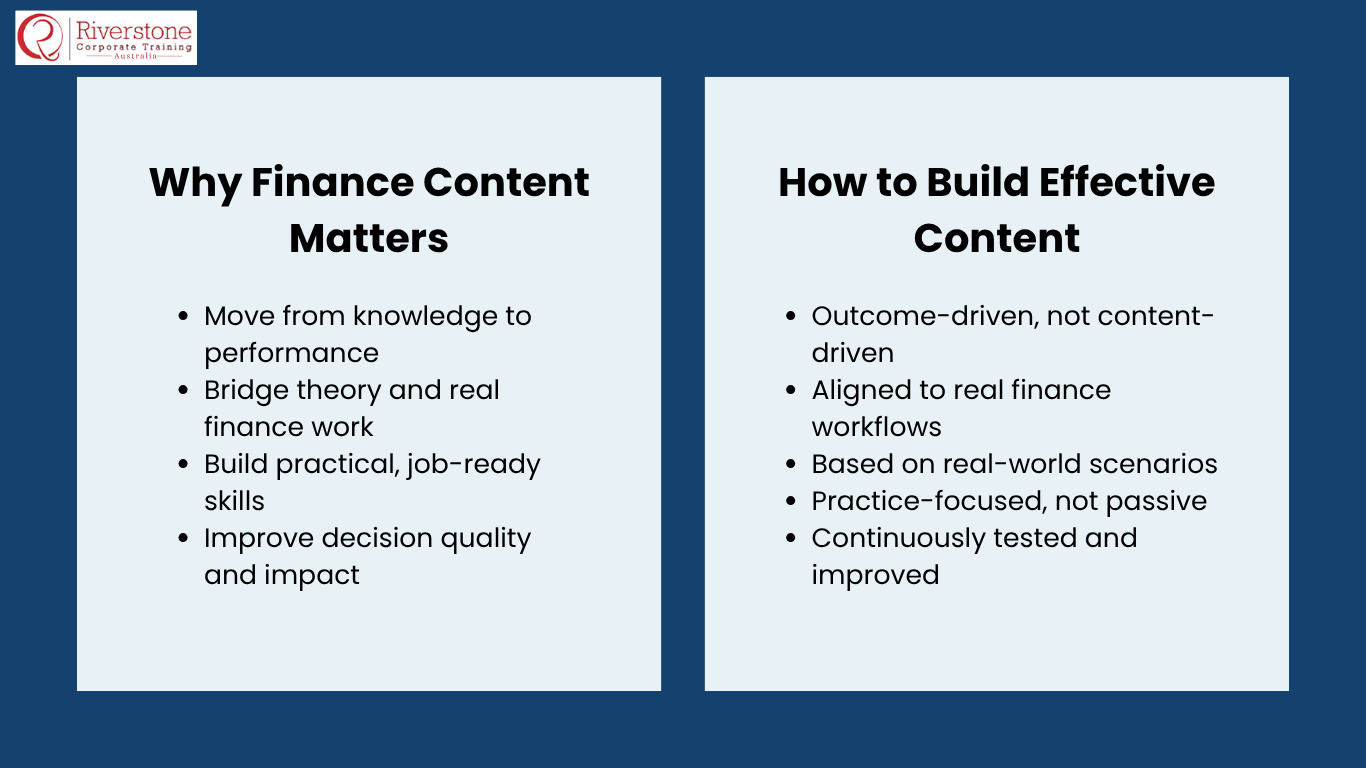
The development of finance eLearning content is a challenging intersection of technical discipline, professional practice and adult education theory: it needs to meet the standards of a technically sophisticated discipline, the expectations of professionals who will apply their learning in a high-stakes commercial environment, and the learning principles of adult learning theory that determine how knowledge is best learned and retained. The traditional eLearning design approaches of passive video content, multiple-choice questions and abstract finance concepts fail in finance because they do not reflect the nature of the skills being taught, and do not deliver the behavioural change that makes learning valuable to business.
- Designing finance learning courses that build workplace capability is a different approach to designing finance courses that simply provide information – it is based on the particular analytical problems that finance professionals encounter in practice, the contexts in which they apply their skills to make decisions, and the performance criteria that determine whether they are successful in their jobs.
- The most effective corporate finance training solutions are those that start with the end in mind – with a specification of the performance outcome that the learner should be able to deliver in the workplace after the course, and then work backwards to identify the knowledge, skills, and practice activities needed to deliver that performance.
The development of professional finance skills through eLearning and blended digital content is becoming an important part of finance team capability-building, due to the size, geography, and time pressures of today’s finance functions. High-quality digital learning can provide consistent, high-quality skill development to 200 finance professionals across 12 countries – a level of consistency and efficiency of capability building that is impossible with classroom-based learning at scale. However, the quality of digital finance learning is constrained by the design of the content, and poor-quality digital content delivers poor-quality learning at scale, just as it does in the classroom.
- Finance skills training in the workplace that actually leads to a change in practice is not about delivering information; it is about designing learning experiences that build on the existing knowledge of the finance professional, offer structured practice in the target skill in a realistic environment, provide timely feedback on their performance, and build the analytical confidence that drives them to continue practising after the training is over.
- This guide covers the full cycle of finance eLearning content development: why finance content needs particular design approaches, understanding the needs and motivations of the finance learner, principles of content design, a five-step content development process, examples of content development, obstacles to content development, the technology ecosystem and how to build organisational capability for content development.
|
The measure of the effectiveness of any finance learning content is not whether the learner knows more at the end of it, but whether they do more. Finance eLearning is about closing the gap between knowledge and action, not just between ignorance and knowledge. |
02 Why Finance Learning Content Must Be Different
Finance eLearning content must reflect the discipline’s distinctive features. Finance knowledge is highly contextual – a DCF valuation, a debt capacity analysis, a budget variance analysis, for example, are all very different things when applied to a tech startup versus an infrastructure company, and learning that ignores this contextual specificity results in knowledge that is not transferred well to the learner’s workplace context.
- Finance skills are procedural as well as declarative – professionals must know not only what WACC is and how to calculate it, but also how to make the particular judgments (beta, ERP, capital structure comparisons) that are necessary to produce a credible WACC. Learning content that teaches the formula but not the judgment means that students can pass an exam but not create a defensible valuation.
- Finance professionals are the most sceptical students – they are taught to question assumptions, test logic, and analyse data. Technically flawed material, material that uses unrealistic examples, or material that uses authority as a basis for argument will be summarily rejected. This sceptical approach is not a problem: content aims to survive the scrutiny of a finance professional.
Another challenge for online finance education resources for professionals is the time constraints they face. Finance practitioners are among the busiest people in any organisation – they work in a deadline-driven environment, juggle many competing priorities, and are extremely sensitive to learning content that is not sufficiently valuable for the time they must invest in it. This means that the learning value must justify the time on screen, and that the content structure should allow learners to access isolated components of the skill set as needed rather than having to complete a full course.
- The high-stakes nature of financial work poses a particular motivational challenge that content designers must understand. Finance practitioners are more engaged in learning when they can see the link between the skill they are learning and the business consequences of using that skill well (or poorly). Learning content that justifies the importance of a skill in commercial terms – what decisions it informs, what mistakes it avoids, what value it generates – creates more motivated learners than content that simply describes the skill as a competency.
- Interactive finance learning content should also address the range of roles within the finance function, including a financial controller, an FP&A analyst, a credit risk manager, and a corporate development specialist. Each requires different skills, makes different decisions, and has different learning needs. Generic finance ‘professional’ content is rarely as effective for these audiences as content tailored to the role and context in which the skill will be used.
03 Understanding the Finance Learner — Needs, Contexts and Motivations
The first step in the design of finance training content is to understand the specific population of learners for whom the content is being developed – their current level of skill, their role and decision-making context, the gap between their current level of performance and the level of performance required, and the factors that will drive their motivation and enablement to engage with the content. A generic or shallow learner analysis will result in content that is poorly targeted, no matter how technically proficient it might be.
- The critical learner characteristic for finance eLearning content is the learner’s level of relevant prior knowledge, because finance is an accumulative field where new concepts build on prior knowledge. Content that assumes excessive prior knowledge will not be understood by learners who lack the necessary foundation; content that reviews excessive prior knowledge will bore experienced practitioners who need to learn more advanced skills.
- Learning context is the second important learner characteristic. A credit analyst who needs training in DSCR should know how it is used to make lending decisions in their role, not just a generic description of the formula. A strategic analyst learning about DCF needs to understand how it relates to the particular capital allocation decisions their firm makes. Contextualised, role-specific practical finance materials lead to much better transfer-of-work performance than generic technical materials.
For professional finance skills training, content designers need to consider all of the learner’s motivations – intrinsic (interest in the subject matter, the problem-solving process), extrinsic (career advancement, performance review, qualification requirements), and practical (the specific skill they need to learn to perform their current job). The best content stimulates all three types of motivation: it is interesting, perceived as relevant to a career, and provides skills that can be applied immediately to produce tangible benefits in the learner’s work.
Table 1: Finance Learner Profiles — Characteristics, Needs and Content Design Implications
| Learner Profile | Primary Skill Gap | Motivation Type | Content Design Implication |
|---|---|---|---|
| Graduate analyst (0–2 years) | Technical foundation: modelling, accounting, analysis basics | Career development, professional qualification support, and confidence building | Build from first principles; use the organisation’s own data; heavy practice emphasis; immediate feedback loops |
| Experienced analyst seeking advancement (2–5 years) | Commercial application of technical skills; business partnering; advanced techniques | Career progression; stretch assignment readiness; visible impact on senior stakeholders | Scenario-based content; connect skills to strategic decisions; include ambiguous real-world cases |
| Manager / Senior professional | Leadership of analytical work; communicating insights; developing junior professionals | Senior role readiness; team leadership effectiveness; peer credibility | Focus on communication and coaching skills; case studies from senior decision contexts; peer-benchmarking |
| Non-finance professional learns finance basics | Financial literacy: reading statements, understanding key metrics, basic planning concepts | Role effectiveness; stakeholder communication; business case construction | Jargon-free language; strong contextualisation in their own functional area; practical tools for immediate use |
| Specialist professional (tax, risk, treasury) | Deep technical update; regulatory changes; cross-functional integration | Regulatory compliance; peer credibility; technical leadership | High technical density; current standards; case studies from relevant specialist context; expert-level credibility in content |
04 Principles of Effective Finance Content Design
Designing finance learning courses that result in skill development requires adherence to a set of principles grounded in evidence about how adults learn technical material and how their learning translates to the workplace. The most critical of these principles – contextualisation, worked example density, deliberate practice, and spaced retrieval – are backed up by a strong body of cognitive science research and have implications for the design and content choices that characterise a finance eLearning course.
- The contextualisation principle dictates that all concepts be taught in a specific, realistic context that matches the context in which they will be used. Rather than defining the concept of working capital and then presenting a general example, effective finance content presents a specific business context (a company with cash tied up in inventory and receivables). It uses that context to understand, apply, and test the concept.
- Worked examples are the most effective learning tool for teaching procedural finance skills – the step-by-step demonstration of how to complete a realistic analysis task, with each step explained as it is completed, engages the cognitive processes that lead to skill acquisition more effectively than any amount of conceptual explanation. The content should offer several examples before asking the learner to work independently, ranging from fully worked to partially worked to independent practice.
Deliberate practice – opportunities to practice the target skill in realistic settings, with immediate feedback on performance, and diagnostic information about the errors and gaps that need to be addressed – is essential in real-world finance learning tools. Practice in finance eLearning is not about answering multiple-choice questions (which test recognition, not performance) – it is about performing analytical tasks such as filling in parts of a financial model, calculating a key ratio based on given data, or assessing credit risk based on a set of financial data.
- The spacing and interleaving effects described in cognitive science have implications for the design of finance training courses: content that is revisited across multiple spaced sessions (rather than all in one go) leads to much longer retention of the learning, and content that requires the learner to alternate between related but different types of skills (rather than practise one type of skill to fluency) leads to improved transfer to new situations.
- Managing cognitive load is especially important in finance content, where the technical nature of the material can easily exceed the learner’s working memory capacity before learning occurs. Design strategies include segmentation (breaking complex processes into well-defined steps), signalling (making the structure of the content explicit through headings, summaries, and so on), and dual coding (using both verbal and visual representations of the same concept).
05 Five Key Steps: Deriving WACC for a Real Company
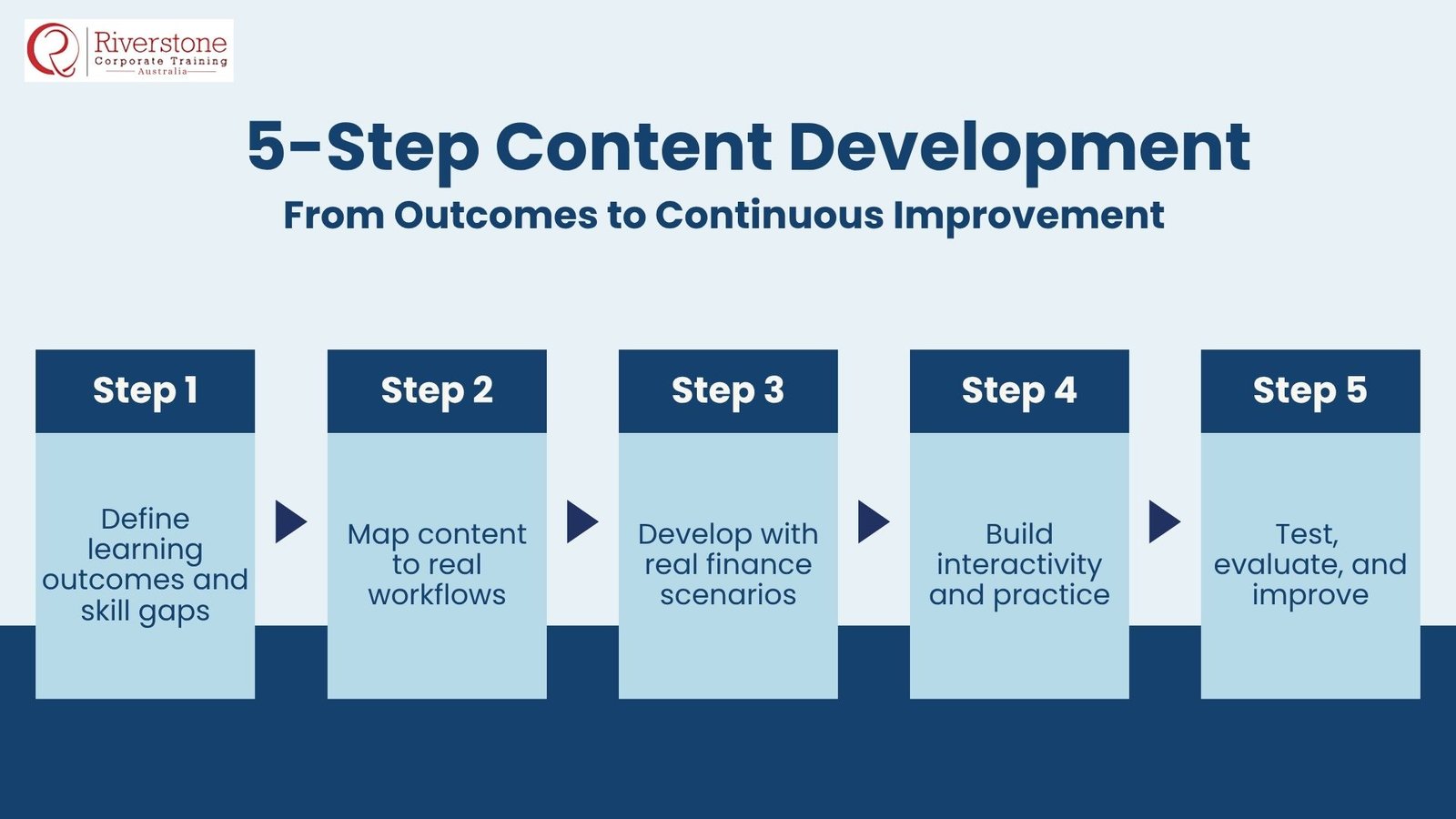
The process of developing finance eLearning content can be broken into five stages: defining the learning outcome, designing, developing, and evaluating the content. Knowing this process – and the design choices made at each step that determine the quality of the content – provides content developers with the operational blueprint to build finance learning programs that build workplace capability.
Step 1 — Define the Learning Outcome and Skill Gap
The key step in developing finance content occurs before content is developed: the specification of the learning outcome – the skill the learner will be able to perform at work as a result of this content that they are not able to (or not as effectively) perform today. This defines the content design, and poorly specified outcomes lead to unfocused content that delivers information but does not develop the skill.
- Good learning outcomes for workplace finance skills training are performance outcomes, not knowledge outcomes. ‘The learner will know DCF methodology’ is a knowledge outcome – it refers to a state of mind, rather than an action. ‘The learner will be able to build a two-stage DCF model for a profitable operating business using provided financial data, and defend the discount rate assumptions to a senior reviewer’ is a performance outcome – it describes what the learner will do, in what circumstances, and to what standard.
- The skill gap analysis that precedes outcome specification should be based on actual evidence of performance – samples of work product, observation of analysts performing the target skill, structured manager assessment – rather than assumptions about what learners need based on job titles or role descriptions. Performance-based skill gap analysis leads to more relevant and effective content than needs analysis based on curriculum or competency models.
Step 2 — Map the Content Architecture to Real Workflows
The content architecture of finance training programs must be based on the workflow in which the target skill is applied in the job. Rather than organising content according to conceptual categories (types of valuation methodology, types of financial risk), the most effective design organises content according to the workflow tasks the learner is performing: ‘How to value an acquisition target’, ‘How to structure a credit analysis memo’ or ‘How to prepare a board-ready financial presentation’.
- A workflow-based content architecture has two key advantages: it makes the relevance of each element of content very clear to the learner (the learner can see that each piece of content is part of a task they recognise from their own work), and it produces a natural sequencing of content that mirrors the decision-making process rather than the conceptual structure of the discipline.
- The content design should explicitly specify the prerequisites for each learning unit – what the learner needs to know and be able to do before they can engage with the content. In finance, prerequisites are especially critical because it is a cumulative discipline. A student without a good understanding of financial statements will not be able to engage with content on credit analysis; a student without a good understanding of DCF will not be able to engage with content on WACC and cost of capital.
Step 3 — Develop Content with Authentic Finance Scenarios
Interactive finance learning content is at its best when the scenarios and examples embedded in it reflect the actual complexity, uncertainty, and commercial implications of finance work. The best scenarios are those that describe a particular business context – a firm contemplating an acquisition, a credit analyst underwriting a new loan, an FP&A team developing the annual budget – and then use this context as the backdrop for all of the analytical tasks in the learning unit.
- Finance scenarios must be authentic in three ways: the business scenario must reflect realistic financial dynamics (revenues, costs, margins and balance sheet structure that reflect the actual economics of businesses in the relevant sector); the decisions presented in the scenario must reflect real commercial dilemmas (not problems with a clear, obvious answer); and the financial data provided must be sufficiently complete to support the analytical task at hand but insufficient to avoid the need for the learner to make judgements about how to resolve inconsistencies.
- Real-world finance learning tools are based on scenarios that progress through a learning unit, where the first analytical task uncovers information that alters the complexity of the second task, and where the learner’s success in the first task affects the options available in the second. This scenario structure is more interesting than cases and more like the incremental discovery process that occurs in real analysis.
Step 4 — Build in Interactivity and Practice
Interactive finance eLearning that is skill-building must include practice activities that require the learner to execute the analytical tasks of interest, not just identify accurate information about the tasks. The best practice activities in finance eLearning are those that require the learner to generate a product (a calculation, an evaluation, a recommendation) rather than choose from a set of options.
- Financial modelling exercises in embedded spreadsheet environments – where the learner uses a simple version of Excel within the eLearning content – are the best practice for quantitative finance skills. These environments provide true practice in a very similar environment to the real work environment, with specific, timely feedback on the quality of the learner’s work.
- Decision case exercises – where the learner is presented with a real-world business scenario and must make a structured judgement (rate this credit risk, value this acquisition, list the top three risks in this business plan) – are the best practice format for developing the commercial judgement aspect of finance skill that purely quantitative exercises can’t provide.
Step 5 — Test, Evaluate and Iterate
To continuously improve corporate finance training solutions, a robust evaluation process is needed to determine whether the training is having the desired impact on learner performance – not just whether learners complete it, enjoy it, or can recall facts about it. The Kirkpatrick model offers an evaluation framework: reaction, learning, behaviour and results.
- Pre- and post-programme measurements of the target skill – where learners complete the same analytical assignment before and after the programme – are the most direct measure of learning effectiveness. They should be performance assessments (the learner is asked to complete a piece of work) rather than knowledge assessments (multiple-choice questions about concepts) to measure skill change rather than knowledge change.
- The continuous improvement process should be built into the content development process: pilot the content with a representative sample of the target learner population before deployment, use the pilot feedback and performance data to improve the content, and plan for annual reviews to update the content in response to regulatory and best practice changes and learner feedback.
06 Real-World Content Development Examples
The design principles for corporate finance training solutions are illustrated best through examples of how they apply to specific content development challenges. The following three examples are typical finance eLearning content development issues – fictionalised but analytically real, as they are based on real-life content development experiences.
A Global Bank — Building Credit Analysis eLearning at Scale
A global commercial bank was looking to build a uniform credit analysis competency across its commercial lending teams in 14 countries, where teams had developed distinct approaches and credit analysis standards. The bank’s central credit academy engaged a finance education resources provider to create a modular eLearning programme to cover five areas of credit analysis competency: financial statement analysis, DSCR modelling, borrower risk assessment, security and collateral evaluation, and credit memo writing.
- Each module was based on a common scenario architecture: a set of realistic-looking company financials for a business in a particular industry, with a narrative that introduced increasing complexity throughout the module. Rather than abstractly introducing credit ratios, each ratio was introduced in the context of what it said about the particular business in the scenario, and learners had to calculate the ratio from the scenario data rather than simply memorise the formula.
- The credit memo module was the most technically creative: learners were given a credit memo for a different business (with identified strengths and weaknesses) and asked to identify the three most important credit issues that should have been identified in the memo but were not. This “find the gap” exercise format was much more effective at improving credit memo writing quality than exercises requiring learners to produce a memo from scratch, because it made the quality standard transparent and assessable, whereas production exercises did not. Completion of the programme led to a significant increase in credit memo quality scores at the one-month follow-up.
A Technology Company — Financial Literacy for Non-Finance Leaders
A European technology company rapidly growing in multiple geographies wanted to improve the financial literacy of its non-finance senior managers – engineers, product managers, and sales leaders – who made decisions with substantial financial implications but without the finance background to appreciate the consequences of their decisions.
- The challenge in developing the practical finance training materials was that the audience was highly intelligent and experienced in their respective fields. Very wary of any content that seemed simplistic or patronising – but they really did not understand financial concepts beyond the most elementary. The answer to this challenge was to create all content in the context of decisions that the target audience made in their roles: for product managers, this meant product investment decisions and product unit economics; for sales leaders, it meant deal economics, margin analysis, and customer lifetime value.
- The most effective module was ‘Reading the Numbers in Your Business’, which used a scenario to walk the learner through the financial consequences of a product release, showing the impact on the P&L of the product manager’s decisions along the way. This decision-narrative approach – where the learner sees the financial outcomes of decisions that they recognise as similar to their own – is more engaging and leads to more lasting learning than teaching financial concepts. Surveys conducted after the course found a 68% increase in the number of managers who reported they “understand the financial implications of my business decisions” – a clear commercial benefit.
An Accounting Firm — Technical Updates for Qualified Professionals
A mid-size accounting firm needed to update its 200 qualified auditors and accountants on the new International Financial Reporting Standards (IFRS) – professionals who were technically sound but required up-to-date, accurate, and relevant information on how practice had changed under the new standards. The problem was that traditional regulatory update training (heavy reading and passive delivery) resulted in low retention and low confidence in applying the changes.
- The design of the finance training programme solution was a case-comparison approach: for each change in standard, two versions of the same case were presented – a business that had applied the old standard correctly, and the same business applying the new standard correctly. Students were asked to pinpoint the particular treatment differences, quantify the effect of the change, and consider the impact on disclosure. This format provided a clear picture of the change and its impact.
- An interactive “challenge the assumption” element, in which learners were asked to judge whether a business’s management assertion that its treatment of a particular item complied with the new standard was correct, was effective at promoting the scepticism essential to audit work. This format more closely mimicked the judgment challenge faced by auditors than any other. Assessment of competency three months after the course was substantially higher than the same assessment for the same course last year, in which the technical update was delivered through lectures.
07 Common Challenges and Lessons Learned
The most common challenges that content developers face in developing finance eLearning content are structural, technical, and editorial, and anticipating these challenges in advance allows developers to build processes and governance models to mitigate them.
Table 2: Finance Content Development Process — Phases, Activities and Common Failure Points
| Phase | Key Activity | Common Failure Mode | Best Practice Response |
|---|---|---|---|
| Learner analysis | Define the audience, skill gaps, and performance context | Generic learner description (‘finance professionals’) that does not reflect actual role diversity; skill gap analysis based on role titles rather than performance evidence | Conduct structured interviews with a sample of target learners and their managers; use examples of actual work product to calibrate the current performance standard |
| Learning outcome specification | Write performance-based outcomes for each content unit | Knowledge outcomes (‘learner will understand X’) that cannot be measured; outcomes set at an inappropriately generic level | Write outcomes in the format: ‘Given [context], the learner will be able to [do specific task] to [quality standard]’. Test each outcome for observability and measurability. |
| Scenario development | Create authentic, realistic finance scenarios for the content | Scenarios with obviously correct answers; scenarios that do not reflect the actual complexity of real finance decisions; financial data that is too clean or too simple | Have the scenarios reviewed by practitioners in the target role; test the scenario with a sample learner before full development; ensure the financial data reflects realistic imperfection |
| Practice activity design | Design meaningful activities that require performance, not recognition | Defaulting to multiple-choice assessment, practice activities that are too easy or too disconnected from the real task | Design at least one practice activity per learning unit that requires the learner to produce an output (calculate, assess, recommend); provide automated or structured human feedback |
| Technical accuracy review | Ensure all financial content is technically accurate and current | Content that contains technical errors or presents outdated standards; content that is technically accurate but commercially unrealistic | Build an SME review into the development process; conduct technical review before learner pilots; plan for regular currency reviews as standards evolve |
| Evaluation design | Plan measurement of learning and performance impact | Evaluating completion rates and satisfaction rather than skill change and performance impact; no pre-/post-comparison framework | Design assessment instruments before content development; build in a pre-programme baseline assessment; schedule post-programme performance follow-up at 1 and 3 months |
The overarching challenge in finance eLearning content development is the balance between technical quality and accessibility and engagement – a challenge that most development teams face keenly because the subject matter experts who ensure the content is technically accurate and the instructional designers who ensure the content is accessible and engaging have different (and sometimes opposing) priorities. Technical experts want detail and accuracy; learning designers want simplicity and brevity. The best corporate finance eLearning solutions are developed as a collaborative effort between content and design expertise, rather than having one subordinate to the other.
- The single most common lesson from experienced finance content developers is to keep it short: courses that are too comprehensive produce learners who are well informed but not well skilled. An engaging 45-minute course that delivers a measurable improvement in a specific skill is more useful than a three-hour survey course that provides superficial knowledge of 15 topics.
- The second lesson is that practitioner review and involvement are essential. Finance content that has not been reviewed by practitioners who actually perform the work being taught (not just financial experts who know the theory) is consistently too simplistic, lacks important real-world complications and fails to explain the specific steps where practitioners get stuck.
08 Technology and Tools for Finance Content Delivery
E-learning finance education resources are available across a growing variety of platforms and formats, each with particular strengths and weaknesses for finance education. Technology is an important design consideration – not because the technology is the determinant of the quality of the learning (which is governed by the principles of content design outlined above), but because it is the determinant of the kind of interactivity that is possible, the accessibility of the content, the ease of content update, and the quality of the data available for measuring the effectiveness of the content.
- Learning Management Systems (LMSs) – such as Cornerstone, SAP SuccessFactors, Docebo, and TalentLMS – deliver, track, and report on the use of eLearning content. They are critical to organisations delivering workplace finance skills training at scale, but they are merely vessels for content. The LMS is the container for content; the authoring tool is the creator of content.
- eLearning authoring tools – Articulate Storyline, Adobe Captivate, Rise – enable non-technical content creators to develop interactive eLearning content without programming. The most critical feature of an authoring tool for finance content is the ability to develop interactive financial analysis exercises: drag-and-drop financial statement assembly, numerical input boxes, branching scenarios that flow from user choices, and real-time scored feedback on financial calculations.
Interactive finance learning content is increasingly being delivered in video formats – short, focused instructional videos that demonstrate an example, explain a concept, or present a case study. The key to successful use of video in finance learning is the video’s use: talking-head lectures, regardless of the quality of the lecturer, result in poor learning outcomes. Video that shows an analysis being conducted – a financial analyst building a financial model, a credit analyst marking up a set of financial statements, or a credit analyst performing a credit analysis – is much more effective because it provides the cognitive modelling that triggers observational learning.
- Adaptive learning technologies – systems that vary the content presented to individual learners based on their demonstrated ability, providing more practice on areas of weakness and moving rapidly through areas of competency – have great potential for professional finance skill development because the range of finance skills in even a nominally targeted audience is extremely broad. Adaptive delivery enables a single content delivery programme to provide both a refresher for experienced practitioners and a full build for less experienced professionals, without either audience having to endure content that’s poorly tailored to the other.
- The most significant development in the technology of finance eLearning content development is the addition of AI-powered assessment and feedback tools that can review the quality of financial models, analytical memos and case studies and provide targeted feedback at a level of detail that would be unviable through human assessment at scale. These are still in development, but the most advanced versions already enable learners to get instant feedback on the quality of their DCF assumptions or their credit memo structure, mimicking the learning impact of expert review at a cost and scale that make it feasible for large-scale finance training programs.
09 Building a Finance Content Development Capability
To deliver corporate finance training at scale, it is not enough to have well-designed individual training programmes; it is also necessary to have the capability for ongoing development, maintenance, and improvement of finance learning content. This involves putting together the right mix of finance expertise, instructional design expertise and technology – and the governance processes that ensure quality, timeliness and relevance to business needs over time.
Table 3: Finance Content Development — Team Roles and Responsibilities
| Role | Primary Responsibility | Key Skill Requirements | Internal vs External |
|---|---|---|---|
| Finance Subject Matter Expert (SME) | Technical accuracy of content; scenario development; worked example creation; practitioner review | Deep finance technical knowledge; practitioner experience in the target skill area; ability to explain complex concepts clearly | Ideally internal (for contextual authenticity); can be supplemented by external subject experts for specialist topics |
| Instructional Designer | Learning architecture; adult learning principles application; practice activity design; storyboarding | Adult learning theory; eLearning design methodology; understanding of cognitive load management; assessment design | Typically external for smaller organisations; increasingly internal in large L&D functions |
| eLearning Developer | Technical construction of content; authoring tool expertise; LMS integration; interactivity programming | Authoring tool proficiency (Articulate, Captivate, Rise); LMS integration; UI/UX design; media production | Often external for organisations without an established L&D technology infrastructure |
| Content Quality Reviewer | Technical accuracy review; learner experience testing; editorial review | Finance technical knowledge; attention to detail; learner perspective empathy | Should include both internal practitioners and a sample of target learners |
| Programme Owner / L&D Business Partner | Overall programme governance; business alignment; evaluation oversight; continuous improvement coordination | L&D programme management; stakeholder management; evaluation methodology; business acumen | Typically internal — requires a deep understanding of business context and finance capability priorities. |
The governance of the ongoing maintenance process is critical. Finance eLearning content development that delivers superior content initially, but then allows it to become technically out-of-date (when accounting standards change), contextually out-of-date (when business strategy changes) or pedagogically out-of-date (when learner needs or technology change) will see the return on investment diminish. An annual review process triggered by regulatory change, organisational strategy and evaluation reports is the minimum governance process required to maintain content quality.
- The optimal approach to developing finance learning courses in mature organisations is a combination of internal and external expertise: internal SMEs and business partners to provide contextual expertise and ongoing governance, and external instructional design and development expertise for the initial version of the new content. As internal capability is built, more design and development can be moved in-house, saving money and accelerating the content development cycle.
- Building the instructional design capability of finance SMEs through training in adult learning principles, scenario-based design, and assessment development delivers greater returns in the quality of the content they produce. Finance SMEs who are skilled in designing for learning (not just communicating information) produce better content that requires less rework by instructional designers to be effective.
10 Conclusion and Actionable Insights
The development of finance eLearning content that builds workplace finance capability is one of the best investments organisations can make to support the development of the finance capability required by the modern, strategic finance function. The principles of design – performance-based outcomes, scenarios, examples, practice and retrieval – are well-supported and easy to implement. The design process – learner analysis, outcome specification, workflow-based architecture, authentic scenario development, interactivity, and evaluation – offers a coherent approach to the development of quality, practical finance training content.
For content creators, finance instructors, and L&D professionals who develop corporate finance training solutions, the most important principle is the performance gap: the difference between learners’ current performance and their performance at the end of the training. All design choices – the scenarios selected, the practice tasks developed, the feedback and coaching provided – should be assessed in terms of how they help close the gap. The design and delivery of eLearning for the development of professional finance skills are not content development problems; they are performance problems that are solved primarily through content.
- Always begin a content development project with the performance outcome. Document it, make it observable and measurable, and use it to guide all design decisions. If it doesn’t help achieve the performance outcome, it has no place in the programme.
- Design content using real scenarios that reflect the complexity of the real world of finance – not simple examples that are unable to withstand the rigour of the imperfect data, ambiguous circumstances and multiple priorities of practice. Scenarios are not window dressing; they are the medium for learning.
- Build practice tasks that require the learner to generate, not recognise. Learning is achieved through performance, not recognition – and every interactive finance learning content programme should include ample opportunities for learners to practice the desired skill in a situation that simulates the real world, with specific, timely feedback.
- Evaluate at the performance level, not the satisfaction level. Online finance education content is effective if it helps people work differently, and the way to assess this is to measure performance before and after the program, not simply ask learners if they liked the content and found it useful.
- Plan for ongoing improvement to the programme governance. Design the content review cycle, identify the technical currency, owner and build feedback loops that feed insights into learner experience and performance data. The design of finance training that will last requires a disciplined approach, just as the design itself. does
| Our finance content development services help organisations design, develop, and assess eLearning and blended training materials that result in improved workplace performance across all of the finance skill sets – from modelling and analysis to commercial judgement, business partnering and financial leadership. We start with your learners’ performance needs, and finish with content that transforms their practice. |